Table of contents
- What Is a Mutual Separation Scheme (MSS) in Malaysia?
- What Should Employers Consider Before Implementing an MSS in Malaysia?
- 1. Decide on the Package to Offer the Employee
- 2. Decide on Who Are the Employees Involved in the MSS
- 3. Make the Offer and Allow Employees Time to Consider
- 4. Be Willing to Negotiate the MSS Package
- 5. Prepare a Written Mutual Separation Agreement
- 6. Get an Independent Witness to Sign the Settlement Agreement
- What Is the Difference Between MSS and VSS in Malaysia?
- Why Is Mutual Consent Important in an MSS?
- Conclusion
When businesses undergo organisational restructuring, workforce adjustments, or changes in operational requirements, employers may need to consider ending certain employment relationships. One approach is through a Mutual Separation Scheme (MSS), where the employer and employee voluntarily agree to terminate the employment relationship under mutually agreed terms.
Unlike retrenchment, which is initiated by the employer due to redundancy, an MSS involves an agreement between both parties. However, employers must ensure that the separation is genuinely voluntary and that employees are not pressured into accepting the arrangement.
As an established HR and payroll company in Penang, MYWave is committed to helping Malaysian businesses understand important HR practices and responsible workforce management. This article explains how a Mutual Separation Scheme works, the considerations involved, and the recommended procedures for implementing MSS in Malaysia.
What Is a Mutual Separation Scheme (MSS) in Malaysia?
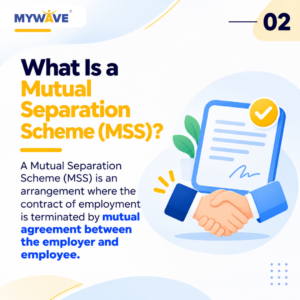
A Mutual Separation Scheme (MSS) is an arrangement where the contract of employment is terminated by mutual agreement between the employer and employee.
Mutual agreement means both parties voluntarily agree to part company on mutually agreed terms. These terms typically include a separation package and other conditions agreed upon before the employment relationship ends.
Unlike a Voluntary Separation Scheme (VSS), an MSS offer is not made to all employees in any category but is targeted at selected employees the employer wishes to remove from the organisation.
Since MSS is not offered to all employees in a particular category, there is a risk that an employee may claim forced resignation if the arrangement is not carried out properly.
MSS is normally targeted at employees who are poor performers. However, employers should understand that an MSS remains a voluntary agreement, even when an employee’s performance is one of the reasons for proposing separation. It should not be used to force an employee to resign or bypass appropriate employment procedures.
What Should Employers Consider Before Implementing an MSS in Malaysia?
Implementing a Mutual Separation Scheme requires employers to carefully consider the employees involved, the proposed separation package, and the process of obtaining mutual agreement.
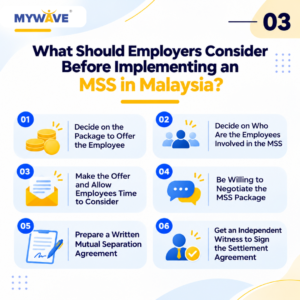
MYWave highlights six important considerations when managing an MSS.
1. Decide on the Package to Offer the Employee
Management should first decide on the package to offer the employee.
The package may include financial compensation and other agreed benefits intended to encourage the employee to accept the mutual separation arrangement.
Unlike statutory retrenchment benefits, an MSS package is generally determined through negotiation and mutual agreement between the employer and employee. Employers should ensure that any outstanding contractual or statutory entitlements are also properly addressed.
2. Decide on Who Are the Employees Involved in the MSS
Management should identify the employees who will be involved in the MSS.
Unlike VSS, which may be offered to all employees or a particular category, MSS is normally targeted at selected employees, including employees who are poor performers.
However, employers should ensure that the selection process and subsequent discussions are handled appropriately, as the arrangement must ultimately be based on mutual consent.
3. Make the Offer and Allow Employees Time to Consider
Employers should make the offer to the employee and allow the employee time to consider the package offered.
Employees should have sufficient opportunity to review the proposed compensation and separation terms before deciding whether to accept.
This is particularly important because mutual agreement means both parties voluntarily agree to part company on mutually agreed terms. An employee should not be pressured or forced to accept the MSS offer.
4. Be Willing to Negotiate the MSS Package
Employers should be willing to negotiate with the employee for additional payments, such as bonuses, unconsumed leave, or enhancement of the package offered.
Negotiation allows both parties to discuss the proposed terms and reach an arrangement that is mutually acceptable.
For example, an employee may request additional compensation or payment for unused annual leave as part of the separation arrangement. Management may consider these requests when finalising the MSS package, while ensuring existing contractual and statutory entitlements are respected.
5. Prepare a Written Mutual Separation Agreement
Once the employee accepts the package, the employer should put up a written agreement and get the employee to signify his or her acceptance before paying the MSS package as agreed.
The written agreement should clearly document the mutually agreed separation terms, including the compensation package, the last day of employment, and the agreed payment arrangements.
Having the terms confirmed in writing helps establish a clear understanding between both parties and reduces the possibility of future disputes.
6. Get an Independent Witness to Sign the Settlement Agreement
Employers should get an independent witness to sign the settlement agreement to avoid the employee claiming that he or she was forced to accept MSS.
An independent witness can help support the documentation of the agreement and the circumstances surrounding its signing.
However, employers should also ensure that the entire MSS process is genuinely voluntary. A signed agreement or witness signature alone does not automatically establish that an employee accepted the arrangement without pressure or coercion.
What Is the Difference Between MSS and VSS in Malaysia?
Although both Mutual Separation Schemes (MSS) and Voluntary Separation Schemes (VSS) involve employees leaving an organisation under agreed arrangements, they differ in their approach and the employees being targeted.
|
Aspect |
Mutual Separation Scheme (MSS) |
Voluntary Separation Scheme (VSS) |
|
Employee selection |
Targeted at selected employees |
Offered to all employees or a certain category |
|
Purpose |
Mutually agreed termination of employment |
Voluntary workforce reduction |
|
Participation |
Both parties voluntarily agree to separate |
Employees choose whether to apply |
|
Compensation |
Negotiated between employer and employee |
Generally based on a VSS package offered by management |
|
Employer’s role |
Negotiates directly with selected employees |
Offers the scheme and reviews applications |
The main distinction is that MSS involves a mutually negotiated separation with selected employees, while VSS allows employees within the offered category to voluntarily apply for separation.
In both arrangements, voluntary participation is essential.
Why Is Mutual Consent Important in an MSS?
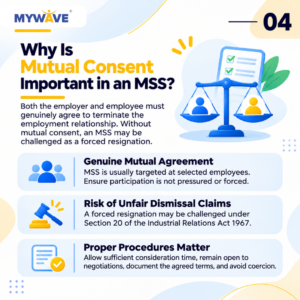
One of the most important considerations when implementing an MSS is ensuring that both the employer and employee genuinely agree to terminate the employment relationship.
Since MSS is normally targeted at selected employees rather than offered across an entire employment category, there is a risk of employees alleging forced resignation if the process is not handled properly.
If an employee is pressured into accepting an MSS, the employee may claim that the separation was not voluntary and challenge the termination under Section 20 of the Industrial Relations Act 1967.
Employers should therefore provide sufficient consideration time, remain open to negotiations, document the agreed terms, and avoid any form of coercion. The objective is to ensure that the termination of employment genuinely reflects the mutual agreement of both parties.
Conclusion
A Mutual Separation Scheme (MSS) allows employers and employees to terminate their employment relationship through mutual agreement on negotiated terms. Unlike VSS, which may be offered to a broader category of employees, MSS is normally targeted at selected employees.
For employers, implementing an MSS requires careful consideration of the proposed compensation package, the employees involved, sufficient time for consideration, and willingness to negotiate. Most importantly, the agreement should be properly documented, signed by the employee, and witnessed independently to help minimise disputes over forced resignation.
As a trusted HR and payroll specialist in Malaysia, MYWave is committed to sharing practical HR knowledge and helping Malaysian businesses understand responsible workforce management practices.
Need professional HR and payroll support for your business?
Contact MYWave to learn how our HR outsourcing, consultancy, and payroll services can support your organisation’s workforce management needs.

👉 Need professional HR support for your business?
 For more information, reach out to us at: https://mywave.biz/contact-us/
 Or, through our email at: enquiry@mywave.biz