Table of contents
- What Is the Last In First Out (LIFO) Principle in Malaysia?
- Guidelines for Complying with the LIFO Principle When Retrenching Employees
- Employment (Termination and Lay-Off Benefits) Regulations 1980
- Regulation 6(1): Amount of Termination and Lay-Off Benefits Payment
- Regulation 6(2): How Wages Are Determined for Termination Benefits
- Retrenchment Guidelines: Formula for Calculating Termination Benefits in Malaysia
- Retrenchment, Voluntary Separation Schemes (VSS), and Mutual Separation Schemes (MSS)
- Conclusion
When businesses face financial difficulties, organisational restructuring, or a surplus of employees, retrenchment may become necessary. However, deciding which employees should be retrenched requires careful consideration of employee selection practices, employment regulations, and termination benefits.
One important principle associated with employee retrenchment in Malaysia is Last In First Out (LIFO). This principle generally requires the most junior employee in the relevant employment category to be considered for retrenchment first, although departures may be justified by valid and objective reasons.
Employers must also understand their responsibilities under the Employment (Termination and Lay-Off Benefits) Regulations 1980, particularly when determining employee eligibility and calculating termination benefits.
As an established HR and payroll company in Penang, MYWave is committed to helping Malaysian businesses understand important employment practices and workforce management responsibilities. This article explains the LIFO principle, retrenchment guidelines, and relevant regulations governing termination benefits in Malaysia.
What Is the Last In First Out (LIFO) Principle in Malaysia?
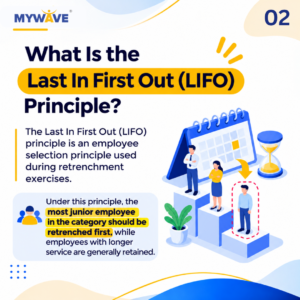
The Last In First Out (LIFO) principle is an employee selection principle used during retrenchment exercises. Under this principle, the most junior employee in the category should be retrenched first, while employees with longer service are generally retained.
For example, if several employees perform similar responsibilities within the same employment category, the employee with the shortest period of service would ordinarily be considered for retrenchment before more senior employees.
However, LIFO is not an absolute statutory requirement. Employers may depart from this principle where valid and objective reasons exist, provided their decisions are supported by genuine business requirements.
Guidelines for Complying with the LIFO Principle When Retrenching Employees
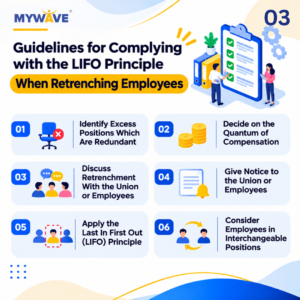
When implementing a retrenchment exercise, employers should consider the following guidelines to ensure that employee selection and termination arrangements are handled appropriately.
1. Identify Excess Positions Which Are Redundant
Management needs to identify excess positions that are redundant.
Before determining which employees should be retrenched, employers should establish which positions are no longer required due to organisational restructuring, reduced production, technological changes, or other genuine business circumstances.
This helps ensure that retrenchment decisions are based on actual operational requirements.
2. Decide on the Quantum of Compensation
Management should decide on the quantum of compensation, which must be in compliance with the Employment (Termination and Lay-Off Benefits) Regulations 1980, or the company’s existing collective agreement, where applicable.
Employers should determine the termination benefits payable to affected employees based on their eligibility, length of service, and applicable employment terms.
3. Discuss Retrenchment With the Union or Employees
Employers should discuss with the union, or if there is no union, with the employees on the need for retrenchment.
Such discussions allow employers to explain the business circumstances leading to workforce reductions and provide an opportunity for appropriate consultation.
4. Give Notice to the Union or Employees
Employers should give notice to the union or employees based on the law or collective agreement.
The notice requirements will depend on applicable employment legislation, contractual terms, and any relevant collective agreement.
5. Apply the Last In First Out (LIFO) Principle
The LIFO principle dictates that the most junior employee in the category should be retrenched first.
This means employers should generally consider employees’ length of service when selecting employees for retrenchment within the same employment category. However, departures from LIFO may be justified where valid and objective reasons exist.
6. Consider Employees in Interchangeable Positions
If the employees are interchangeable or transferable to various positions, then LIFO will have to take into account all the employees in the interchangeable group or category of employees.
For example, where employees perform similar responsibilities across different departments and can be transferred between comparable positions, employers should consider the wider interchangeable group when applying LIFO.
The purpose is to ensure that employee selection is consistent with the relevant employment categories and genuine workforce requirements.
Employment (Termination and Lay-Off Benefits) Regulations 1980
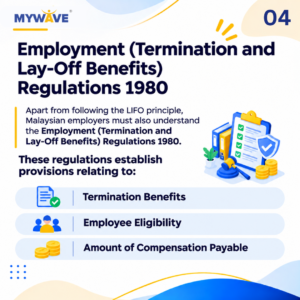
Apart from following the LIFO principle, Malaysian employers must understand the Employment (Termination and Lay-Off Benefits) Regulations 1980, which establish provisions relating to termination benefits, employee eligibility, and the amount of compensation payable.
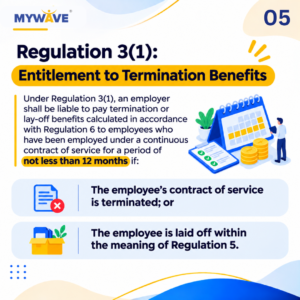
Regulation 3(1): Entitlement to Termination Benefits
Under Regulation 3(1), an employer shall be liable to pay termination or lay-off benefits calculated in accordance with Regulation 6 for employees who have been employed under a continuous contract of service for a period of not less than 12 months if:
- The contract of service of the employee is terminated; or
- The employee is laid off within the meaning of Regulation 5.
This entitlement is subject to the applicable conditions and exclusions under the Regulations. Employers should therefore review employees’ employment records and eligibility before determining termination benefits.
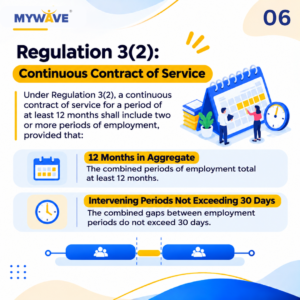
Regulation 3(2): Continuous Contract of Service
Under Regulation 3(2), for the purposes of this regulation, a continuous contract of service for a period of not less than twelve months shall include two or more periods of employment which are not less than twelve months in the aggregate if the intervening period or periods between one period of employment and another does not in the aggregate exceed 30 days.
In simpler terms, employees who have experienced short interruptions between employment periods may still satisfy the continuous service requirement, provided the total interruption does not exceed 30 days and the relevant conditions are met.
This provision is important when determining whether an employee qualifies for termination benefits.
Regulation 6(1): Amount of Termination and Lay-Off Benefits Payment
Under Regulation 6(1), the minimum termination and lay-off benefits payment for eligible employees is determined according to their length of service.
|
Length of Service |
Termination Benefits Entitlement |
|
Less than 2 years |
10 days’ wages for each year of service |
|
2 years but less than 5 years |
15 days’ wages for each year of service |
|
5 years or more |
20 days’ wages for each year of service |
The entitlement is calculated for each year of service, with incomplete years calculated proportionately according to the applicable Regulations.
Employers should also consider employees’ contractual terms or collective agreements where these provide more favourable benefits. Statutory eligibility conditions and exclusions under the Employment Act 1955 must also be taken into account.
Regulation 6(2): How Wages Are Determined for Termination Benefits
Under Regulation 6(2) of the Employment (Termination and Lay-Off Benefits) Regulations 1980, for the purposes of this regulation, “wages” shall have the meaning assigned thereto under Section 2(1) of the Employment Act.
A day’s wages shall be computed in such a manner as to give the employee their average true day’s wages calculated over the period of 12 completed months’ service immediately preceding the relevant date.
This means that the termination benefits calculation considers the employee’s relevant wages over the preceding 12-month period, rather than simply relying on the employee’s latest monthly salary.
Retrenchment Guidelines: Formula for Calculating Termination Benefits in Malaysia
The calculation of termination benefits depends on the employee’s wage arrangement, length of service, and applicable entitlement of 10, 15, or 20 days’ wages per year of service.
Formula for Calculating Termination Benefits for Monthly Rated Employees
For monthly rated employees, the termination benefits calculation follows this formula:
Formula:
Termination Benefits = (Last 12 Months’ Wages ÷ 365) × Length of Service (Years of Service) × Entitlement (10/15/20 days a year)
The last 12 months’ wages refer to the total relevant basic wages, cash payments for work done, and overtime, subject to the statutory definition of wages.
The calculation determines the employee’s average daily wages, which are then multiplied by the length of service and applicable termination benefits entitlement.
Formula for Calculating Termination Benefits for Daily or Piece Rated Employees
For daily or piece rated employees, MYWave’s retrenchment guidelines provide the following formula:
Formula:
Termination Benefits = (Last 12 Months’ Wages ÷ Total Days Worked During Last 12 Months) × Length of Service (Years of Service) × Entitlement (10/15/20 days a year)
The last 12 months’ wages refer to the total relevant basic wages, cash payments for work done, and overtime.
This formula uses the employee’s total days worked during the preceding 12 months to determine the average daily wage before applying the length of service and applicable entitlement.
When calculating statutory benefits, employers should ensure that the final calculation complies with Regulation 6(2) and the applicable definition of wages.
Retrenchment, Voluntary Separation Schemes (VSS), and Mutual Separation Schemes (MSS)
Apart from retrenchment, employers may also consider other workforce reduction arrangements, including Voluntary Separation Schemes (VSS) and Mutual Separation Schemes (MSS).
While retrenchment involves employer-initiated termination arising from genuine redundancy, VSS generally involves offering employees an opportunity to leave voluntarily under a separation scheme. MSS, on the other hand, involves the employer and employee mutually agreeing to end the employment relationship under agreed terms.
Although all three approaches may result in workforce reductions, they differ in their processes, arrangements, and employment considerations.
Conclusion
Employers considering retrenchment must understand that workforce reductions involve more than identifying redundant positions. The selection of affected employees should be guided by fair and objective considerations, while applicable termination benefits must be assessed and calculated correctly.
The Last In First Out (LIFO) principle provides an important guideline for employee selection, while the Employment (Termination and Lay-Off Benefits) Regulations 1980 establish provisions governing eligible employees’ termination benefits and the minimum amounts payable.
As a trusted HR and payroll specialist in Malaysia, MYWave is committed to helping Malaysian businesses understand important employment practices and manage their HR responsibilities more effectively. With expertise in HR consultancy and payroll outsourcing, MYWave provides professional support for businesses ranging from SMEs to large enterprises.
Need professional HR and payroll support for your business?
Contact MYWave to learn how our HR outsourcing and payroll services can support your organisation’s workforce management needs.
👉 Need professional HR support for your business?
 For more information, reach out to us at: https://mywave.biz/contact-us/
 Or, through our email at: enquiry@mywave.biz