Table of contents
- Section 60M of the Employment Act 1955: Prohibition on Termination of Local Employees
- Section 60N of the Employment Act 1955: Retrenchment Due to Redundancy
- Borang PK Malaysia: Mandatory Notification Before Employee Retrenchment
- MYWave's Perspective: Why Employers Must Understand Retrenchment Requirements
- Conclusion: Understanding Employer Responsibilities Before Retrenchment in Malaysia
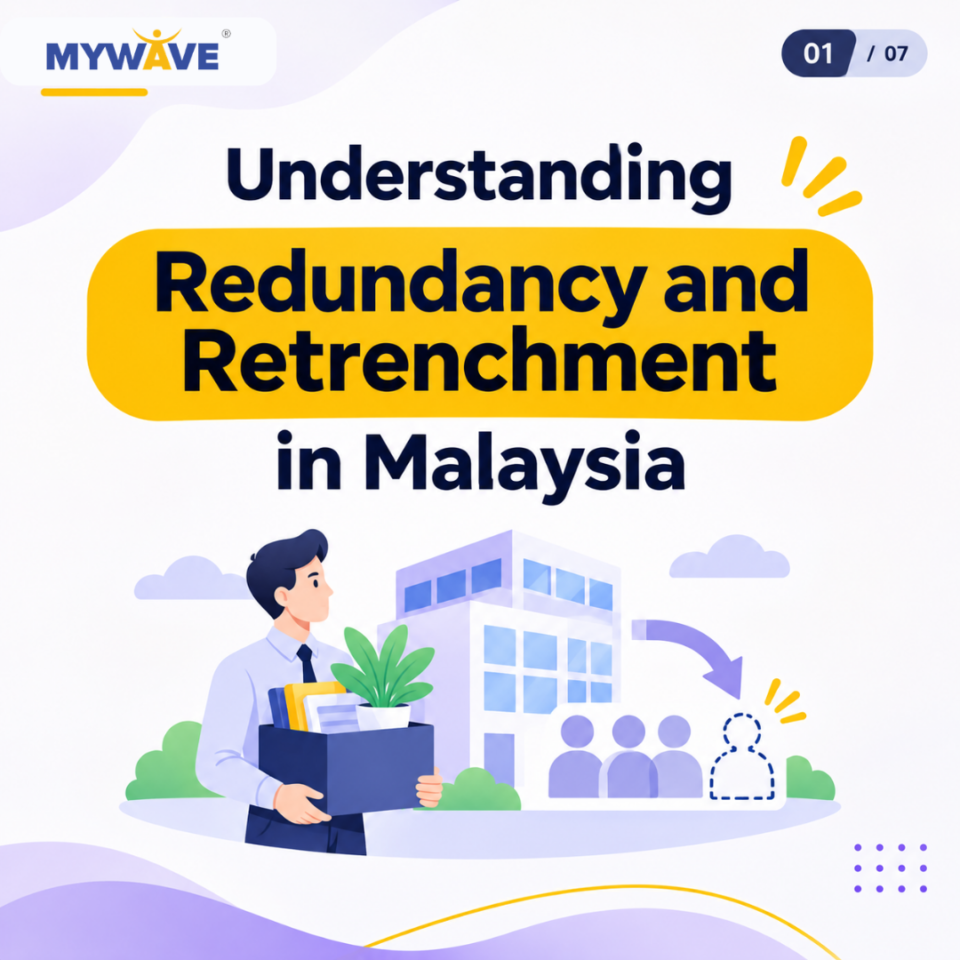
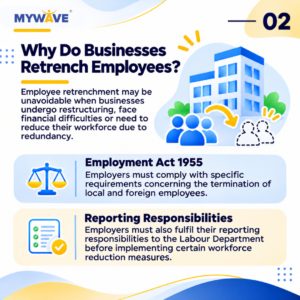
Employee retrenchment is sometimes unavoidable when businesses undergo restructuring, experience financial difficulties, or need to reduce their workforce due to redundancy. However, employers in Malaysia must understand that retrenchment involves more than simply deciding which employees to terminate.
Under the Employment Act 1955, employers must comply with specific requirements concerning the termination of local and foreign employees. They must also fulfil their reporting responsibilities to the Labour Department before implementing certain workforce reduction measures.
As an established HR and payroll company in Penang, MYWave is committed to helping Malaysian businesses understand important employment regulations and responsible workforce management practices. This article highlights three key requirements employers should take note of when retrenching employees in Malaysia.
Section 60M of the Employment Act 1955: Prohibition on Termination of Local Employees
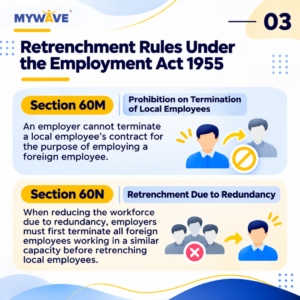
Under Section 60M of the Employment Act 1955, an employer shall not terminate the contract of service of a local employee for the purpose of employing a foreign employee.
This provision prohibits employers from terminating local employees simply to replace them with foreign employees. It protects local employees against being dismissed for the purpose of hiring foreign workers in their place.
For example, an employer cannot terminate the employment of a Malaysian employee simply because the company intends to hire a foreign employee to perform the same responsibilities.
Employers should therefore ensure that any decision to terminate local employees is supported by legitimate employment or business reasons and does not violate Section 60M of the Employment Act 1955.
Section 60N of the Employment Act 1955: Retrenchment Due to Redundancy
Another important provision employers must understand is Section 60N of the Employment Act 1955, which addresses the termination of employment by reason of redundancy.
Under Section 60N:
Where an employer is required to reduce his workforce by reason of redundancy necessitating the retrenchment of any number of employees, the employer shall not terminate the services of a local employee unless he has first terminated the services of all foreign employees employed by him in a capacity similar to that of the local employee.
This means that when an employer needs to reduce its workforce due to redundancy, foreign employees working in a capacity similar to that of local employees must be retrenched first before the employer can terminate the services of local employees in that capacity.
For example, if a manufacturing company needs to reduce the number of production employees due to redundancy, it must first terminate the services of foreign employees employed in a similar capacity before proceeding with the retrenchment of local employees.
The key consideration is whether the foreign and local employees are employed in a similar capacity. Section 60N does not automatically require employers to terminate every foreign employee across all departments before retrenching a local employee.
Employers should therefore review their workforce structure and employment categories carefully before deciding which employees will be affected by retrenchment.
Borang PK Malaysia: Mandatory Notification Before Employee Retrenchment
Apart from complying with Sections 60M and 60N, employers must also fulfil their reporting responsibilities to the Labour Department.
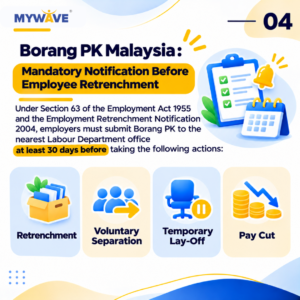
Under Section 63 of the Employment Act 1955 and the Employment Retrenchment Notification 2004, employers must fill in Borang PK and submit it to the nearest Jabatan Tenaga Kerja (Labour Department) office at least 30 days before taking the following actions:
- Retrenchment – Terminating employees due to redundancy or workforce reduction.
- Voluntary Separation – Offering employees the opportunity to leave voluntarily under a separation scheme.
- Temporary Lay-Off – Temporarily laying off employees due to operational circumstances.
- Pay Cut – Implementing reductions in employees’ wages.
Borang PK is an official notification form used to inform the Labour Department about an employer’s intended workforce reduction measures.
When Must Employers Submit Borang PK?
According to the Department of Labour Peninsular Malaysia (JTKSM), the reporting requirements are as follows:
|
Borang PK Section |
Submission Deadline |
|
Parts I to IV |
At least 30 days before the action is taken |
|
Part V |
Within 14 days after the action is taken |
|
Part VI and applicable attachment |
Within 30 days after the action is taken |
Parts V and VI are required for retrenchment and separation schemes. Employers should also ensure that the applicable attachment is submitted according to the Labour Department’s requirements.
Failure to comply with the Borang PK notification requirements constitutes an offence under Section 63 of the Employment Act 1955.
Employers should therefore plan their workforce reduction exercises carefully and ensure that the required notification is submitted within the prescribed timeframe.
For more information, employers can refer to the official JTKSM employee retrenchment guidelines.
MYWave’s Perspective: Why Employers Must Understand Retrenchment Requirements
Retrenchment involves important employment responsibilities that should be considered before any workforce reduction decisions are implemented.
For Malaysian businesses employing both local and foreign employees, understanding Sections 60M and 60N is particularly important. Employers must ensure that their decisions comply with the restrictions on terminating local employees and the requirements relating to foreign employees in similar employment capacities.
At the same time, employers should not overlook administrative responsibilities such as Borang PK submission. Failing to provide the required notification can create compliance issues, even when the organisation has genuine business reasons for reducing its workforce.
As an established HR outsourcing and consultancy company in Penang, MYWave understands the importance of responsible HR management, accurate employee records, and compliance with Malaysian employment regulations. Through its HR consultancy and payroll outsourcing services, MYWave supports businesses in managing their HR administration and workforce-related responsibilities more effectively.
Conclusion: Understanding Employer Responsibilities Before Retrenchment in Malaysia
Employers planning to retrench employees in Malaysia must understand their responsibilities under the Employment Act 1955.
Section 60M prohibits employers from terminating local employees for the purpose of employing foreign employees, while Section 60N requires employers to first terminate foreign employees working in a similar capacity before retrenching local employees due to redundancy.
Employers must also complete and submit Borang PK to the Labour Department at least 30 days before implementing retrenchment, voluntary separation, temporary lay-offs, or pay cuts, with additional reporting requirements where applicable.
As a trusted HR and payroll specialist in Malaysia, MYWave is committed to helping Malaysian businesses understand important employment regulations and improve their HR management practices.
Need professional HR and payroll support for your business?
Contact MYWave to learn how our HR outsourcing, consultancy, and payroll services can support your organisation’s workforce management needs.
👉 Need professional HR support for your business?
 For more information, reach out to us at: https://mywave.biz/contact-us/
 Or, through our email at: enquiry@mywave.biz