Table of contents
- What Is Redundancy and Retrenchment in Malaysia?
- When Is Employee Retrenchment Considered Justified in Malaysia?
- Code of Conduct for Industrial Harmony: Guidelines for Redundancy and Retrenchment in Malaysia
- Employer Responsibilities When Managing Redundancy and Retrenchment in Malaysia
- Common Mistakes Employers Should Avoid When Considering Retrenchment
- Conclusion: Understanding Redundancy and Retrenchment Is Essential for Malaysian Employers
Business restructuring, economic uncertainty, technological advancements, and changes in operational requirements can sometimes force organisations to make difficult decisions about their workforce. Among these decisions, redundancy and retrenchment are particularly sensitive, as they directly affect employees’ livelihoods while carrying significant implications for employers.
In Malaysia, employers are generally entitled to reorganise their businesses according to operational needs. However, retrenchment must be supported by genuine business reasons and carried out in good faith. Understanding the principles behind redundancy and retrenchment in Malaysia is therefore essential for business owners, HR professionals, and employers responsible for workforce planning.
As an established HR and payroll company in Penang, MYWave believes that helping Malaysian businesses understand employment practices, industrial relations principles, and responsible workforce management is an important part of supporting the local business community.
This article explains the meaning of redundancy and retrenchment, the legal principles established through Malaysian case law, and the measures employers should consider under the Code of Conduct for Industrial Harmony before reducing their workforce.
What Is Redundancy and Retrenchment in Malaysia?
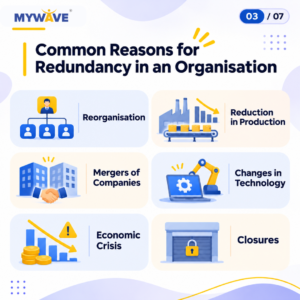
Redundancy refers to a surplus of labour to the requirement of the organisation and is normally the result of reorganisation, reduction in production, mergers of companies, changes in technology, economic crisis, and closures.
The usual consequence of redundancy is retrenchment, which refers to the termination by the employer of employees found to be surplus to the requirements of the organisation.
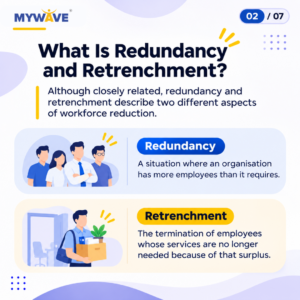
Although the terms are closely related, they describe two different aspects of workforce reduction. Redundancy refers to a situation where an organisation has more employees than it requires, while retrenchment refers to the termination of employees whose services are no longer needed because of that surplus.
Common Reasons for Redundancy in an Organisation
Redundancy may arise from several business and operational circumstances:
-
Reorganisation
Businesses may restructure their departments, responsibilities, or operational processes to improve efficiency. During this process, certain positions may become unnecessary because their responsibilities have been consolidated or redistributed.
-
Reduction in Production
When demand for products or services declines, organisations may reduce their production activities. As a result, the existing workforce may exceed the number of employees required to support the reduced workload.
-
Mergers of Companies
Corporate mergers may result in overlapping responsibilities between employees from different organisations. Where multiple positions perform similar functions, the merged organisation may identify surplus positions.
-
Changes in Technology
Technological advancements, automation, and digital transformation can change how work is performed. When technology reduces the need for certain manual or administrative functions, some existing positions may become redundant.
-
Economic Crisis
Unfavourable economic conditions may significantly affect an organisation’s financial performance and business activities, requiring employers to reassess their workforce requirements.
-
Closures
When a company closes its operations or discontinues a particular business division, employees working in the affected operations may face redundancy because their positions are no longer required.
While these circumstances may create legitimate reasons for redundancy, employers should not assume that retrenchment is automatically justified simply because one of these situations exists. The actual circumstances and the genuineness of the employer’s decision remain important considerations.
When Is Employee Retrenchment Considered Justified in Malaysia?
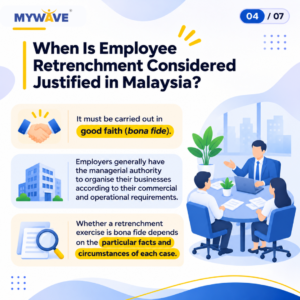
An important principle governing employee retrenchment in Malaysia is that the exercise must be carried out in good faith, or bona fide.
Employers generally have the managerial authority to organise their businesses according to their commercial and operational requirements. However, whether a retrenchment exercise is bona fide or otherwise is a question of fact and degree, depending on the particular facts and circumstances of each case.
This principle was established in the Malaysian Court of Appeal case of William Jacks & Co (M) Sdn Bhd v S Balasingam [1997] 3 CLJ 235.
Understanding the William Jacks & Co (M) Sdn Bhd v S Balasingam Case
In this case, the Court recognised that an employer is entitled to organise its business in the manner it considers best. So long as that managerial power is exercised bona fide, the decision is immune from examination even by the Industrial Court.
However, the Industrial Court is empowered, and indeed duty-bound, to investigate the facts and circumstances of a particular case to determine whether that exercise of power was in fact bona fide.
This judgment establishes two important principles for employers considering retrenchment.
Employers Have the Right to Organise Their Businesses
Employers are entitled to make business decisions involving operational restructuring, workforce requirements, and organisational efficiency. For instance, a company experiencing changes in customer demand may reorganise its departments or consolidate certain functions to improve operational efficiency.
Such decisions generally fall within the employer’s managerial authority, provided they are made for genuine business purposes.
Retrenchment Must Be Conducted in Good Faith (Bona Fide)
Although employers have the right to reorganise their businesses, the Industrial Court can investigate whether a retrenchment exercise was genuinely carried out in good faith.
For example, an employer may genuinely need fewer employees following a reduction in production or the closure of a department. However, using restructuring as an excuse to terminate employees for reasons unrelated to genuine redundancy may raise questions about whether the exercise was bona fide.
The principle established in the William Jacks case is therefore particularly important: employers have the right to organise their businesses, but the exercise of that managerial power must be genuine and carried out in good faith.
Code of Conduct for Industrial Harmony: Guidelines for Redundancy and Retrenchment in Malaysia
Before proceeding with retrenchment, Malaysian employers should understand the principles outlined in the Code of Conduct for Industrial Harmony, which provides guidelines for maintaining constructive industrial relations and responsible employment practices.
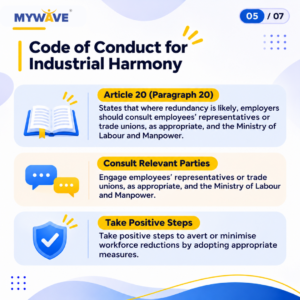
Of particular relevance is Article 20 (paragraph 20) of the Code of Conduct for Industrial Harmony, which states that in circumstances where redundancy is likely, an employer should, in consultation with their employees’ representatives or trade union, as appropriate, and in consultation with the Ministry of Labour and Manpower, take positive steps to avert or minimise reductions of workforce by adopting appropriate measures.
The Code identifies six measures that employers should consider before proceeding with workforce reductions.
1. Limitation on Recruitment
One of the recommended measures is limiting the recruitment of new employees. When an organisation anticipates redundancy, continuing to hire additional employees may create unnecessary workforce costs.
By temporarily restricting recruitment, employers can review whether existing employees are sufficient to meet operational requirements before considering retrenchment.
2. Restriction of Overtime Work
Employers should also consider restricting overtime work to minimise unnecessary labour expenses. When business activities decline, reviewing overtime arrangements may help organisations manage their existing workforce more efficiently.
For example, a manufacturing company experiencing reduced production demand may reassess its overtime requirements before considering employee retrenchment.
3. Restriction of Work on Weekly Day of Rest
The Code also recommends restricting work on employees’ weekly day of rest. Where operational demands have declined, employers may consider whether additional rest-day work is still necessary.
Reducing unnecessary rest-day work may help businesses adjust their workforce utilisation while managing additional employment costs.
4. Reduction in Number of Shifts or Days Worked a Week
Another recommended measure is reducing the number of shifts or days worked a week.
For businesses operating multiple shifts, a decline in production or operational demand may mean that existing working schedules are no longer necessary. Employers may therefore consider adjusting shift arrangements to better reflect their current business requirements.
Such adjustments should take into account employees’ contractual terms and applicable employment requirements.
5. Reduction in the Number of Hours of Work
Employers may also consider reducing the number of hours of work when business activities decline.
For instance, an organisation experiencing a temporary slowdown may explore revised working arrangements instead of immediately terminating employees. However, changes affecting employees’ contractual working hours or remuneration should be handled in accordance with applicable employment requirements.
6. Re-training and/or Transfer to Other Department or Work
The final measure recommended under the Code is re-training and/or transfer to other departments or work.
When certain positions become redundant due to restructuring or technological changes, employers may consider whether affected employees can be retrained or transferred to other suitable roles within the organisation.
For example, employees whose existing responsibilities have been reduced through automation may be able to undergo training and take on different duties.
This approach may help employers retain experienced employees while adapting their workforce to changing operational requirements.
The underlying principle of these six measures is that employers should take positive steps to avert or minimise reductions of workforce before proceeding with retrenchment. Although not every measure will be practical for every organisation, considering these alternatives can support more responsible workforce management.
Employer Responsibilities When Managing Redundancy and Retrenchment in Malaysia
Managing redundancy involves more than identifying positions that are no longer required. Employers must also consider whether the retrenchment exercise is supported by genuine business circumstances and whether appropriate measures have been considered to minimise workforce reductions.
The legal principles discussed in the William Jacks case, together with the recommendations under the Code of Conduct for Industrial Harmony, highlight several important responsibilities for employers.
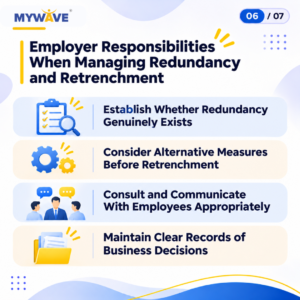
Establish Whether Redundancy Genuinely Exists
Before proceeding with retrenchment, employers should assess whether their organisation genuinely has a surplus of labour relative to its operational requirements.
This involves understanding the business circumstances that have created the redundancy, such as reduced production, organisational restructuring, or technological changes. Employers should be able to establish a reasonable connection between these circumstances and the resulting need to reduce their workforce.
Consider Alternative Measures Before Retrenchment
As recommended under the Code of Conduct for Industrial Harmony, employers should explore appropriate alternatives before proceeding with retrenchment.
These may include restrictions on recruitment and overtime, adjustments to working arrangements, or opportunities for retraining and transferring employees. The suitability of these measures will depend on the organisation’s operational circumstances and workforce requirements.
Consult and Communicate With Employees Appropriately
Effective communication is an important part of managing redundancy responsibly. Employees may experience considerable uncertainty when organisational restructuring affects their positions.
The Code of Conduct for Industrial Harmony encourages employers to consult employees’ representatives or trade unions, as appropriate, when redundancy is likely. Such consultation can help employers communicate the reasons behind proposed workforce adjustments and consider possible alternatives.
Maintain Clear Records of Business Decisions
Because the genuineness of a retrenchment exercise may be examined, employers should maintain appropriate documentation supporting their decisions.
Records of organisational changes, business requirements, consultations, and alternative measures considered can help establish a clear account of the circumstances leading to the retrenchment exercise.
Common Mistakes Employers Should Avoid When Considering Retrenchment
One mistake employers should avoid is treating retrenchment purely as an immediate cost-cutting measure without sufficiently evaluating the underlying workforce situation. Although reducing employee numbers may lower certain expenses, it can also result in the loss of valuable skills, experience, and organisational knowledge.
Another concern is failing to distinguish genuine redundancy from other employment-related issues. Retrenchment should arise from a genuine surplus of labour rather than being used as a reason to terminate employees for matters unrelated to organisational requirements.
Employers should also avoid overlooking the alternative measures recommended under the Code of Conduct for Industrial Harmony. In some circumstances, restrictions on overtime, revised working arrangements, or employee transfers may help organisations manage operational changes without immediately reducing their workforce.
Ultimately, responsible retrenchment management requires employers to balance genuine business requirements with appropriate workforce planning and employee relations practices.
Conclusion: Understanding Redundancy and Retrenchment Is Essential for Malaysian Employers
Redundancy and retrenchment may arise when organisations experience restructuring, economic challenges, technological changes, or reduced operational requirements. However, employers should understand that retrenchment must be supported by genuine business circumstances and carried out in good faith.
The decision in William Jacks & Co (M) Sdn Bhd v S Balasingam [1997] 3 CLJ 235 reinforces the importance of exercising managerial power bona fide, while Article 20 of the Code of Conduct for Industrial Harmony encourages employers to consider appropriate measures to avert or minimise workforce reductions.
As one of Penang’s established HR and payroll service providers, MYWave is committed to sharing practical HR knowledge and supporting Malaysian businesses in understanding their workforce management responsibilities. With expertise in HR consultancy and payroll outsourcing services, MYWave helps businesses manage their HR operations more effectively.
Contact MYWave to learn how our HR outsourcing and consultancy services can support your organisation’s workforce management needs.
👉 Need professional HR support for your business?
 For more information, reach out to us at: https://mywave.biz/contact-us/
 Or, through our email at: enquiry@mywave.biz