Table of contents
- What Is a Voluntary Separation Scheme (VSS) in Malaysia?
- What Should Employers Consider Before Implementing a VSS in Malaysia?
- How to Implement a Voluntary Separation Scheme (VSS) in Malaysia
- Step 1: Make a VSS Offer to Targeted Employees
- Step 2: Inform Employees About the Compensation Package
- Step 3: Allow Employees Time to Consider the VSS Offer
- Step 4: Review and Accept or Reject Applications
- Step 5: Notify Employees of Their Application Outcome
- Step 6: Obtain Employee Acceptance and Make Payment
- Step 7: Consider Retrenchment if VSS Applications Are Insufficient
- Why Is Voluntary Participation Important in a VSS?
- Conclusion:
When businesses face financial difficulties, organisational restructuring, or excess manpower, reducing their workforce may become necessary. Rather than immediately proceeding with retrenchment, employers may consider offering a Voluntary Separation Scheme (VSS) as an alternative approach to workforce reduction.
A Voluntary Separation Scheme allows employees to voluntarily leave an organisation in exchange for a compensation package offered by the employer. However, implementing a VSS requires careful planning, particularly when determining compensation, managing employee applications, and ensuring that participation remains voluntary.
As an established HR and payroll company in Penang, MYWave is committed to helping Malaysian businesses understand important employment practices and workforce management responsibilities. This article explains how a VSS works, the factors employers should consider, and the recommended procedures for implementing a Voluntary Separation Scheme in Malaysia.
What Is a Voluntary Separation Scheme (VSS) in Malaysia?
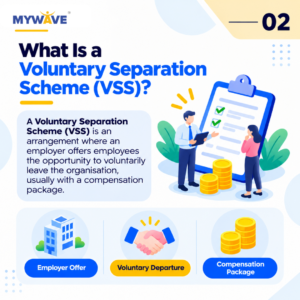
A Voluntary Separation Scheme (VSS) is an arrangement where an employer offers employees the opportunity to voluntarily leave the organisation, usually with a compensation package.
The term voluntary means the employee has the choice to decide whether he or she wants to participate. In a VSS, the offer may be made to all employees in the company or to a certain category of employees, depending on the organisation’s requirements.
Importantly, employers should not pressure employees who are not interested in participating in the VSS scheme. Once employees are pressured or forced to apply for the VSS, it is no longer a voluntary separation. The employee can then allege that he or she was forced to resign and claim unfair dismissal under Section 20 of the Industrial Relations Act 1967.
Employers should therefore ensure that employees can make their decisions freely, without pressure or coercion.
What Should Employers Consider Before Implementing a VSS in Malaysia?
Before offering a Voluntary Separation Scheme, management should identify the organisation’s workforce requirements and determine an appropriate compensation package.
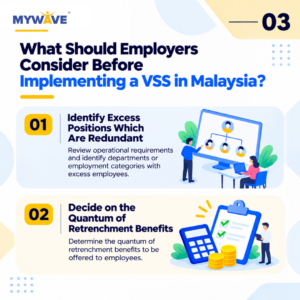
1. Identify Excess Positions Which Are Redundant
Management needs to identify excess positions which are redundant. This involves reviewing the organisation’s operational requirements and identifying departments or employment categories where there are excess employees.
2. Decide on the Quantum of Retrenchment Benefits
Management should decide on the quantum of retrenchment benefits to be offered to employees.
MYWave’s VSS guidelines highlight three considerations:
- The quantum should not be less than termination benefits payable under the Employment Act 1955, where the relevant statutory entitlement applies.
- The compensation range may be from 20 days’ wages for each year of service to 1.5 months’ wages for each year of service.
- If the VSS package is not attractive, the acceptance rate may be low.
The compensation range is a suggested VSS package guideline rather than a fixed statutory rate. Employers should consider offering a package that encourages voluntary participation while remaining financially manageable for the organisation.
How to Implement a Voluntary Separation Scheme (VSS) in Malaysia
Once management has identified the excess positions and determined the compensation package, the organisation can proceed with the VSS offer and application process.
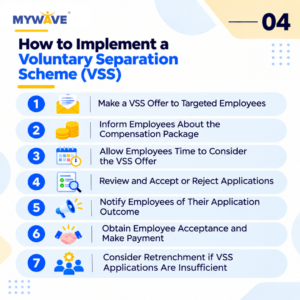
Step 1: Make a VSS Offer to Targeted Employees
Management will normally make a VSS offer to all employees in the targeted category where there are excess headcounts.
Step 2: Inform Employees About the Compensation Package
Employers should inform employees of the quantum of compensation and other conditions of the VSS package so that they understand the proposed arrangement before making a decision.
Step 3: Allow Employees Time to Consider the VSS Offer
Employees should be allowed sufficient time to consider the VSS offer, normally 2 to 3 weeks.
This gives employees an opportunity to review the compensation package and decide whether they wish to participate voluntarily.
Step 4: Review and Accept or Reject Applications
Although the offer is made to all employees in the targeted category, management has the right to accept or reject applications.
An employee’s application therefore does not automatically guarantee acceptance into the VSS scheme.
Step 5: Notify Employees of Their Application Outcome
After the VSS offer is closed, management should make a decision to accept or reject applications and notify the applicants of the outcome.
For successful applicants, the company should write to them and confirm:
- The company’s acceptance of their application.
- The actual amount of benefits they are going to receive.
- The last day of their employment.
- The date of payment of the VSS package.
Step 6: Obtain Employee Acceptance and Make Payment
The company should get employees to sign and indicate their acceptance of the VSS package. Once the terms are confirmed, employees should be paid on the agreed date of payment.
The VSS package is not subject to EPF and SOCSO contributions, insofar as it represents genuine compensation for loss of employment. Other payments, such as outstanding wages, must be assessed separately according to the applicable contribution requirements.
Step 7: Consider Retrenchment if VSS Applications Are Insufficient
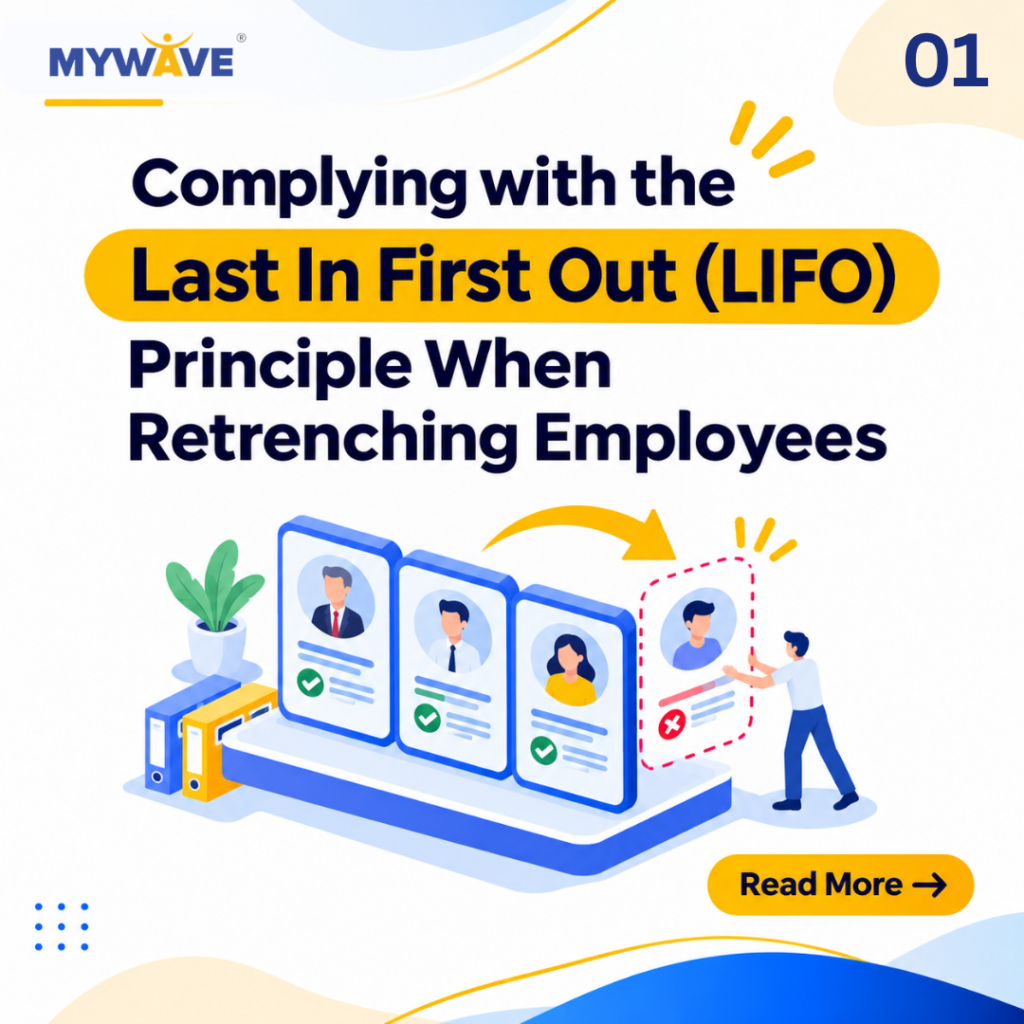
If less than the required number of employees apply for the VSS scheme, the company may retrench some employees based on the Last In First Out (LIFO) principle.
Under LIFO, the most junior employee in the relevant employment category would generally be considered for retrenchment first. However, any subsequent retrenchment exercise should be supported by genuine business requirements and appropriate employee selection criteria.
Why Is Voluntary Participation Important in a VSS?
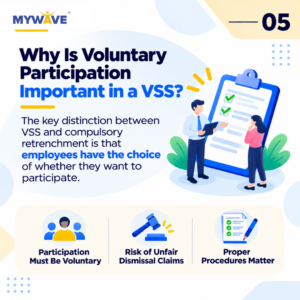
The key distinction between VSS and compulsory retrenchment is that employees have the choice of whether they want to participate.
Employers should not pressure or force employees to accept a VSS offer, even when the organisation has specific workforce reduction targets. If employees are forced to resign through a VSS, they may allege that their separation was not genuinely voluntary and pursue an unfair dismissal claim under Section 20 of the Industrial Relations Act 1967.
Clear communication, sufficient consideration time, and proper documentation are therefore important when implementing a VSS.
Conclusion:
A Voluntary Separation Scheme (VSS) provides Malaysian employers with an alternative approach to reducing excess manpower by allowing employees to voluntarily participate in a separation arrangement.
However, implementing a VSS requires careful planning. Employers should identify redundant positions, determine an appropriate compensation package, communicate the terms clearly, allow sufficient consideration time, and properly manage the acceptance and payment process. Most importantly, employee participation must remain voluntary.
As a trusted HR and payroll specialist in Malaysia, MYWave is committed to sharing important HR knowledge and helping Malaysian businesses understand responsible workforce management practices.
Need professional HR and payroll support for your business?
Contact MYWave to learn how our HR outsourcing, consultancy, and payroll services can support your organisation’s workforce management needs.
👉 Need professional HR support for your business?
 For more information, reach out to us at: https://mywave.biz/contact-us/
 Or, through our email at: enquiry@mywave.biz