Trust is a fundamental part of the employment relationship. Employers need to be able to rely on employees to provide truthful information, act faithfully in the interests of the organisation and avoid situations where their personal interests conflict with their responsibilities at work.
Two workplace issues that can seriously affect this trust are fake medical certificates and conflicts of interest.
Submitting a fake medical certificate involves dishonesty towards an employer. A conflict of interest creates a different concern: an employee places themselves in a position where their personal interests conflict with the duties they owe their employer.
For Malaysian businesses, understanding these forms of employee misconduct is important because misconduct is not always limited to what happens during an employee’s normal working duties. Honesty, disclosure, good faith, and fidelity can also become important considerations in the employment relationship.
Fake Medical Certificates as Serious Employee Misconduct
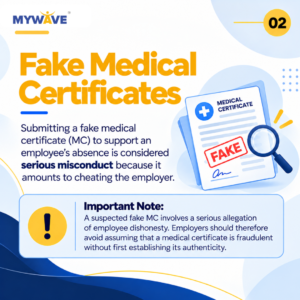
Submitting a fake medical certificate (MC) to support an employee’s absence is considered serious misconduct because it amounts to cheating the employer. The issue therefore goes beyond the employee simply being absent from work. If false documentation has deliberately been used to justify that absence, the employer is dealing with a question of employee honesty.
However, an employer who suspects that an employee has submitted a fake MC should first establish whether the medical certificate is actually fake. The employer should confirm the authenticity of the medical certificate with the hospital or doctor concerned before proceeding further.
Where the MC is confirmed to be fake, a domestic inquiry should be held to allow the employee to explain before disciplinary action is taken.
The sequence matters. Suspicion that an MC may be fake is not the same as confirming that it is fake. Employers should establish the facts before concluding the employee’s conduct.
Fake MC Case Example 1: Malaysia Airline Systems Bhd v Ibrahim Bin Abd Hamid
The seriousness of submitting a fake medical certificate can be seen in Malaysia Airline Systems Bhd v Ibrahim Bin Abd Hamid [2002] 3 ILR 525.
The employee was a Security Officer, and his position demanded a high degree of integrity. He asked a friend to obtain a medical certificate for him and gave his friend RM15. His friend subsequently returned with the medical certificate. The employee admitted that he did not see a doctor and knew that what he was doing was wrong. The Court considered the employee’s conduct particularly serious because he was a Security Officer, a position that demanded a high degree of integrity.
Although the employee was a first-time offender and had served the company for 15 years, the Court held that his dismissal was justified.
The case demonstrates how submitting false documentation can become a serious employment matter. It also shows how the employee’s position and the level of integrity expected of that position can be relevant when considering the seriousness of the misconduct.
Why Employers Should Verify a Suspected Fake Medical Certificate
A suspected fake MC involves a serious allegation of employee dishonesty. Employers should therefore avoid assuming that a medical certificate is fraudulent without first establishing its authenticity. Confirmation should be obtained from the relevant hospital or doctor. If the medical certificate is confirmed to be fake, the employee should still be provided with an opportunity to explain during the disciplinary process.
For employers, the practical approach is clear: verify the medical certificate first and then proceed based on the facts established.
What Is a Conflict of Interest in the Workplace?
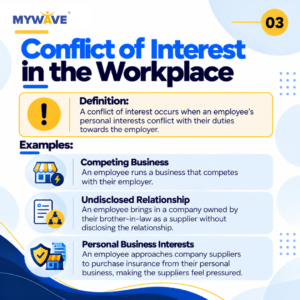
A conflict of interest at work occurs when an employee places themselves in a position where their personal interests conflict with their duties towards the employer. Such a conflict may prevent the employee from faithfully discharging their obligations.
Employees also have an implied obligation to serve their employer with good faith and fidelity.
A conflict of interest can therefore arise when an employee’s outside business activities, financial interests or personal relationships interfere with their responsibilities towards the organisation.
The issue does not necessarily have to involve theft or another immediately obvious form of misconduct. A conflict can arise simply because an employee’s personal interests have become inconsistent with the interests they are expected to protect as part of their employment.
The following Malaysian employment cases demonstrate how conflicts of interest can arise in different circumstances.
Conflict of Interest Case Example 1: Running a Business in Competition With the Employer
In Panma Tractors Sdn Bhd v Lee Kui Sin, Award No. 575/1997, the employee was found to be running his own business at the same time as he was working for the company. His business was in competition with his employer.
The Court held that an employee who, while still employed, carries on a business in competition with his employer commits serious misconduct. Such conduct was inconsistent with the employee’s duty to serve his employer with good faith and fidelity.
The case demonstrates a direct form of employee conflict of interest. The employee’s own commercial interests were placed in competition with the interests of the employer he was still expected to serve.
The problem was therefore not simply that the employee had another business. The significant issue was that the business competed with his employer, creating a conflict between his personal business interests and his duties as an employee.
Conflict of Interest Case Example 2: Undisclosed Relationship With a Company Supplier
A conflict of interest can also arise where an employee has a personal relationship with a company supplier but does not disclose that relationship.
This occurred in Cycle & Carriage Bintang Bhd v Suraj Prakash Jetly, Award No. 312/1997. The employee brought in Gautama Engineering Sdn Bhd as one of the company’s suppliers. However, Gautama Engineering Sdn Bhd was owned by the employee’s brother-in-law, and the employee did not disclose this relationship to the company.
The employee had a fiduciary responsibility to act in the best interests of the company and should have disclosed his relationship with the supplier. His failure to disclose the relationship placed him in a position of conflict of interest.
This case highlights why disclosure becomes important when an employee’s personal relationships overlap with business decisions.
From the employer’s perspective, the arrangement may initially appear to be an ordinary supplier relationship. The situation changes when the employee responsible for bringing in that supplier has an undisclosed personal relationship with the business owner.
Conflict of Interest Case Example 3: Personal Business Activities Involving Company Suppliers
An employee does not necessarily need to operate a business that directly competes with their employer for a conflict of interest to arise. Personal business activities can also become problematic when they involve the employer’s existing business relationships.
This can be seen in Gardenia Bakeries Sdn Bhd v Sin Chin Peng, Award No. 1458/2007.
The employee was involved in the insurance business outside his employment. He argued that his insurance activities were conducted after office hours and during weekends and did not affect the performance of his duties with the company. However, he had approached the company’s suppliers to purchase insurance from him.
The suppliers felt pressured to purchase insurance because of their business relationship with the company. This created a conflict between the employee’s personal business interests and his obligations towards his employer.
The case is particularly relevant because the employee’s argument focused on the fact that his insurance activities took place outside working hours and did not affect his work performance. However, the conflict arose from the way his personal business activities became connected with the company’s suppliers.
When Does an Employee’s Outside Business Become a Conflict of Interest?
The three conflict-of-interest cases demonstrate that outside business activities can create different types of problems.
- In Panma Tractors Sdn Bhd v Lee Kui Sin, the employee was running a business that competed with his employer.
- In Cycle & Carriage Bintang Bhd v Suraj Prakash Jetly, the employee brought in a company owned by his brother-in-law as a supplier without disclosing the relationship.
- In Gardenia Bakeries Sdn Bhd v Sin Chin Peng, the employee approached the company’s suppliers to purchase insurance from his personal business, and those suppliers felt pressured because of their relationship with the company.
The circumstances differ, but the underlying principle is the same: an employee should not place themselves in a position where personal interests conflict with their duties towards their employer.
This is also why an outside business should not be assessed only by asking whether it takes place during working hours. An employee’s personal activity may take place after office hours or on weekends but can still create a conflict if it interferes with the employee’s obligations or becomes connected with the employer’s business relationships.
Conclusion
Fake medical certificates and conflicts of interest demonstrate why some forms of employee misconduct in Malaysia cannot be assessed solely by looking at whether an employee has completed their everyday duties. A suspected fake medical certificate should first be verified with the relevant hospital or doctor. Where the MC is confirmed to be fake, the employee should be allowed to explain before disciplinary action is taken.
Conflicts of interest require employers to look at whether an employee’s personal interests have become inconsistent with their responsibilities towards the organisation. Running a competing business, failing to disclose a relationship with a supplier, and using company supplier relationships to advance a personal business can all create serious concerns.
For Malaysian employers, clear HR processes and proper handling of employee misconduct can help protect the trust required for a healthy employment relationship.
As an established HR and payroll agency in Malaysia, MYWave provides HR outsourcing and consultancy services to businesses that need experienced support with employee management and broader HR operations. Malaysian businesses looking to strengthen their HR practices can contact MYWave to discuss their HR outsourcing and consultancy requirements.

👉 Contact Us Now
 For more information, reach out to us at: https://mywave.biz/contact-us/
 Or, through our email at: enquiry@mywave.biz