Table of contents
- What Is Employee Misconduct?
- Minor Misconduct vs Major or Serious Misconduct
- Understanding Condonation in Employee Misconduct
- 1. The Employer Must Have Knowledge of the Misconduct
- 2. Forgiveness or Waiver May Be Express or Implied
- 3. Continuing Employment Without Disciplinary Action May Amount to Condonation
- 4. Employers Should Take Action Within a Reasonable Time
- 5. There Should Be No Double Punishment for the Same Misconduct
- 6. Investigation Does Not Amount to Condonation
- 7. Conduct Inconsistent With Forgiveness Can Show That Misconduct Has Not Been Condoned
- Condonation in Practice: Two Different Employee Misconduct Scenarios
- Disciplinary Actions for Employee Misconduct Under Section 14(1) of the Employment Act 1955
- Disciplinary Process for Serious Employee Misconduct
- Managing Minor Misconduct Through Progressive Disciplinary Action
- Is Absenteeism Considered Employee Misconduct?
- Is Being Late to Work Considered Misconduct?
- What Malaysian Industrial Court Cases Show About Habitual Lateness
- Using Attendance and Leave Management Systems to Support Better HR Administration
- Conclusion
Employee misconduct is one of those HR issues that can appear straightforward until an employer actually has to deal with it. An employee repeatedly arrives late. Another is frequently absent. A more serious incident occurs that causes management to question whether the employment relationship can continue. While all of these situations may involve misconduct, they should not automatically be treated in the same way.
For Malaysian employers, effectively managing employee misconduct requires understanding the seriousness of the conduct, responding within a reasonable time, giving employees appropriate opportunities to explain or improve where applicable, and following the proper disciplinary process. This distinction becomes particularly important with common workplace problems such as absenteeism and lateness. While these are generally treated as minor misconduct initially, repeated behaviour despite warnings can become much more serious.
As an established HR and payroll agency in Malaysia, MYWave works with businesses on practical HR and workforce management matters. Understanding how misconduct and disciplinary action should be approached is an important part of building consistent and effective employee management practices.
What Is Employee Misconduct?
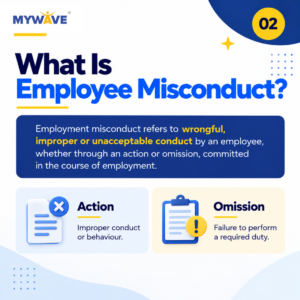
Employment misconduct refers to wrongful, improper, or unacceptable conduct by an employee, whether through an action or omission, committed in the course of employment.
The conduct may violate the employee’s employment contract, company rules, established workplace standards, or the employee’s legal or implied obligations. In doing so, the behaviour may undermine the employment relationship or the employer’s legitimate business interests.
However, recognising that misconduct has occurred is only the beginning.
Employers must also consider the nature and seriousness of the misconduct, because a relatively minor infringement should not necessarily be approached in the same way as an act serious enough to destroy the relationship of trust and confidence between employer and employee.
Minor Misconduct vs Major or Serious Misconduct
One of the most important distinctions when managing misconduct is whether the employee’s behaviour amounts to minor misconduct or major/serious misconduct.
What Is Minor Misconduct?
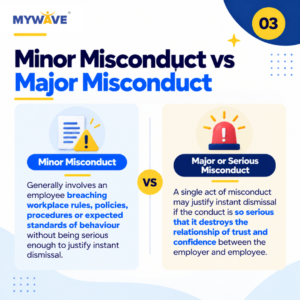
Minor misconduct generally involves an employee breaching workplace rules, policies, procedures or expected standards of behaviour without the conduct being serious enough to fundamentally damage the employment relationship or justify instant dismissal.
Minor misconduct may therefore be capable of correction through measures such as counselling, coaching, warnings or other progressive disciplinary action. The underlying principle is that an employee who commits minor misconduct should generally be given an opportunity to improve and correct the behaviour. However, “minor” does not mean the employer must continue accepting the behaviour indefinitely.
When the same misconduct continues despite warnings and opportunities to improve, repeated minor misconduct can eventually result in more serious disciplinary consequences, including termination.
What Is Major or Serious Misconduct?
Major or serious misconduct is fundamentally different.
A single act of misconduct may potentially justify instant dismissal where the conduct is so serious that it destroys the relationship of trust and confidence between the employer and employee and demonstrates an unwillingness by the employee to be bound by fundamental terms of the employment relationship.
This is why employers should look beyond simply asking whether misconduct occurred. The seriousness, circumstances and effect of the conduct on the employment relationship are also important considerations.
Understanding Condonation in Employee Misconduct
Another important concept for employers handling misconduct is condonation.
In employment matters, condonation involves an employer forgiving an employee’s misconduct or waiving the right to discipline the employee for it. Whether misconduct has been condoned can depend on what the employer knew, how the employer responded after discovering the misconduct, and whether disciplinary action was pursued within a reasonable period. Employers therefore need to understand the following principles when responding to employee misconduct.
1. The Employer Must Have Knowledge of the Misconduct
Before condonation can occur, the employer must first have knowledge of the employee’s misconduct.
An employer cannot be regarded as having condoned misconduct that it did not know had occurred. The question of forgiveness or waiver only becomes relevant once the employer is aware of the employee’s conduct.
2. Forgiveness or Waiver May Be Express or Implied
Condonation involves an employer forgiving the misconduct or waiving its right to discipline the employee for that misconduct.
This forgiveness can be express. For example, the employer could directly inform the employee that no disciplinary action will be taken.
However, forgiveness may also be implied through the employer’s inaction. This makes the employer’s response after becoming aware of misconduct particularly important.
3. Continuing Employment Without Disciplinary Action May Amount to Condonation
If an employer knows about misconduct but allows the employee to continue working without taking disciplinary action for an unreasonable period, this may amount to implied condonation.
However, the fact that an employee continues working while an investigation is being carried out does not necessarily mean that the employer has forgiven the misconduct.
The circumstances surrounding the employer’s actions therefore matter.
4. Employers Should Take Action Within a Reasonable Time
An employer that intends to discipline an employee should act within a reasonable time after discovering the misconduct.
An unexplained or excessive delay may imply that the misconduct has been condoned.
This does not mean employers should rush to impose punishment before establishing what happened. Rather, employers should avoid discovering misconduct and then allowing the matter to remain unaddressed for an unreasonable period.
5. There Should Be No Double Punishment for the Same Misconduct
Once misconduct has been condoned or an appropriate disciplinary penalty has already been imposed, the employer should not subsequently dismiss the employee for the same incident.
This principle reinforces the importance of employers considering the appropriate disciplinary response when dealing with a misconduct case rather than attempting to punish the same incident again later.
6. Investigation Does Not Amount to Condonation
Employers are entitled to investigate allegations of misconduct before deciding whether disciplinary action is warranted. Time spent conducting a fair investigation or domestic inquiry is generally not regarded as condonation.
This distinction is important. An employer taking time to properly investigate an allegation is not necessarily ignoring or forgiving the misconduct. The investigation is part of determining what occurred and whether disciplinary action should follow.
7. Conduct Inconsistent With Forgiveness Can Show That Misconduct Has Not Been Condoned
The actions an employer takes after discovering alleged misconduct can demonstrate that the employer has not forgiven or condoned the misconduct. Examples include:
- issuing a show cause letter;
- suspending the employee pending investigation; or
- commencing a domestic inquiry.
These actions generally demonstrate that the employer intends to address the alleged misconduct rather than overlook or forgive it.
Taken together, these principles show why employers should respond to employee misconduct in a timely and consistent manner. Employers can take the necessary time to investigate an allegation fairly, but they should also avoid unexplained delays or conduct that could suggest the misconduct has already been forgiven.
Condonation in Practice: Two Different Employee Misconduct Scenarios
Example 1: Condonation
In the first, an employee is absent for two days without approved leave. Management knows about the absence but allows the employee to continue working for several months without issuing a show cause letter or taking disciplinary action.
In those circumstances, the employer may potentially be regarded as having condoned the misconduct and may be unable to later discipline or dismiss the employee solely for that particular absence.
Example 2: No Condonation
An employee is suspected of theft. Once the suspected theft is discovered, the employer acts as soon as possible by suspending the employee on half pay, conducting an investigation, issuing a show cause letter and holding a domestic inquiry before reaching a decision on dismissal.
The entire process could take several weeks.
However, the time required to carry out that process would not itself amount to condonation because the employer has consistently demonstrated an intention to address the alleged misconduct.
The difference between these situations illustrates an important point for HR teams and employers: taking time to properly investigate misconduct is different from simply failing to act.
Disciplinary Actions for Employee Misconduct Under Section 14(1) of the Employment Act 1955
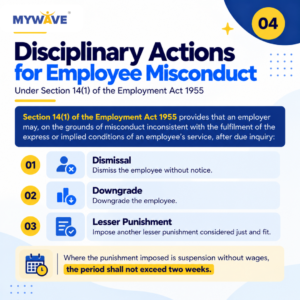
Section 14(1) of the Employment Act 1955 provides that an employer may, on the grounds of misconduct inconsistent with the fulfilment of the express or implied conditions of an employee’s service, after due inquiry:
- dismiss the employee without notice;
- downgrade the employee; or
- impose another lesser punishment considered just and fit.
Where the punishment imposed is suspension without wages, the period shall not exceed two weeks.
The key point for employers is that disciplinary action should not simply be a reaction to an allegation. The process of establishing what happened and giving the employee an appropriate opportunity to respond is an important part of misconduct management.
Disciplinary Process for Serious Employee Misconduct
When a complaint involving serious misconduct arises, employers need a structured process for establishing the facts and determining the appropriate outcome. The disciplinary process may involve an investigation into the complaint, followed by a show cause process and, where appropriate, a domestic inquiry. A serious misconduct process can involve:
Complaint of serious misconduct → investigation → show cause → notice of domestic inquiry → domestic inquiry → finding → disciplinary action or closure of the case
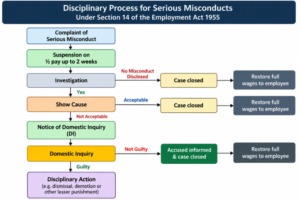
Depending on the circumstances, suspension may also form part of the process.
Where an employee is suspended on half pay pending inquiry, the process outlined under Section 14 provides for a period not exceeding two weeks. Where the inquiry does not disclose misconduct on the employee’s part, the employer must restore the amount of wages withheld.
Ultimately, if the allegation is not established, the case should be closed. Where misconduct is established, the employer can determine the appropriate disciplinary action based on the circumstances.
Managing Minor Misconduct Through Progressive Disciplinary Action
Minor misconduct requires a different approach. Rather than immediately treating every breach as grounds for termination, a progressive disciplinary process gives an employee opportunities to understand the problem and correct their behaviour.
Depending on the circumstances and the employer’s procedures, this progression may involve:
Counselling and advice → verbal warning → written warning → suspension without pay → termination
This approach is particularly relevant when dealing with recurring workplace issues such as absenteeism and lateness. The first incident may be minor. What changes the situation is when the employee continues the same behaviour after receiving counselling, warnings, and opportunities to improve.
Is Absenteeism Considered Employee Misconduct?
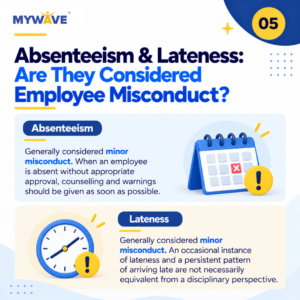
Absenteeism is generally considered minor misconduct. When an employee is absent without appropriate approval, counselling and warnings should be given as soon as possible following the absenteeism. The objective at this stage is to address the problem and provide the employee with an opportunity to correct their behaviour.
However, habitual absenteeism can become serious misconduct.
Where an employee has been given repeated opportunities to improve but continues to ignore warnings, the employer may eventually have grounds to take stronger disciplinary action, potentially including dismissal.
This demonstrates why employers should maintain consistency when managing attendance issues. Repeated absenteeism should not simply accumulate without action and then suddenly become the basis for a severe disciplinary response.
Is Being Late to Work Considered Misconduct?
Lateness is also generally considered minor misconduct. An occasional instance of lateness and a persistent pattern of arriving late are therefore not necessarily equivalent from a disciplinary perspective.
Where lateness becomes persistent or habitual—particularly after the employee has repeatedly been warned—it may be treated as serious misconduct.
This progression from minor to potentially serious misconduct reinforces the importance of employers addressing lateness when it occurs rather than allowing a recurring attendance problem to continue indefinitely.
What Malaysian Industrial Court Cases Show About Habitual Lateness
Malaysian Industrial Court decisions referenced in cases involving employee lateness demonstrate that persistent late attendance can become a legitimate disciplinary concern.
In Sarimah Lee v Freescale Semiconductor (Malaysia) Sdn Bhd, Award No. 1406/2009, reference was made to several earlier decisions involving habitual lateness. In Hong Voon Holdings Sdn Bhd, Kuantan v Puan Rosnani bte Sidin Jerantut [1986] 2 ILR 1643 (Award No. 378 of 1986), habitual late attendance was found to be a good ground for dismissal. Similar views were referenced in Petroliam National Bhd v Anuar Mohd Ariff [2000] 3 ILR 492 (Award No. 694 of 2000) and Taipan Asia Travel (M) Sdn Bhd v Thomas Chong Vei Meng [1996] 2 ILR 174 (Award No. 273 of 1996).
The Industrial Court’s decision in Newmet Konsulten v Tan Swee Gek [2007] 1 ILR 733 (Award No. 413 of 2007) also referred to UEM Genisys Sdn Bhd v Keith Douglas [2001] 1 ILR 747 (Award No. 171 of 2001), where late coming together with acts of defiance and blatant disregard of company procedures were treated as gross misconduct justifying dismissal.
Using Attendance and Leave Management Systems to Support Better HR Administration
Managing absenteeism and lateness also depends on employers having reliable attendance and leave information. When attendance records are fragmented or leave administration is handled through disconnected processes, identifying attendance patterns and maintaining accurate employee records can become more difficult.
MYWave‘s emplX cloud HR and payroll system includes solutions such as e-Time and e-Leave that can support businesses in managing employee time attendance and leave processes within their HR operations.
For businesses with employees working across different locations, emplX also provides GPS-based time attendance capabilities. Employees can perform check-ins and check-outs through the emplX Time Attendance application, with GPS coordinates, date, and time recorded as part of the attendance process. The application also provides attendance history and supports syncing attendance records submitted when internet connectivity was unavailable.
Technology does not determine whether employee behaviour constitutes misconduct or what disciplinary action should be imposed. What it can do is give HR teams more organised workforce information to support day-to-day attendance and leave administration.
Conclusion
Employee misconduct cannot be effectively managed through punishment alone.
Employers need to understand whether the behaviour is minor or serious, respond within a reasonable period, investigate where necessary, and give employees appropriate opportunities to explain themselves or correct their behaviour.
Absenteeism and lateness demonstrate why this matters particularly well. Both generally begin as minor misconduct, yet habitual behaviour that continues despite repeated warnings can develop into a much more serious employment issue.
For businesses that need support strengthening their HR processes, attendance management or employee disciplinary practices, MYWave provides HR outsourcing and consultancy services alongside the emplX cloud HR and payroll ecosystem.
With the right HR processes, workforce information and experienced support in place, Malaysian employers can manage employee issues more consistently while maintaining clearer standards across the organisation.
👉 Contact Us Now
 For more information, reach out to us at: https://mywave.biz/contact-us/
 Or, through our email at: enquiry@mywave.biz