Some forms of employee misconduct develop gradually. Repeated lateness or absenteeism, for example, may begin as minor misconduct before becoming more serious when the behaviour continues despite warnings. Other workplace incidents can be serious from the outset.
Assault and fighting at work can immediately affect workplace safety and working relationships. Theft and cheating by employees raise equally serious concerns because they can undermine the honesty, fidelity, trust and confidence expected within an employment relationship.
For Malaysian employers, however, the seriousness of an allegation should not replace the need to establish what actually happened. A workplace fight may involve questions about who initiated the confrontation and whether an employee was acting in self-defence. Allegations of theft or cheating require clear evidence. Understanding these distinctions can help employers approach serious employee misconduct in Malaysia more carefully and consistently.
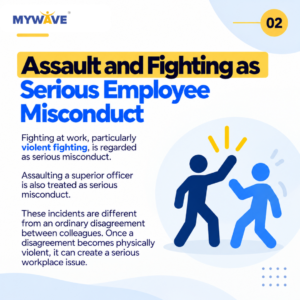
Assault and Fighting as Serious Employee Misconduct
Fighting at work, particularly violent fighting, is regarded as serious misconduct. Assaulting a superior officer is similarly treated as serious misconduct. These incidents are fundamentally different from an ordinary disagreement between colleagues. Once a disagreement becomes physically violent, the behaviour can create a serious workplace issue.
However, the fact that two employees were involved in a physical confrontation does not necessarily mean that both employees should automatically be treated in exactly the same way. An employee who is attacked may be justified in defending themselves. At the same time, the employee’s response should not be out of proportion to the attack. This means employers dealing with assault or fighting at work need to examine the circumstances surrounding the incident before determining the appropriate response.
Why Employers Should Determine Who Started a Workplace Fight
The importance of establishing how a workplace fight began can be seen in Kedah Cement Sdn Bhd v Sharudin Abdul Malik, Award No. 432/2004.
“In line with equity, good conscience and the substantial merits of the case, it was incumbent on the company to inquire who started the fight for the purpose of determining whether such misconduct merited the extreme punishment of dismissal. The right of self defense should be available to the claimant. A factual finding that he had acted in self defense would entail an incidental finding of a prior physical attack coupled with a finding as to who started the fight. The court found it untenable for the company to maintain that whether the claimant acted in self defense was relevant but as to who started the fight was irrelevant. The claimant could not be expected, in the flurry of the moment, to contemplate matters like avenues of escape while straddling a stationary motor cycle. He was virtually caught in a cornered position. He did what any reasonable person would do and defended himself.”
An important issue in the case was determining who started the fight, particularly when considering whether the misconduct warranted the extreme punishment of dismissal.
The employee’s right to self-defence was also relevant. Determining whether the employee had genuinely acted in self-defence required consideration of whether there had been an earlier physical attack and who had initiated the confrontation. The circumstances surrounding the incident were significant. The employee was effectively caught in a cornered position while on a stationary motorcycle and responded by defending himself.
The case illustrates an important point for employers dealing with workplace fighting and employee misconduct: being involved in a fight does not necessarily mean that an employee initiated it.
Where self-defence is raised, employers should therefore examine what happened before and during the confrontation rather than considering only the fact that physical contact occurred.
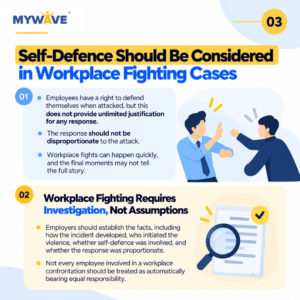
Self-Defence Should Be Considered in Workplace Fighting Cases
Employees have a right to defend themselves when attacked, but this does not provide unlimited justification for any response. The act of self-defence should not be disproportionate to the attack. This distinction matters because workplace fights can happen quickly, and the final moments of an altercation may not tell the full story.
An employer investigating a workplace fight should therefore consider the sequence of events surrounding the incident. Establishing who initiated the physical confrontation and how the other employee responded can provide important context when assessing the alleged misconduct.
The key issue is not simply:
“Was this employee involved in a fight?”
The circumstances may also require the employer to establish whether the employee initiated the violence or was responding to an attack.
Workplace Fighting Requires Investigation, Not Assumptions
Physical confrontations at work can place management under pressure to respond quickly because of their seriousness. However, the seriousness of the incident should not eliminate the need to establish the facts.
Where appropriate, employers need to understand how the confrontation developed, who initiated it, whether self-defence was involved and whether the response was proportionate to the attack.
The principles surrounding assault and fighting therefore demonstrate why employers should avoid treating every employee involved in a workplace confrontation as automatically bearing equal responsibility.
A proper understanding of the circumstances is essential before deciding how the misconduct should be addressed.
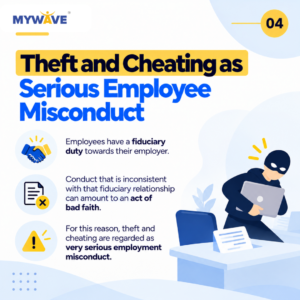
Theft and Cheating as Serious Employee Misconduct
While assault and fighting primarily raise concerns about physical behaviour, theft and cheating in the workplace raise another fundamental employment issue: honesty. Employees have a fiduciary duty towards their employer. Conduct inconsistent with that fiduciary relationship can amount to an act of bad faith. For this reason, theft and cheating are regarded as very serious employment misconduct.
Dishonest behaviour can undermine the trust that exists between an employer and employee. When an employer can no longer rely on an employee’s honesty, the effect can extend beyond the individual incident itself and affect the underlying employment relationship.
However, because accusations of theft and cheating are serious, employers also need to be careful when establishing whether such misconduct actually occurred.
The standard of proof for theft and cheating is high, and there must be clear-cut evidence. This is an important consideration for employers investigating suspected employee theft or cheating. Suspicion by itself should not be treated as proof. The employer needs to establish the facts and evidence surrounding the alleged misconduct before concluding.
The seriousness of the allegation makes this particularly important. An accusation involving theft, cheating, or dishonesty can have significant consequences for the employment relationship, so the conclusion should be supported by clear evidence.
Case Example 1: Employee Cheating Can Involve Dishonesty and Misrepresentation
Cheating in an employment context is not limited to physically taking money or property from an employer. Dishonesty can also arise through misrepresentation.
This issue can be seen in Sitt Tatt Industrial Gasses Sdn Bhd v Puvananderan Ganasamoorthy, Award No. 396/2003.
The employee had represented that he had previously been employed by another company and that he had experience in obtaining ISO certification. This representation was relevant because the employee had been hired as Head of Quality Management, and the company wanted someone capable of bringing it through ISO 9002 certification.
The employee had also signed an application form containing a declaration that the information supplied was true.
The case involved the elements of dishonesty and deception arising from the employee’s misrepresentation. It also highlighted the employee’s duty of fidelity and the importance of trust and confidence within the employer-employee relationship. This demonstrates why employee cheating can extend beyond conventional theft. Deliberately providing false or misleading information can also raise serious concerns about an employee’s honesty towards the employer.
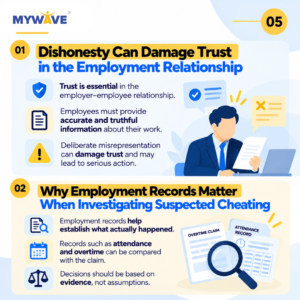
Dishonesty Can Damage Trust and Confidence in the Employment Relationship
Trust is an important part of the relationship between an employer and employee. Employers regularly depend on employees to provide accurate information about their work, qualifications, attendance, claims and other employment-related matters.
When information is deliberately misrepresented, the issue is therefore not merely that a record or statement is incorrect. The dishonesty itself can affect the employer’s ability to place trust and confidence in the employee. This distinction also reinforces why the facts surrounding alleged employee cheating need to be established carefully.
There is a significant difference between an error and deliberate deception. Employers dealing with suspected dishonesty should therefore establish what information was provided and the circumstances surrounding it before reaching a conclusion.
Case Example 2: False Overtime Claims as Employee Cheating
Another example of employee cheating can arise when an employee submits an overtime claim for hours that were not actually worked. This can be seen in Malaysian Airlines System Bhd v Nik Akhbar Bin Nik Mustafa & 5 Others, Award No. 243/2015.
The employees acknowledged that they had left their workplace earlier than scheduled on 2 June 2009, but subsequently submitted overtime claims. The attendance and overtime records showed that the employees had signed off at 7:00 a.m., despite having actually left the workplace at approximately 4:00 a.m. Their scheduled working hours were supposed to continue until 4:45 a.m. This meant they had not even completed their scheduled working hours before leaving. Despite this, overtime claims were made extending until 7:00 a.m.
The case provides a practical example of how employee cheating can involve employment-related claims and records, rather than the physical theft of company property.
Why Employment Records Matter When Investigating Suspected Cheating
The false overtime claim example also demonstrates the importance of employment records when employers need to establish what actually happened. In that situation, the employee’s actual departure time could be considered alongside the overtime claim that had been submitted. This type of documentation can help an employer establish whether the information provided by an employee corresponds with what actually occurred.
The same principle applies more broadly when investigating allegations of employee dishonesty: decisions should be based on evidence relevant to the alleged misconduct.
Where an allegation involves overtime claims, for example, attendance and overtime records may be particularly relevant. Where an allegation involves a representation made by an employee, the employer may need to examine the information or declarations that were actually provided.
Serious Employee Misconduct Should Be Assessed Based on the Facts
Assault, fighting, theft and cheating may all constitute serious workplace misconduct, but the circumstances surrounding each incident remain important.
For assault and workplace fighting, employers should establish how the confrontation occurred. Who initiated the fight? Was an employee attacked? Was the employee acting in self-defence? Was the response proportionate?
For theft and cheating, evidence becomes particularly important because of the seriousness of the allegations. Employers need to distinguish between suspicion and misconduct that can actually be established.
Misrepresentation and false claims also demonstrate that employee dishonesty can take different forms. It does not necessarily require the physical removal of company property.
Across these situations, one principle remains consistent: the seriousness of alleged misconduct should not cause employers to skip the process of establishing what actually happened.
Conclusion
Assault, fighting, theft and cheating are among the types of workplace behaviour that can create serious employment issues.
Violent fighting and assault can affect workplace safety, while theft, cheating and deliberate misrepresentation can undermine the honesty and trust expected within the employment relationship.
At the same time, employers should avoid reaching conclusions solely because an allegation sounds serious.
Workplace fighting may require consideration of who initiated the confrontation and whether self-defence was involved. Theft and cheating require clear evidence. Claims involving dishonesty should be examined according to the circumstances and information available.
For Malaysian businesses, having clear HR processes for handling employee misconduct can help management respond more consistently when difficult workplace situations arise.
As an established HR and payroll agency in Malaysia, MYWave provides HR outsourcing and consultancy services to businesses that need experienced support with their HR and workforce-management requirements. Businesses looking to strengthen their HR processes and employee-management practices can contact MYWave to discuss their HR outsourcing and consultancy needs.

👉 Contact Us Now
 For more information, reach out to us at: https://mywave.biz/contact-us/
 Or, through our email at: enquiry@mywave.biz