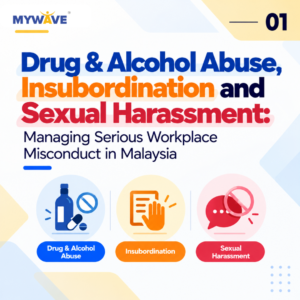
Some forms of employee misconduct in Malaysia can have consequences that extend well beyond an individual employee. Drug or alcohol abuse during working hours may create workplace safety concerns. Insubordination can challenge the authority that forms part of the employment relationship. Sexual harassment can violate an employee’s dignity and undermine the employer’s responsibility to provide a safe and conducive working environment.
These situations can be serious, but employers still need to establish the circumstances and follow an appropriate process before deciding what action to take.
For Malaysian employers and HR teams, understanding these different forms of workplace misconduct is an important part of managing employees consistently and maintaining appropriate workplace standards.
Drug and Alcohol Abuse as Serious Employee Misconduct
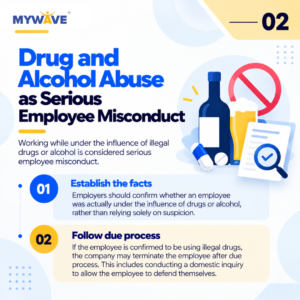
Working while under the influence of illegal drugs or alcohol is serious misconduct. Where an employee is suspected of being on drugs or drunk during working hours, the employer should establish whether the employee was actually under the influence rather than relying solely on suspicion.
An employee suspected of being on drugs or drunk can be sent to the company’s panel doctor for a urine or blood test. If the employee tests positive for illegal drugs, the doctor should be asked to send the sample to a laboratory for a confirmatory test.
If the employee is confirmed to be using illegal drugs, the company may terminate the employee after due process. This includes conducting a domestic inquiry to allow the employee to defend themselves.
The process is important because suspicion, an initial positive result, and a confirmed result are not necessarily the same thing. Employers should establish the facts before deciding on disciplinary action.
Drug Abuse Case Example 1: Perusahaan Otomobil Nasional v Muhd Awaidlah Bin Abd Kadir
The seriousness of drug abuse during working hours can be seen in Perusahaan Otomobil Nasional v Muhd Awaidlah Bin Abd Kadir, Award No. 1511/2011.
The Court stated that being tested positive for drugs during working hours was an extremely serious misconduct. The Court also took into consideration the fact that the employee was working on the factory floor, where there were numerous machineries.
The effect of drugs on an employee could result in fatal injuries to the factory floor and, as such, the company viewed this type of misconduct seriously to protect other workers in the factory. The company could not afford to have employees who were on drugs because they were not only jeopardising their own lives, but also the lives of other co-workers in the factory.
The Court had, in numerous decisions, held that drug abuse is serious misconduct which justified the company’s decision to dismiss the employee.
The case highlights why the employee’s working environment can be especially relevant when considering drug abuse. Where machinery and other workers are involved, an employee under the influence can create consequences beyond their own individual conduct.
Why Drug and Alcohol Abuse at Work Requires Proper Verification
Drug and alcohol abuse can be an extremely serious workplace issue, but employers should still establish the facts before deciding how to respond.
Where illegal drug use is suspected, testing provides a means of determining whether that suspicion is supported. Where an initial test is positive for illegal drugs, a confirmatory laboratory test should follow.
If illegal drug use is confirmed, the employee should still be allowed to defend themselves through the appropriate process before termination is considered.
This reflects an important principle in handling serious employee misconduct: the seriousness of an allegation does not remove the need to establish what actually happened.
What Is Insubordination in the Workplace?
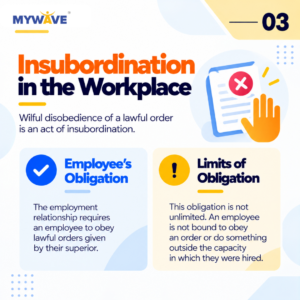
Wilful disobedience of a lawful order is an act of insubordination. The employment relationship requires an employee to obey lawful orders given by their superior. However, this obligation is not unlimited. An employee is not bound to obey an order or do something outside the capacity in which they were hired.
The distinction is important when considering whether an employee’s refusal amounts to insubordination. The issue is not simply whether an employee has refused to do something requested by a superior. The nature of the instruction itself also matters. Where an order is lawful and falls within the employment relationship, however, an employee is expected to obey the lawful orders of their superior.
Insubordination can also involve an employee challenging the authority of their superior. Challenging authority amounts to giving formal notice that the employee will no longer act in a subordinate capacity.
This goes to the nature of the employer-employee relationship itself. Employees are employed in a subordinate capacity and are generally expected to comply with lawful directions from their superiors.
For employers, the important distinction is therefore between an employee who refuses a lawful order and an employee who is being instructed to do something outside the capacity in which they were hired.
Insubordination Case Example 1: Ngeow Voon Yean v Sungei Wang Plaza Sdn Bhd/Landmarks Holdings Berhad
The principle surrounding an employee’s obligation to obey lawful orders was considered by the Federal Court in Ngeow Voon Yean v Sungei Wang Plaza Sdn Bhd/Landmarks Holdings Berhad [2006] 3 CLJ 837.
The Court referred to the general rule governing the doctrine of superior orders and stated that:
“The most fundamental implied duty of an employee is to obey his employer’s orders.”
The Court also referred to the classic modern statement of this duty in Laws v London Chronicle (Indicator Newspapers) Ltd [1959] 2 All ER 285.
The principle discussed was that wilful disobedience of an order will justify summary dismissal where the wilful disobedience involves a lawful and reasonable order and demonstrates a disregard of an essential condition of the employment contract.
The reasoning emphasised that the servant must obey the proper orders of the master and that, unless the employee does so, the relationship is fundamentally affected.
For employers, the case reinforces an important distinction when dealing with insubordination at work: the focus should be on wilful disobedience of a lawful and reasonable order, rather than treating every disagreement or refusal as automatically amounting to the same level of misconduct.
Sexual Harassment in the Workplace
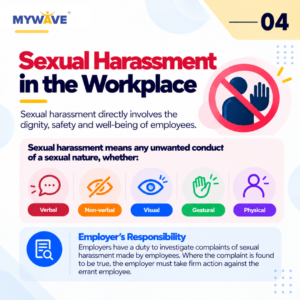
Sexual harassment raises a different type of workplace concern because it directly involves the dignity, safety and well-being of employees.
Employers have a duty to investigate complaints of sexual harassment made by employees. Where the complaint is found to be true, the employer must take firm action against the errant employee.
This responsibility is connected with the employer’s fundamental implied obligation to provide employees with a safe and conducive working environment. An employer cannot allow an employee’s dignity, self-respect and esteem to be wilfully violated by another employee.
For employers, receiving a sexual harassment complaint therefore requires action. The complaint should be investigated so that the circumstances can be established and, where the complaint is substantiated, firm action should follow.
What Is Sexual Harassment?
Sexual harassment means any unwanted conduct of a sexual nature, whether:
- verbal;
- non-verbal;
- visual;
- gestural; or
- physical.
The conduct is directed at a person and is offensive or humiliating, or constitutes a threat to the person’s well-being, arising out of and in the course of employment. This definition is important because sexual harassment is not limited to physical conduct.
Unwanted conduct of a sexual nature can take several different forms, including words, non-verbal behaviour, visual conduct and gestures. The central considerations are the sexual nature of the unwanted conduct, how it affects the person towards whom it is directed, and its connection with employment.
Employers Have a Responsibility to Investigate Sexual Harassment Complaints
When an employee raises a sexual harassment complaint, the employer has a duty to investigate it. The purpose is to establish whether the complaint is true rather than ignoring the allegation or immediately reaching a conclusion without investigation.
If the complaint is substantiated, the employer must take firm action against the employee responsible. This responsibility should also be understood within the wider obligation to maintain a workplace where employees’ dignity, self-respect and esteem are not wilfully violated by others.
Sexual harassment is therefore not simply a private disagreement between two employees. Where a complaint arises in the workplace, the employer has a responsibility to address it.
Managing Serious Workplace Misconduct Requires HR Knowledge
Drug and alcohol abuse, insubordination and sexual harassment involve different behaviours, but all three demonstrate why managers and HR teams need to understand how to respond when serious workplace issues arise.
For suspected drug abuse, the focus includes testing, confirmation, and allowing the employee to defend themselves before disciplinary action is taken.
For insubordination, employers need to consider whether there has been wilful disobedience of a lawful order while recognising that an employee is not bound to perform something outside the capacity in which they were hired.
For sexual harassment, employers have a duty to investigate complaints and take firm action where the complaint is found to be true.
These are situations where managers making disciplinary decisions without sufficient understanding can create unnecessary problems. Building stronger HR knowledge across management teams can therefore help businesses handle employee matters more consistently.
Strengthen HR and Management Knowledge Through MYWave Training Programmes
Understanding employee misconduct is not only important for HR professionals. Managers and supervisors can also find themselves dealing with employee complaints, behavioural problems, workplace disputes and disciplinary matters.
Topics involving employee management and workplace conduct can help managers better understand their responsibilities, recognise issues that require HR attention and respond more appropriately when workplace problems arise.
MYWave provides training programmes, webinars and seminars that help businesses strengthen HR and management knowledge across their organisation.
Conclusion
Drug and alcohol abuse, insubordination and sexual harassment can all become serious workplace matters, but each requires employers to consider different facts.
Suspected illegal drug use should be properly tested and confirmed. Insubordination involves wilful disobedience of lawful orders, while employees are not bound to perform something outside the capacity in which they were hired. Sexual harassment complaints should be investigated, with firm action taken where a complaint is substantiated.
The common thread is the importance of employers understanding the nature of the misconduct before deciding how to respond.
As an established HR and payroll agency in Malaysia, MYWave supports Malaysian businesses through HR outsourcing, consultancy and professional training programmes. Businesses looking to strengthen their employee-management knowledge can also explore MYWave’s HR training programmes, webinars and seminars to equip managers and HR teams with stronger practical knowledge for managing workplace issues.

👉 Contact Us Now
 For more information, reach out to us at: https://mywave.biz/contact-us/
 Or, through our email at: enquiry@mywave.biz