Table of contents
- What Is Training Need Analysis (TNA)?
- Understanding the Performance Gap in TNA
- Why Training Needs Analysis Matters for SMEs
- The Real Cost of Skipping TNA
- What Training Need Analysis Is — and What It Is Not
- A Simple Rule of Thumb for Training Need Analysis
- Why TNA Provides a Better Starting Point for SME Training
- Conclusion
- 👉 Contact Us Now!
When a business notices a performance problem, it can be tempting to assume that employees need training. However, before deciding on a training programme, the organisation first needs to understand the actual performance gap and determine whether training is the right solution.
This is the purpose of Training Need Analysis (TNA). Instead of making training decisions based on assumptions, TNA provides a systematic and evidence-based way to examine the difference between current and desired employee performance. For SMEs, this approach does not need to be complicated. TNA can be proportional, repeatable and SME-friendly, giving businesses a practical way to diagnose a performance gap before deciding how it should be addressed.
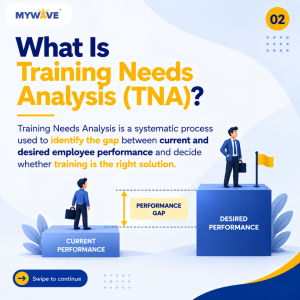
What Is Training Need Analysis (TNA)?
Training Need Analysis is a systematic process used to identify the gap between current and desired employee performance and decide whether training is the right solution.
The key principle behind TNA is to diagnose the real cause before prescribing. A performance problem may be visible, but businesses should not immediately assume that training will solve it. The first priority is to understand what the actual gap is. TNA should therefore be evidence-based, not assumption-based. Rather than deciding what employees need based on assumptions, the organisation looks at the performance gap and uses that as the basis for determining the appropriate response. At the same time, TNA can be proportional, repeatable and SME-friendly. It is not a process reserved only for large organisations. SMEs can also use TNA as a practical approach to understanding employee performance needs and making more informed training decisions.
Understanding the Performance Gap in TNA
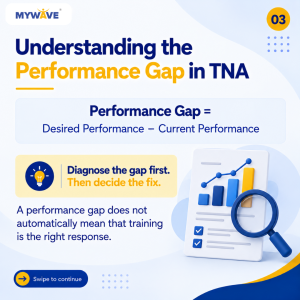
At the centre of Training Need Analysis is the performance gap. The concept can be expressed using a simple formula:
Performance Gap = Desired Performance − Current Performance
Desired performance represents the level of performance that should be achieved, while current performance represents the level being achieved now. The difference between the two is the performance gap. The important point is that identifying this gap comes before deciding how to address it.
Diagnose the gap first. Then decide the fix.
This sequence is fundamental to TNA because the existence of a performance gap does not automatically mean that a particular training programme is the right response. The gap needs to be understood before a solution is prescribed.
Why Training Needs Analysis Matters for SMEs
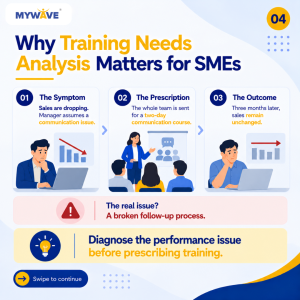
The importance of TNA becomes clearer when we consider what can happen when an organisation makes a training decision before properly diagnosing the performance problem. The training material illustrates this through the “Wrong Training” story.
Step 1: The Symptom
The company has a problem:
- Sales are dropping.
- The manager assumes that the decline in sales is caused by a communication issue.
Step 2: The Prescription
Based on that assumption, a decision is made:
- The whole team is sent for a two-day communication course.
- At this point, training has already been prescribed based on what management believes is causing the problem.
Step 3: The Outcome
Three months later:
- Sales remain unchanged.
- The reason becomes clear: the real issue was a broken follow-up process.
The company had identified a genuine business problem — declining sales — but the training it selected did not address the actual cause of that problem. This example highlights why Training Need Analysis matters. Businesses need to diagnose the performance issue before deciding that training is the appropriate response.
The Real Cost of Skipping TNA
When an organisation skips Training Need Analysis and prescribes training without first understanding the performance gap, there can be several consequences.
- The first is a wasted training budget. Resources have been committed to training, but the original problem remains unresolved.
- The second is disengaged learners. Employees have been sent for training even though the programme may not address the actual performance issue they are facing.
- The third is unchanged business results. As demonstrated by the sales example, training does not necessarily improve the outcome when the real cause of the performance problem has not been addressed.
These three consequences can be summarised as:
Wasted training budget · Disengaged learners · Unchanged business results
The key point is straightforward: TNA prevents all three by diagnosing before prescribing.
For SMEs, this makes Training Need Analysis an important foundation for making training decisions. The purpose is not simply to identify a course for employees to attend, but to understand the actual performance gap before determining whether training is needed.
What Training Need Analysis Is — and What It Is Not
Understanding TNA also means being clear about what should and should not be considered a Training Need Analysis. The distinction can be summarised as follows:
|
TNA is NOT |
TNA IS |
|
A training wish-list |
An evidence-based needs assessment |
|
The same as a training calendar |
The foundation before building a training calendar |
|
Only for large companies |
Practical for SMEs of any size |
|
A one-time exercise |
An ongoing, business-linked process |
A Simple Rule of Thumb for Training Need Analysis
There is one useful rule that brings these principles together:
If it is not tied to a real performance gap and a measurable outcome, it is not TNA.
This reinforces the central idea behind Training Need Analysis. The process begins with an actual performance gap and remains connected to an outcome that can be measured. TNA is therefore not about choosing training first and then looking for a reason to conduct it. It is about understanding the performance needs first and deciding on the appropriate response afterwards.
Why TNA Provides a Better Starting Point for SME Training
Training Need Analysis gives SMEs a structured starting point for understanding employee performance needs. Rather than assuming that a visible performance issue requires training, the organisation first identifies the difference between current and desired performance.
The process is based on evidence rather than assumptions and follows a simple principle: diagnose the real cause before prescribing.
The “Wrong Training” example demonstrates why this matters. When declining sales were assumed to be a communication issue, the team was sent for communication training. Three months later, sales remained unchanged because the real issue was a broken follow-up process. The training did not address the actual problem.
For SMEs, the lesson is clear. Training should be connected to a real performance gap and measurable outcome, and TNA provides the foundation for identifying that need.
Conclusion
Training Need Analysis begins with a simple but important shift in thinking. Instead of immediately asking what training employees should attend, businesses first identify the gap between current and desired performance.
From there, the principle remains straightforward: diagnose the gap first, then decide the fix.
For Malaysian SMEs, this provides a practical and evidence-based foundation for approaching employee training needs. It can help businesses avoid the consequences of prescribing the wrong training and keep training decisions connected to genuine performance gaps and measurable outcomes.
As an HR, payroll, and training specialist in Malaysia, MYWave continues to share practical knowledge that helps Malaysian businesses better understand HR and workforce development. As MYWave works towards being the best HR and payroll training provider in Malaysia, its focus is on supporting businesses with relevant HR knowledge and training solutions that address their organisational and workforce needs.



👉 Contact Us Now!
Contact our team to inquire about any questions you may have about HR, payroll, and training.
👉 For more information, reach out to us at: https://mywave.biz/contact-us/
📧 Or, through our email at: enquiry@mywave.biz