Table of contents
- What Are the 4 Communication Styles in the Workplace?
- The Same Workplace Message Can Be Communicated Differently
- Why Understanding Workplace Communication Styles Matters
- Develop Better Workplace Communication with MYWave
- 👉 Want to strengthen workplace communication and collaboration within your organisation?
Have you ever worked with someone who wants to make a decision immediately, while another colleague wants more information before moving forward? Or perhaps one person naturally turns a meeting into a conversation while someone else prefers to stay focused on the task.
These differences can often be seen through different communication styles in the workplace. Understanding how colleagues communicate can help employees recognise why people respond differently to the same situation and improve how teams work together.
Four communication styles that can commonly be recognised are Red, Yellow, Green and Blue. Each has different characteristics and priorities. As a trusted Malaysian HR & Workplace training provider, MYWave helps organisations develop greater awareness of these workplace communication differences and strengthen collaboration among employees.
What Are the 4 Communication Styles in the Workplace?
The four communication styles can be understood through their main characteristics:
|
Communication Style |
Key Characteristics |
What They Value |
|
Red |
Direct, decisive, and ambitious |
Progress |
|
Yellow |
Energetic, persuasive, expressive, and relationship-building |
Engagement |
|
Green |
Calm, supportive, patient, and harmony-oriented |
Harmony |
|
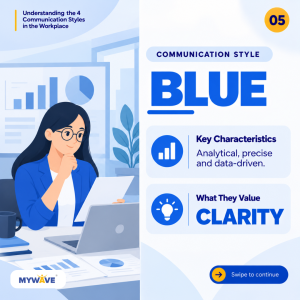
Blue |
Analytical, precise and data-driven |
Clarity |
Understanding these characteristics can make it easier to recognise why colleagues may approach the same workplace situation very differently.
Red Communication Style: Direct, Decisive and Focused on Progress
Red behaviour is ambitious, direct and decisive. A Red communicator tends to focus on moving forward rather than waiting unnecessarily.
Imagine a team meeting scheduled for 2:00pm. At 2:15pm, the manager still has not arrived and nobody has received an update. A Red communicator may ask:
“Can we start the meeting without the manager?”
They may also suggest that someone call the manager. From their perspective, waiting is not moving things forward, and there is little reason to continue waiting when work can be done.
The key to understanding Red behaviour is simple: Red values progress.
Yellow Communication Style: Energetic, Expressive and Focused on Engagement
Yellow behaviour is energetic, persuasive and expressive, with a natural focus on building relationships. Put a Yellow communicator into the same delayed meeting, and the reaction can be very different. Instead of concentrating on the delay, they may start talking to colleagues, telling jokes or discussing something completely unrelated, such as a recent football match.
For Yellow, the waiting time becomes an opportunity to interact with the people around them. Building relationships can take priority over focusing entirely on work.
In short, Yellow values engagement.
Green Communication Style: Calm, Supportive and Focused on Harmony
Green behaviour is calm, patient, supportive, and harmony-oriented. When the manager is late, a Green communicator may respond:
“Maybe the manager is busy, let’s give him some time.”
They may also engage with the Yellow colleague while waiting. Rather than immediately confronting the situation, Green tends to give others the benefit of the doubt. Maintaining good relationships and avoiding unnecessary conflict are important characteristics of this communication style.
For Green, harmony matters.
Blue Communication Style: Analytical, Precise and Focused on Clarity
Blue behaviour is analytical, precise and data-driven. Details matter to a Blue communicator. When faced with the delayed meeting, Blue may start asking questions:
“Did the manager send out an email?”
“Are we in the correct room?”
“Is the meeting postponed?”
Rather than simply waiting or moving ahead, Blue wants to establish what has happened. If the manager cannot attend as planned, that change should have been clearly communicated. This reflects Blue’s underlying priority: clarity.
The Same Workplace Message Can Be Communicated Differently
Communication styles not only affect how employees respond to situations. They can also influence how someone delivers a message.
Consider a manager who scheduled a team meeting for 2:00 pm but suddenly needs to postpone it to 4:00 pm because of an unexpected client meeting.
- A Red-style message would be direct. It would communicate the new meeting time, tell employees to use the additional time to complete their assigned tasks, and reinforce that the meeting will begin at 4:00 pm sharp.
- A Green-style message would take a more considerate approach. It may apologise for the change, thank the team for their patience and understanding, and invite employees to raise any difficulties caused by the new meeting time.
- A Blue-style message would focus heavily on clarity. It could clearly state the new meeting time, venue, and agenda so employees have the necessary information.
- A Yellow-style message would feel more energetic and conversational, thanking everyone for being flexible and expressing enthusiasm about catching up with the team at the rescheduled meeting.
The situation has not changed. The meeting is still being moved from 2:00 pm to 4:00 pm. What changes is how that information is communicated.
Why Understanding Workplace Communication Styles Matters
Recognising different communication styles can help employees better understand their colleagues. A short and direct response does not communicate in the same way as a supportive response. An expressive colleague approaches communication differently from someone who wants precise information and details. The four styles provide a simple way to remember these differences:
Red values progress. Yellow values engagement. Green values harmony. Blue values clarity.
Being able to recognise these different priorities creates a foundation for better communication and collaboration in the workplace.
Develop Better Workplace Communication with MYWave
Teams are made up of people who communicate differently. Understanding those differences can help employees recognise different communication behaviours and become more aware of what their colleagues value when communicating. The next step is learning how to communicate across those differences, particularly when contrasting communication styles create misunderstanding or friction.
As a trusted Malaysian HR & Workplace training provider, MYWave provides workplace training programmes that help organisations develop practical skills among employees and managers.



👉 Want to strengthen workplace communication and collaboration within your organisation?
Contact MYWave to explore our HR and workplace training programmes for your team.
👉 For more information, reach out to us at: https://mywave.biz/contact-us/
📧 Or, through our email at: enquiry@mywave.biz