Malaysian employers need to understand how maternity leave and paternity leave entitlements in Malaysia work, who qualifies, how long the leave lasts, and what conditions apply. These are not simply company benefits determined entirely by internal HR policies. The Employment Act 1955 contains specific provisions governing maternity and paternity leave.
For HR teams, knowing these requirements helps ensure that employee leave policies are administered consistently while giving eligible employees the leave they are entitled to.
As an experienced HR and payroll agency in Malaysia, MYWave believes employers should understand these requirements clearly and incorporate them properly into their HR and leave management processes.
Maternity Leave in Malaysia Under Section 37 of the Employment Act 1955
Maternity protection is addressed under Part IX of the Employment Act 1955.
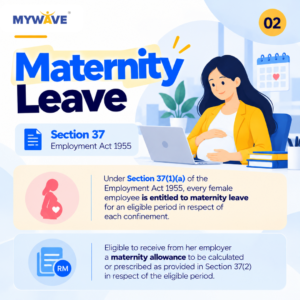
Under Section 37(1)(a) of the Employment Act 1955, every female employee is entitled to maternity leave for an eligible period in respect of each confinement and, subject to Part IX, to receive a maternity allowance from her employer calculated or prescribed as provided under Section 37(2).
The eligible period for maternity leave is not less than 98 consecutive days.
This is important for employers because maternity leave should be treated as a defined employment entitlement rather than simply another category within a company’s general leave policy.
Understanding the Conditions for Maternity Leave and Maternity Allowance
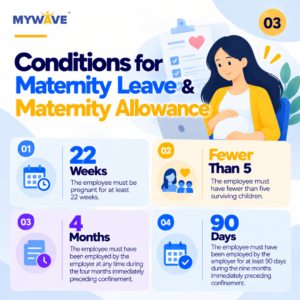
The maternity leave and allowance provisions involve several conditions that employers and employees should understand. The conditions covered include:
- the employee being pregnant for at least 22 weeks;
- having fewer than five surviving children;
- having been employed by the employer at any time during the four months immediately preceding confinement; and
- having been employed by the employer for at least 90 days during the nine months immediately preceding confinement.
For the purposes of Section 37 of the Employment Act 1955, “children” refers to all natural children irrespective of age. The “eligible period” refers to a period of maternity leave of not less than 98 consecutive days.
For HR departments, these conditions demonstrate why maternity leave administration requires accurate employment information rather than simply recording the employee’s expected dates of absence.
A structured leave system can make this easier to administer. emplX e-Leave, for example, allows employees to apply for leave electronically while giving employers a centralised way to manage leave applications, approvals and employee leave records.
Maternity Protection Is More Than Providing 98 Days of Leave
Employers should also understand that maternity protection under the Employment Act 1955 goes beyond determining how many days of leave an employee receives.
Section 37(4) of the Employment Act 1955 addresses termination during the period in which a female employee is entitled to maternity leave.
An employer who terminates the service of a female employee during the period in which she is entitled to maternity leave commits an offence. The provision includes an exception where the termination is on the ground of closure of the employer’s business. This makes maternity leave an area where employers need to pay particular attention to how employment decisions are handled during the employee’s protected maternity period.
Employment Terms Cannot Provide Less Favourable Maternity Protection
Another important maternity protection appears under Section 43 of the Employment Act 1955. Terms or conditions relating to maternity protection cannot be less favourable than those provided under Part IX of the Employment Act 1955, even where the employee has consented to those less favourable terms.
Where a term or condition is less favourable, it is null and void. For employers, this means internal employment terms should be aligned with the maternity protections provided under the Employment Act 1955. An employee agreeing to a less favourable arrangement does not make that arrangement valid.
How Does Paternity Leave Work in Malaysia?
The Employment Act 1955 also provides paid paternity leave for eligible married male employees.
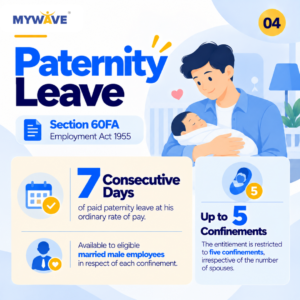
Under Section 60FA(1) of the Employment Act 1955, a married male employee is entitled to seven consecutive days of paid paternity leave at his ordinary rate of pay in respect of each confinement, subject to the applicable conditions.
Unlike maternity leave, however, the number of confinements covered by this entitlement is limited.
Under Section 60FA(2) of the Employment Act 1955, paid paternity leave is restricted to five confinements, irrespective of the number of spouses. This distinction is important when employers establish and administer their paternity leave policies.
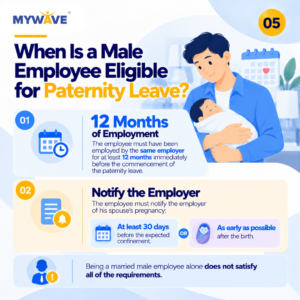
When Is a Male Employee Eligible for Paternity Leave?
Being a married male employee alone does not satisfy all of the requirements.
Under Section 60FA(3) of the Employment Act 1955, a married male employee is entitled to paternity leave from his employer if he has been employed by the same employer for at least 12 months immediately before the commencement of the paternity leave.
There is also a notification requirement. The employee must notify the employer of his spouse’s pregnancy at least 30 days before the expected confinement, or as early as possible after the birth. For HR teams, communicating this requirement clearly to employees can help reduce confusion when paternity leave is requested.
Conclusion
The biggest priority is having HR policies that clearly reflect the applicable maternity and paternity leave provisions. Employees should understand their leave entitlement, the conditions that apply, and any notification requirements they need to follow. HR teams should also have accurate employee records so eligibility can be determined consistently.
This becomes increasingly important as the workforce grows. When leave information is spread across emails, paper forms, and spreadsheets, tracking different entitlements and employee absences becomes more difficult.
For companies looking to strengthen their HR processes while reducing the administrative workload on their internal teams, contact MYWave to find out how our HR, payroll, and workforce management solutions can support your organisation.
👉 Contact Us Now
 For more information, reach out to us at: https://mywave.biz/contact-us/
 Or, through our email at: enquiry@mywave.biz