Identifying a performance gap is an important starting point in Training Needs Analysis (TNA), but understanding where that gap comes from requires businesses to look at the situation from more than one perspective. A training need may be connected to the direction and performance of the organisation, the requirements and processes surrounding a particular job, or the performance of an individual employee. Looking at only one of these areas can provide an incomplete picture of what the business actually needs.
This is where the 3-Level Training Needs Analysis (TNA) Model becomes useful. The model examines training needs from three different but connected levels: Organisational, Job / Task, and Individual. Most TNA exercises involve all three levels, beginning with the broader needs of the business before narrowing the analysis down to the role and eventually the individual employee.
For SMEs in Malaysia, this provides a structured way to examine employee and organisational training needs rather than treating every performance issue as an isolated employee problem.
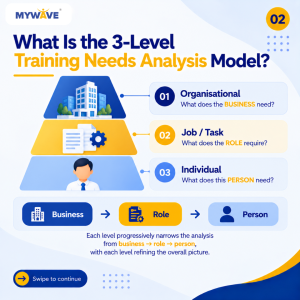
What Is the 3-Level Training Needs Analysis Model?
The 3-Level TNA Model looks at training needs from three angles:
- Organisational — What does the BUSINESS need?
- Job / Task — What does the ROLE require?
- Individual — What does this PERSON need?
The levels progressively narrow the analysis from business → role → person, with each level refining the overall picture.
At the organisational level, the focus is on the company’s strategy, KPIs, and factors driving change. At the job or task level, attention shifts towards job descriptions, standard operating procedures (SOPs) and workflow bottlenecks. At the individual level, the analysis looks more closely at appraisals, self-assessment and observed employee performance.
Rather than immediately concluding that a particular employee needs training, the 3-Level TNA Model encourages businesses to start broadly and progressively understand where the actual need exists.
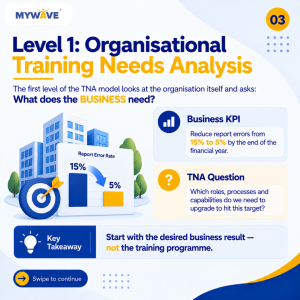
Level 1: Organisational Training Needs Analysis
The first level of the TNA model looks at the organisation itself and asks:
What does the business need?
At this level, the focus is on business strategy, KPIs and change drivers. The purpose is to understand what the organisation is trying to accomplish and where capabilities may need to be strengthened to support those objectives.
Several key questions can guide the organisational-level analysis. What are the company’s top KPIs this year? Where is the business currently underperforming? What drivers of change are affecting the organisation, such as new technology, regulation or expansion? Most importantly, what capabilities will the organisation need to deliver its strategy?
These questions keep the analysis connected to business performance rather than looking at training as a separate HR activity.
An Example of Organisational-Level TNA
Suppose a company’s KPI is to:
Reduce report errors from 15% to 5% by the end of the financial year.
Rather than immediately deciding that employees need training, the TNA question becomes:
Which roles, processes and capabilities do we need to upgrade to hit this target?
This changes the focus from choosing a training programme to understanding what needs to improve within the organisation. The KPI establishes the desired business result, while the TNA question helps the organisation investigate the roles, processes and capabilities connected to achieving it.
For MYWave, this business-linked approach is an important part of effective workforce development. As MYWave positions itself as one of the best HR and payroll training providers in Malaysia, the focus is not simply on providing training programmes, but on helping organisations understand the needs that should drive employee development in the first place.
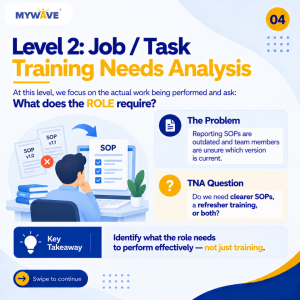
Level 2: Job / Task Training Needs Analysis
Once the broader business need is understood, the second level moves closer to the actual work being performed. The central question becomes:
What does the role require?
At the Job / Task level, the focus is on job descriptions, SOPs and workflow bottlenecks. Businesses examine whether employees have clear and current processes to follow, where problems are occurring within workflows and what skills or competencies a particular role requires.
Some of the key questions at this level include whether the company’s SOPs and job descriptions are current, where errors or delays occur within the workflow, what skills and competencies employees in the role should have, and which task-level failures continue to recur each month. These questions help businesses examine the job itself before deciding that poor performance necessarily means an employee lacks the required skills.
An Example of Job / Task-Level TNA
Consider a situation where a company discovers that:
Reporting SOPs are outdated and team members are unsure which version is current.
At this point, the appropriate TNA question is:
Do we need clearer SOPs, a refresher training, or both?
This example demonstrates why examining the job and task level is important. The problem involves uncertainty surrounding the organisation’s reporting SOPs, so the analysis needs to consider the process itself as well as whether employees require additional training. Instead of automatically sending employees for a course, the business first examines whether the SOP needs to be clarified, whether refresher training is needed, or whether both actions are required.
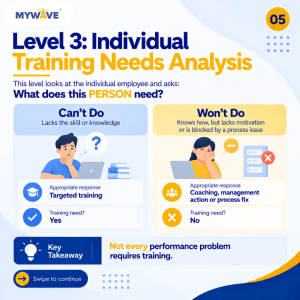
Level 3: Individual Training Needs Analysis
The third level narrows the analysis to the individual employee and asks:
What does this person need?
At the Individual level, the focus is on appraisals, self-assessment and observed performance. This is where the organisation looks more closely at the performance of specific employees and investigates what may be causing an individual performance gap. The analysis can begin by asking which individuals are underperforming and what those employees themselves say about their performance gaps. Businesses should also examine whether the employee genuinely lacks a required skill or whether the problem relates to motivation or a process issue. Wherever possible, the assessment should be connected to specific, real examples that can be observed.
One of the most important distinctions at this level is understanding the difference between an employee who “Can’t Do” and an employee who “Won’t Do.”
“Can’t Do” vs “Won’t Do”: Is It Really a Training Need?
Not every individual performance problem should become a training programme. The TNA model separates individual performance issues into two important categories.
Won’t Do
A “Won’t Do” situation occurs when the employee knows how to perform the task but lacks motivation or is blocked by a process issue. In this situation, the employee already possesses the necessary knowledge or skill. Training therefore does not address the underlying problem. According to the TNA model, a “Won’t Do” issue should instead be addressed through coaching, management action, or a process fix.
It is not really a training need.
Can’t Do
A “Can’t Do” situation is different. Here, the employee genuinely lacks the skill or knowledge required to perform as expected. Because the performance issue comes from an actual skill or knowledge gap, targeted training can be used to address the need.
This is a training need.
The distinction can be summarised simply:
|
Performance Issue |
What It Means |
Appropriate Response |
Training Need? |
|
Won’t Do |
Knows how, but lacks motivation or is blocked by a process issue |
Coaching, management action or process fix |
No |
|
Can’t Do |
Genuinely lacks the skill or knowledge |
Targeted training |
Yes |
This is one of the most important principles within the Individual level of TNA: always separate “Can’t Do” from “Won’t Do” because only one is a training need.
For businesses, this distinction can prevent training from being used as the default response to every employee performance issue. Where the employee already knows how to perform the task, another training programme does not address the motivation or process issue that is affecting performance.
Conclusion
A useful Training Needs Analysis should look beyond the individual employee. By examining the organisation, the job or task and the individual, businesses can develop a clearer understanding of where performance needs originate and whether training is actually required.
The 3-Level TNA Model provides a straightforward structure: understand what the business needs, identify what the role requires, and determine what the person needs. At the individual level, businesses should then distinguish between employees who genuinely lack the necessary skill or knowledge and situations where motivation or processes are the real issue.
As an HR and payroll training provider in Malaysia, MYWave supports Malaysian businesses through HR and workforce knowledge as well as training solutions. For organisations looking to strengthen employee capabilities, MYWave’s HRDC claimable training programmes provide businesses with training options to support their workforce development needs.

👉 Contact Us Now!
Contact our team to inquire about any questions you may have about our training programmes and solutions.
👉 For more information, reach out to us at: https://mywave.biz/contact-us/
📧 Or, through our email at: enquiry@mywave.biz