Table of contents
- The 5-Step Training Need Analysis (TNA) Process
- Step 1: Define the Performance Gap
- Step 2: Choose the Appropriate TNA Level or Levels
- Step 3: Gather the Data
- Step 4: Analyse the Performance Gap
- Step 5: Recommend and Plan the Training
- From Diagnosis to an Actionable Training Plan
- Conclusion
- 👉 Contact Us Now!
Knowing that employees or teams are not performing at the expected level is only the first step in a Training Need Analysis (TNA). The next challenge is determining the actual performance gap, where it exists, what is causing it, and, ultimately, whether training is the appropriate solution.
For SMEs, this process does not need to be overly complicated. A structured 5-Step Training Need Analysis process can take the business from identifying a performance problem to developing an actionable training plan based on the needs that have been identified.
The process follows a clear sequence:
Define the Gap → Choose the Level(s) → Gather Data → Analyse the Gap → Recommend & Plan
The first two steps help frame the question. Steps three and four help surface the cause. The final step turns the findings into action.
The 5-Step Training Need Analysis (TNA) Process
A practical TNA process can be broken down into five steps:
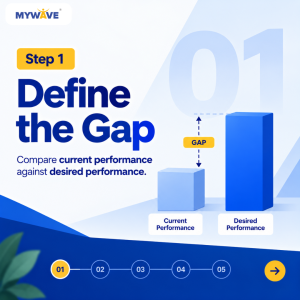
Step 1: Define the Gap — Compare current performance against desired performance.
Step 2: Choose the Level(s) — Determine whether the analysis should focus on the Organisational, Job, or Individual level, or a combination of these levels.
Step 3: Gather Data — Use methods such as surveys, interviews and observation to gather relevant information.
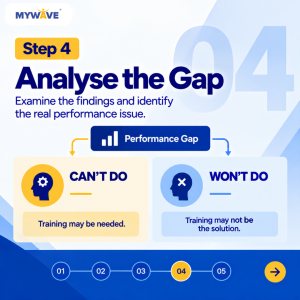
Step 4: Analyse the Gap — Examine the findings and distinguish between a genuine “Can’t Do” issue and a “Won’t Do” issue.
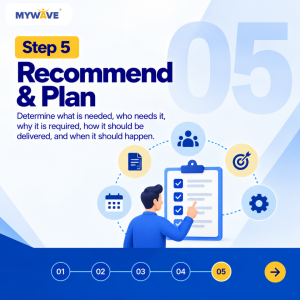
Step 5: Recommend & Plan — Determine what is needed, who needs it, why it is required, how it should be delivered, and when it should happen.
Together, these five steps provide a repeatable process that moves from diagnosis to decision and then delivery.
Step 1: Define the Performance Gap
The first step in conducting a Training Need Analysis is to define the gap between current and desired performance. A useful gap statement should include four things: the current state, the desired state, the measurable gap, and who is affected. Bringing these elements together helps the organisation describe the performance issue clearly rather than working from a broad or vague assumption that something needs to improve.
For example:
“Complaint resolution averages 12 minutes vs the SOP target of 5 minutes for the Customer Service team (8 staff).”
This is a useful gap statement because it establishes the current performance of 12 minutes, identifies the desired SOP target of 5 minutes, shows a measurable difference between the two, and specifies that the gap affects the Customer Service team of eight staff. By defining the gap in this way, the organisation has a clearer performance issue to investigate during the remaining stages of the TNA.
Step 2: Choose the Appropriate TNA Level or Levels
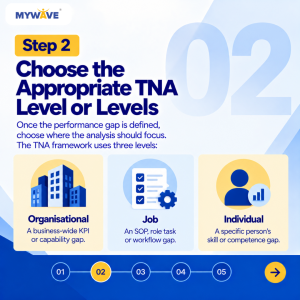
Once the performance gap has been defined, the next step is to decide where the analysis needs to focus. The TNA framework uses three levels:
- Organisational (Org) — A business-wide KPI or capability gap.
- Job — An SOP, role task or workflow gap.
- Individual (Indv) — A specific person’s skill or competence gap.
A performance issue does not necessarily belong exclusively to one level. We recommend selecting at least one level while recognising that a combination will often apply. The practical approach is to start broad. First confirm whether there is an Organisational gap, then drill down into the Job level, and finally examine the Individual level where relevant. This creates a progression from the wider business issue towards the particular role or person involved.
For SMEs conducting TNA, defining the gap and selecting the appropriate level provide the foundation for the analysis. As MYWave positions itself as one of the best HR and payroll training providers in Malaysia, this structured approach helps keep training discussions connected to an identifiable performance need rather than beginning with a predetermined training programme.
Step 3: Gather the Data
After defining the gap and choosing the appropriate TNA level, the next step is to gather data. The TNA framework recommends mixing two or more methods to obtain the most reliable picture. Different methods provide different types of information, so combining them can help businesses understand the performance issue more clearly.
Surveys and Questionnaires
Surveys and questionnaires provide a fast and scalable method for gathering information. They are particularly useful for collecting self-assessed proficiency and training history across teams. This makes surveys suitable when information needs to be gathered broadly from a larger group of employees.
Interviews and Focus Groups
Interviews and focus groups provide deeper insight and can help uncover why people behave the way they do. Where surveys provide broad input, interviews and focus groups allow the organisation to explore the reasons behind particular responses or behaviours in greater depth.
Observation
Observation provides an objective, on-the-job view of performance. Instead of relying entirely on what employees say they do, observation allows the organisation to examine what people actually do while performing their work.
Document Review
Document review provides a low-cost starting point for gathering existing evidence about performance. Relevant documents can include appraisals, error logs, SOPs and customer complaints. Reviewing these materials can provide a useful baseline before the organisation moves further into the analysis.
The four methods therefore provide different perspectives:
|
Data-Gathering Method |
Main Value |
|
Surveys / Questionnaires |
Fast and broad |
|
Interviews / Focus Groups |
Deep and qualitative |
|
Observation |
Objective and real |
|
Document Review |
Low-cost baseline |
Rather than depending entirely on one source of information, the TNA process recommends combining two or more methods to develop a more reliable picture of the performance issue.
Step 4: Analyse the Performance Gap
Once the data has been gathered, the fourth step is to analyse the gap. The TNA framework recommends using a Gap Analysis Matrix to score each competency. However, identifying a competency gap alone is not enough. The organisation also needs to determine what is actually causing that gap. This brings the analysis back to an important distinction:
Can’t Do vs Won’t Do
- A “Can’t Do” situation represents a genuine skill or knowledge gap. In this case, training is the answer.
- A “Won’t Do” situation occurs when the employee lacks motivation or is being blocked by a process. In this situation, coaching or a process solution is the answer instead.
The distinction can be summarised as follows:
|
Analysis |
Cause |
Response |
|
Can’t Do |
Genuine skill or knowledge gap |
Training is the answer |
|
Won’t Do |
Lacks motivation or is blocked by a process |
Coaching / process is the answer |
The rule within the TNA process is clear:
Only “Can’t Do” outcomes belong in a training plan.
This prevents the organisation from automatically converting every identified performance gap into a training programme. The gap first needs to be analysed so that the recommended response matches the actual issue identified through the TNA.
Step 5: Recommend and Plan the Training
After the performance gap has been analysed and a genuine training need has been identified, the final step is to recommend and plan the response. The TNA framework sets out the key areas that should be specified when developing the recommendation:
- What — Identify the training topic and learning outcome.
- Who — Identify the target group and headcount.
- Why — Connect the training to the identified gap and KPI.
- How — Determine the training mode and provider.
- When — Establish the appropriate time frame.
- Measure — Define the success metric and review.
This moves the TNA from analysis into an actionable training plan. Instead of simply stating that employees “need training”, the recommendation identifies what needs to be learned, who needs the training, why it is necessary, how it will be delivered, when it should happen and how success will be measured.
For MYWave, this connection between an identified performance need and a clear training plan is an important part of effective employee development. As MYWave continues to establish itself as the best HR and payroll training provider in Malaysia, the focus is on helping businesses approach training with a clearer understanding of what they need to achieve.
From Diagnosis to an Actionable Training Plan
The five stages of Training Need Analysis work together as one repeatable process rather than as isolated activities.
- Steps 1 and 2 frame the question. The organisation defines the difference between current and desired performance and determines whether the issue should be examined at the Organisational, Job, or Individual level.
- Steps 3 and 4 surface the cause. Relevant information is gathered using methods such as surveys, interviews, observation and document review, before the organisation analyses whether the gap represents a genuine skill or knowledge problem.
- Step 5 turns the findings into action. Once a genuine training need has been established, the organisation specifies what is required, who requires it, why it matters, how and when training should be delivered, and how the result will be measured.
The overall process can therefore be understood as:
Diagnose → Decide → Deliver
This gives SMEs a structured way to move from an observed performance problem towards a training recommendation based on the findings of the analysis.
Conclusion
A Training Need Analysis gives SMEs a clear process for moving from a performance issue to an appropriate response. Rather than beginning by choosing a training programme, the organisation first defines the performance gap, identifies the appropriate level of analysis and gathers the information needed to understand what is happening. The findings are then analysed to distinguish a genuine skill or knowledge gap from a motivation or process issue. Only when the analysis identifies a “Can’t Do” outcome does that need belong in the training plan. From there, the organisation can specify the training topic, target group, connection to the gap and KPI, delivery method, timeline and success measure.
By following the 5-Step Training Need Analysis process, SMEs can move systematically from diagnosis to decision and delivery.
As MYWave continues to position itself as the best HR and payroll training provider in Malaysia, the company supports Malaysian businesses with HR and workforce knowledge as well as training solutions designed to support employee development. Businesses looking to strengthen their workforce capabilities can explore MYWave’s training programmes and broader HR solutions.



👉 Contact Us Now!
Contact our team to inquire about any questions you may have about our training programmes and solutions.
👉 For more information, reach out to us at: https://mywave.biz/contact-us/
📧 Or, through our email at: enquiry@mywave.biz