Table of contents
- Why Different Communication Styles Can Create Friction at Work
- How to Adapt Your Communication Style at Work
- Situation 1: A Red Manager Giving Feedback to a Green Employee
- Situation 2: A Yellow Colleague Asking a Blue Colleague for Help
- Situation 3: A Blue Colleague Addressing a Yellow Colleague Who Is Late
- Situation 4: A Blue Colleague Asking a Red Manager for More Time
- Better Communication Starts with Understanding What Others Need
- Conclusion
- 👉 Want to help your team communicate and collaborate more effectively?
Have you ever wondered why a colleague talks so much, asks for so much information, provides too little information, takes longer to accept something new, or seems unnecessarily direct when speaking?
Sometimes, the issue comes down to different communication styles in the workplace.
Red, Yellow, Green, and Blue communicators have different priorities and ways of communicating. When these differences meet in the workplace, misunderstandings and friction can happen. Over time, this can weaken teamwork and reduce productivity and morale.
The solution is not to expect everyone to communicate in the same way. Employees and managers can instead learn to recognise different communication styles and adapt how they communicate with one another.
As a trusted Malaysian HR & Workplace training provider, MYWave helps organisations develop practical workplace communication skills that can support stronger teamwork and collaboration.
Why Different Communication Styles Can Create Friction at Work
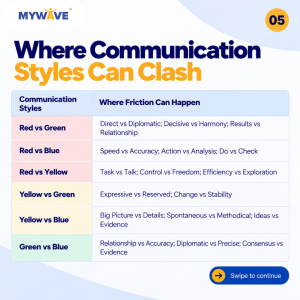
Each communication style tends to approach workplace situations differently.
Red values progress. Yellow values engagement. Green values harmony. Blue values clarity.
Because their priorities are different, certain combinations can naturally experience friction.
|
Communication Styles |
Where Friction Can Happen |
|
Red vs Green |
Direct vs Diplomatic; Decisive vs Harmony; Results vs Relationship |
|
Red vs Blue |
Speed vs Accuracy; Action vs Analysis; Do vs Check |
|
Red vs Yellow |
Task vs Talk; Control vs Freedom; Efficiency vs Exploration |
|
Yellow vs Green |
Expressive vs Reserved; Change vs Stability |
|
Yellow vs Blue |
Big Picture vs Details; Spontaneous vs Methodical; Ideas vs Evidence |
|
Green vs Blue |
Relationship vs Accuracy; Diplomatic vs Precise; Consensus vs Evidence |
For example, Red may want to act quickly while Blue wants to check the information first. Yellow may want freedom to explore ideas while Red is more focused on completing the task efficiently. Green may approach a conversation diplomatically, whereas Red may communicate the same point much more directly.
Recognising these differences is the first step towards adapting workplace communication.
How to Adapt Your Communication Style at Work
Adapting communication does not mean changing the objective of the conversation. It means thinking about the person receiving the message and adjusting how that message is delivered. There are three important steps.
1. Observe First
Start by recognising the communication style of the person you are speaking with. Look at how the person communicates and what appears to matter most to them. This can help you identify whether they are more focused on progress, engagement, harmony or certainty.
2. Package the Message
Once you recognise the other person’s communication style, tailor your delivery accordingly. The message itself may remain the same, but the way it is presented can change. A person who needs certainty, for example, may require clearer details than someone who is primarily focused on progress.
3. Listen Deeply
Communication is not only about delivering your own message. Listen carefully to understand what the other person truly needs. A useful way to remember these communication needs is:
Red needs progress. Yellow needs engagement. Green needs harmony. Blue needs certainty.
The following workplace situations demonstrate how this can work in practice.
Situation 1: A Red Manager Giving Feedback to a Green Employee
The Situation
A Green employee submits a report to a Red manager. The manager discovers that the report contains mistakes that need to be corrected. Because Red is naturally direct and focused on progress, the manager’s first response may be very straightforward.
Natural Response
“There are too many mistakes in this report. Improve your work and send it to me by this afternoon.”
The message communicates what needs to happen and when. However, Green is calm, supportive, and harmony-oriented, so the same instruction can be delivered differently.
Adapted Response
“Thanks for your effort. There are some things that need to change though, can you update it and get back to me by this afternoon? I would appreciate that.”
The task has not changed. The employee still needs to correct the report and return it that afternoon.
What changes are in the delivery. The adapted response acknowledges the employee’s effort before addressing the changes that need to be made, making the communication more suitable for someone who values harmony.
Situation 2: A Yellow Colleague Asking a Blue Colleague for Help
The Situation
A Yellow colleague wants to organise a company dinner and asks a Blue colleague for help. Yellow is naturally expressive and may be comfortable with an open-ended request.
Natural Response
“Hey there, I would love it if you could help me plan the company dinner sometime soon! You can go with the general dinners we usually have or be creative. Just have fun!”
For Blue, however, details and certainty matter. A broad request may not provide enough information about what is actually expected.
Adapted Response
“Hey there, I would love it if you could help me plan the company dinner! For a budget of RM30 per pax, can you work out maybe 2–3 venues by Friday? After that, we can discuss some activities.”
The adapted message gives the Blue colleague clearer parameters: RM30 per person, 2–3 venue options and a Friday deadline.
Instead of leaving the request completely open, Yellow packages the message with the additional detail Blue needs.
Situation 3: A Blue Colleague Addressing a Yellow Colleague Who Is Late
The Situation
A Blue colleague is waiting for a meeting scheduled for 2:00pm. The Yellow colleague arrives five minutes late. Because Blue values clarity and precision, the natural response may focus immediately on the agreed meeting time.
Natural Response
“The meeting is supposed to start at 2:00pm, why are you late?”
The concern remains valid, but the message can be adapted when communicating with Yellow, who values engagement.
Adapted Response
“Glad you made it. Next time, could you let us know if you’re running late? It helps everyone stay on track.”
The adapted response still addresses the problem. The Yellow colleague is asked to communicate when running late, but the message begins with engagement before addressing what should happen next time.
Situation 4: A Blue Colleague Asking a Red Manager for More Time
The Situation
A Red manager is eager to begin a project, but a Blue colleague believes the company should take a little more time to verify the data. This is a classic difference between the two styles: Red focuses on speed and action, while Blue focuses on accuracy and analysis.
Natural Response
“We need to wait first and make sure all the numbers are correct.”
For a Red manager focused on moving the project forward, simply being told to wait may not address their need for progress.
Adapted Response
“I’ve checked the numbers, but can you give me another 15 minutes? Once the numbers are correct, I’m sure the project will be successful.”
The Blue colleague still gets additional time to verify the numbers. However, the adapted response provides Red with something important: a clear timeframe for moving forward.
Rather than simply asking the manager to wait, the colleague explains that another 15 minutes is needed before the project can proceed.
Better Communication Starts with Understanding What Others Need
Adapting workplace communication does not mean abandoning your own communication style. It means recognising that the person receiving your message may communicate differently from you. Remember the three steps:
- Observe first to recognise the communication style.
- Package the message according to the person receiving it.
- Listen deeply to understand what they truly need.
Most importantly, keep the needs behind each style in mind: Red needs progress, Yellow needs engagement, Green needs harmony, and Blue needs certainty. Different communication styles can be a strength rather than a barrier when employees learn how to flex their communication and connect better with one another.
Conclusion
Better workplace collaboration starts with employees and managers understanding how different people communicate. When teams learn to recognise these differences and adapt appropriately, they are better equipped to communicate across different working styles.
As a trusted Malaysian HR & Workplace training provider, MYWave provides practical workplace training programmes that help organisations strengthen employee and managerial capabilities.




👉 Want to help your team communicate and collaborate more effectively?
Contact MYWave to explore our HR and workplace training programmes and find a suitable training programme for your organisation.
👉 For more information, reach out to us at: https://mywave.biz/contact-us/
📧 Or, through our email at: enquiry@mywave.biz