Annual leave and sick leave may be the employee leave categories employers deal with most often, but employees can require time away from work for many other reasons. An employee who serves as an officer of a trade union may need leave to carry out union duties. Others may need time away because of compassionate circumstances, marriage, bereavement, pilgrimage, or unexpected events such as floods, fires, and landslides.
For Malaysian employers, understanding these different leave situations helps HR teams establish clearer policies and manage employee absence more consistently.
Trade Union Leave Under Section 6 of the Industrial Relations Act 1967
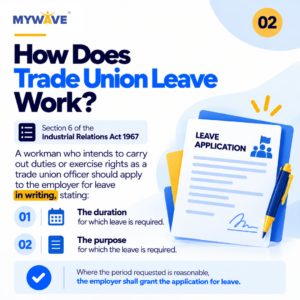
Section 6 of the Industrial Relations Act 1967 addresses leave for a workman who intends to carry out duties or exercise rights as an officer of a trade union. The workman should apply to the employer for leave in writing, stating:
- the duration for which leave is required; and
- the purpose for which the leave is required.
Where the period requested is reasonable, the employer shall grant the application for leave.
For employers, this provides a clear process for handling trade union leave. The employee should formally communicate why the leave is required and how long they expect to be away rather than treating the absence as an informal arrangement.
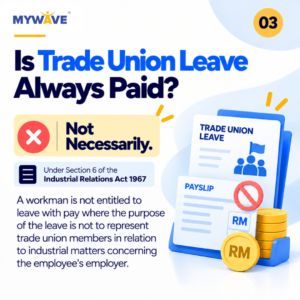
Is Trade Union Leave Always Paid?
Not necessarily.
Under Section 6 of the Industrial Relations Act 1967, a workman is not entitled to leave with pay where the purpose of the leave is not to represent members of the trade union in relation to industrial matters concerning the employee’s employer.
The purpose of the leave therefore matters when determining whether the employee is entitled to leave with pay. This is also why the written application should clearly state both the purpose and duration of the requested trade union leave.
Calculation of Wages for Incomplete Month’s Work
There are circumstances where a monthly-paid employee does not complete a full month of service. In such cases, employers need to determine the wages payable for that particular month correctly.
Under Section 18A(1) of the Employment Act 1955, notwithstanding Section 60I, an employee who is employed on a monthly rate of pay and has not completed a whole month of service shall be paid wages based on the prescribed calculation where:
- the employee commences employment after the first day of the month;
- the employee’s employment is terminated before the end of the month;
- the employee takes leave of absence without pay for one or more days of the month; or
- the employee takes leave of absence because they have been called up for national service under the National Service Act 1952 [Act 425], to present themselves for national service training as required under the National Service Training Act 2003 [Act 628], or to comply with any other written law relating to national service.
Formula for Calculating Wages for an Incomplete Month
Section 18A of the Employment Act 1955 provides the following formula for calculating the wages due for that month:
Monthly Wages ÷ Number of Days of the Particular Wage Period × Number of Days Eligible in the Wage Period
For example, the calculation can be expressed as:
Wages for incomplete month = (Monthly wages ÷ Number of days in the particular wage period) × Number of days eligible in the wage period
For Malaysian employers and HR teams, this formula is particularly relevant when handling new employees who join after the beginning of a month, employees whose employment ends before month-end, or employees who take unpaid leave during the month. Applying the appropriate calculation helps ensure that the employee’s wages for the incomplete month are calculated consistently with Section 18A of the Employment Act 1955.
Why Employers Need a Clear Trade Union Leave Process
Trade union leave should be properly distinguished from an employee’s other forms of leave. Employees who need leave to carry out their responsibilities as trade union officers should understand the application requirements. Managers and HR teams should similarly understand how these requests need to be handled. Maintaining proper records of the application, purpose, duration, and approval also gives HR a clearer record of why an employee was away from work.
Compassionate Leave and Other Special Leave in Malaysia
Employees may also experience personal circumstances that require time away from work outside their usual annual or sick leave arrangements. Companies may provide different categories of special leave to accommodate these situations. These can include:
- Compassionate leave
- Marriage leave
- Bereavement leave
- Pilgrimage leave
- Disaster leave
The specific conditions for these leave categories should be clearly addressed through the company’s applicable HR policies. Unlike trade union leave, where Section 6 of the Industrial Relations Act 1967 provides specific requirements, employers should avoid assuming that every type of special leave follows the same statutory rules.
Compassionate and Bereavement Leave
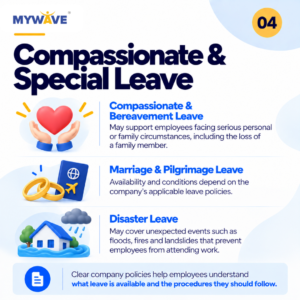
Compassionate and bereavement leave can become relevant when an employee faces serious personal or family circumstances, including the loss of a family member. Where an organisation provides these leave categories, having a clearly communicated company policy helps employees understand how such situations will be handled and what procedures they should follow when requesting leave. This also helps managers respond more consistently when employees face difficult personal circumstances.
Marriage and Pilgrimage Leave
Companies may also provide marriage leave and pilgrimage leave as part of their employee leave benefits. Because the exact entitlement and conditions can depend on the company’s applicable policies, employers should clearly communicate how these leave categories are administered. Employees should know whether these benefits are available to them and what procedures they need to follow when applying.
Disaster Leave for Unexpected Events
Unexpected events can sometimes make it difficult or impossible for an employee to attend work. Disaster leave may cover circumstances involving events such as:
- floods;
- fires; and
- landslides.
These situations can arise without warning, so companies that provide disaster leave should establish clear procedures for how employees should notify their employer and how such leave will be handled.
Conclusion
Trade union leave and compassionate or special leave may arise less frequently than annual and sick leave, but employers still need clear processes for handling them. The key is understanding which requirements are specifically provided by law and which leave benefits depend on the company’s own policies.
MYWave provides HR and payroll outsourcing services in Malaysia, helping businesses establish more structured HR administration and workforce management processes.
For Malaysian businesses looking for experienced HR support, contact MYWave to discuss how our HR, payroll, and workforce management solutions can support your organisation.

👉 Contact Us Now
 For more information, reach out to us at: https://mywave.biz/contact-us/
 Or, through our email at: enquiry@mywave.biz