Table of contents
- Performance Enablement: Creating the Right Conditions for Success
- Performance Monitoring: Why Regular Check-ins Matter
- A Practical Tip for Managers: Keep a Performance Notes Log
- Understanding the COIN-S Framework for Delivering Effective Feedback
- Simulate & Practice the COIN-S Framework with Your Team
- Common Workplace Feedback Scenarios and Recommended Responses
- Conclusion
- 👉 Contact Us Now!
Managing employee performance is not simply about evaluating results at the end of the year. The most effective managers understand that strong performance is built through continuous guidance, meaningful conversations, and consistent support. Rather than waiting for annual appraisals, they create an environment where employees know what is expected of them, receive timely feedback, and have opportunities to improve throughout the year.
Performance monitoring and feedback play a central role in this process. When managers regularly observe progress, discuss achievements, and address challenges early, employees are better equipped to stay aligned with organisational goals while continuously developing their skills and capabilities.
As one of Penang’s trusted HR and payroll outsourcing companies, MYWave believes that helping Malaysian businesses build stronger workplaces goes beyond providing HR and payroll solutions. Sharing practical HR knowledge and proven performance management practices is part of our commitment to helping organisations develop capable leaders and high-performing employees.
In this article, we explore how managers can use effective performance monitoring and feedback to create a culture of continuous employee development.
Performance Enablement: Creating the Right Conditions for Success
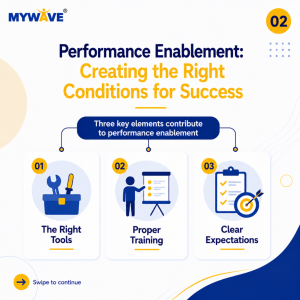
Before managers can evaluate performance fairly, employees must first be given the resources needed to perform well. This is where performance enablement becomes essential. Performance enablement focuses on creating the conditions that allow employees to succeed from the very beginning. Rather than expecting employees to perform without sufficient guidance, organisations should ensure they have the right support to carry out their responsibilities effectively.
Three key elements contribute to performance enablement:
The Right Tools
Employees need access to the systems, technology, and resources required to complete their work efficiently. When appropriate tools are available, employees can focus on delivering results instead of overcoming unnecessary operational challenges.
Proper Training
Even the best tools cannot produce good performance if employees do not know how to use them effectively. Continuous learning and development help employees build confidence while improving both their technical capabilities and workplace competencies.
Clear Expectations
Employees should have a clear understanding of what success looks like. When responsibilities, priorities, and performance expectations are communicated clearly, employees are more likely to remain focused and aligned with organisational objectives.
Performance monitoring becomes far more meaningful when employees have first been equipped with the necessary tools, training, and clarity to perform their roles successfully.
To ensure clarity at the start, the emplX system includes an Objective Acknowledgement feature that requires employees to review and digitally sign off on their KRAs and KPIs, preventing the ‘vague goals’ that often lead to planning failure.
Performance Monitoring: Why Regular Check-ins Matter
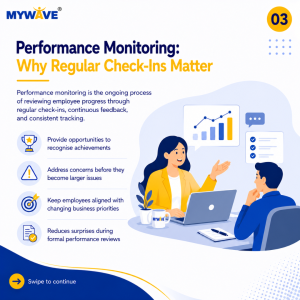
Performance monitoring is the ongoing process of reviewing employee progress through regular check-ins, continuous feedback, and consistent tracking. Rather than waiting until the end of the year to discuss performance, managers should schedule conversations throughout the year. These discussions provide opportunities to recognise achievements, address concerns before they become larger issues, and keep employees aligned with changing business priorities.
Regular monitoring also reduces surprises during formal performance reviews. Because performance has already been discussed throughout the year, review conversations become a summary of ongoing development instead of an attempt to recall events from months earlier. Consistent feedback allows employees to make timely improvements while reinforcing positive behaviours that contribute to both individual and organisational success.
A Practical Tip for Managers: Keep a Performance Notes Log
One of the biggest challenges managers face during performance reviews is remembering everything that happened over the past twelve months. Instead of relying on memory, managers can maintain a simple performance notes log throughout the year. Recording important observations as they happen creates a more balanced and objective picture of an employee’s overall performance.
A performance notes log does not need to be complicated. Managers can simply record important information such as:
- Notable achievements and accomplishments
- Feedback discussions that have taken place
- Improvement areas discussed
When it is time for a one-to-one discussion or formal performance review, these notes provide valuable context and help identify recurring themes rather than isolated incidents.
A conversation can then begin naturally with statements such as:
“Let’s reflect on the themes we’ve discussed throughout the year.”
This approach shifts the discussion away from trying to remember isolated events and instead focuses on consistent patterns of performance, development, and growth. It also encourages fairer and more meaningful performance conversations by ensuring feedback is based on observations gathered over time rather than recent events alone.
Understanding the COIN-S Framework for Delivering Effective Feedback
Providing feedback is one of the most important responsibilities of a manager, but it is also one of the most challenging. Many managers either avoid difficult conversations altogether or deliver feedback in a way that feels vague, overly critical, or personal. As a result, employees may become defensive, confused, or unsure about what they should improve.
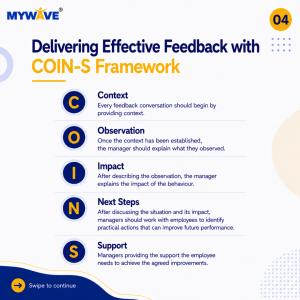
A structured approach helps make feedback more objective, constructive, and easier for employees to understand. One practical model that managers can use is the COIN-S Framework, which guides feedback conversations by focusing on observable behaviours, their impact, and the support needed for improvement.
Rather than criticising an individual, the framework encourages managers to discuss specific situations and work together on practical next steps.
**The COIN Feedback Model is a four-step framework designed by executive coach Anna Carroll in 2003 to structure constructive and positive conversations.
C – Context
Every feedback conversation should begin by providing context. This means clearly describing the specific situation where the behaviour occurred so both the manager and employee are discussing the same event. Without context, feedback can feel vague and leave employees wondering exactly what the manager is referring to. Providing context also helps reduce misunderstandings because it anchors the conversation to a real situation rather than general impressions.
O – Observation
Once the context has been established, the manager should explain what they observed. The emphasis here is on describing facts rather than making assumptions or personal judgments. Managers should focus on behaviours they directly witnessed instead of interpreting an employee’s intentions or attitude. Objective observations help employees understand what happened without feeling personally criticised.
I – Impact
After describing the observation, the manager explains the impact of the behaviour. Employees often understand what they did but may not realise how their actions affected customers, colleagues, projects, or the organisation. Explaining the consequences helps employees understand why the behaviour matters and why improvement is important.
N – Next Steps
Constructive feedback should always look forward rather than dwelling on the past. After discussing the situation and its impact, managers should work with employees to identify practical actions that can improve future performance. The focus is not on assigning blame but on agreeing on realistic and achievable improvements.
S – Support
The final step of the COIN-S Framework reminds managers that employee development is a shared responsibility. Managers should ask what support the employee needs to achieve the agreed improvements. Sometimes employees require additional coaching, training, resources, or simply more regular guidance. Providing support reinforces that feedback is intended to help employees succeed rather than simply evaluate their performance. By ending the conversation with support, managers demonstrate their commitment to helping employees improve while building trust and encouraging continuous development.
Bringing the COIN-S Framework Together
The strength of the COIN-S Framework lies in its logical flow. Instead of giving feedback based on opinions or emotions, managers guide employees through a structured conversation that explains the situation, describes the behaviour, discusses its impact, identifies improvements, and offers support.
Simulate & Practice the COIN-S Framework with Your Team
One of the best ways to become comfortable with giving feedback is through practice. Managers and employees can use a simple role-playing activity to develop confidence in applying the COIN-S Framework in real workplace conversations.
Each practice session involves three roles:
- One person acts as the appraiser, who prepares a piece of feedback they would like to deliver. They may briefly explain the background of the situation before beginning the conversation.
- One person acts as the appraisee, responding naturally while asking questions where further clarification is needed.
- The remaining participants become observers, using the table checklist below to evaluate how effectively the feedback was delivered and providing constructive feedback to the appraiser after each session.
| Focus Areas | Observation Points |
| Facial expression | Smile/fierce/unapproachable/etc. |
| Voice | Pace/pitch/soft/mumbled/monotonous/etc. |
| Words | Vague/no clarity/choice of words/too abrupt/etc. |
| Overall | What was done well/what needs improvement |
To maximise learning, each group should complete at least two practice rounds, allowing different participants to take turns acting as the appraiser and appraisee. This gives everyone an opportunity to experience both giving and receiving feedback while learning from the observations shared by others.
These practice sessions create a safe environment where managers can refine their communication skills before applying the COIN-S Framework in real performance discussions.
Common Workplace Feedback Scenarios and Recommended Responses
Different workplace situations require different approaches to feedback. While the COIN-S Framework provides a consistent structure for delivering feedback, managers should also adapt their communication style based on the employee’s performance or behaviour.
The following examples illustrate common workplace scenarios and the type of feedback managers can provide. These examples help managers recognise when to reinforce positive performance, coach employees towards improvement, or address inappropriate behaviours constructively.
| No. | Performance/Behavior Related Feedback | Scenario & Focus Area |
| 1 | Missed Deadlines |
Scenario: An employee consistently submits reports late. Feedback: Highlight the impact on team timelines and suggest strategies for better time management. |
| 2 | High-Quality Work |
Scenario: A staff member delivers a project with exceptional detail and accuracy. Feedback: Recognize their strengths and encourage them to share best practices with peers. |
| 3 | Lack of Initiative |
Scenario: An employee waits for instructions instead of proactively solving problems. Feedback: Encourage ownership of tasks and provide examples of where initiative could add value. |
| 4 | Improved Performance |
Scenario: A team member who previously struggled has shown noticeable progress. Feedback: Acknowledge the improvement, reinforce the behaviors that led to success, and motivate continued growth. |
| 5 | Skill Gaps |
Scenario: An employee struggles with a new software tool. Feedback: Point out the gap constructively and recommend training or mentoring support. |
| 6 | Disruptive in Meetings |
Scenario: A team member frequently interrupts others. Feedback: Address the behavior respectfully, emphasizing the importance of listening and collaborative dialogue. |
| 7 | Positive Team Spirit |
Scenario: An employee consistently supports colleagues and boosts morale. Feedback: Recognize their contribution to team culture and encourage them to keep modeling this behavior. |
| 8 | Unprofessional Communication |
Scenario: An employee uses informal or inappropriate language in emails. Feedback: Explain the importance of professional tone and provide examples of better phrasing. |
| 9 | Resistance to Change |
Scenario: A staff member openly resists new processes or systems. Feedback: Explore their concerns, explain the rationale behind the change, and encourage adaptability. |
| 10 | Conflict with Colleagues |
Scenario: Two employees have ongoing tension that affects collaboration. Feedback: Address the issue privately, focusing on respectful communication and problem-solving. |
Conclusion
At MYWave, we believe effective performance management extends far beyond annual appraisals. It is about creating a workplace where employees receive continuous guidance, managers are equipped with practical leadership skills, and organisations establish systems that encourage long-term growth.
As one of Penang’s leading HR and payroll outsourcing companies, MYWave is committed to helping Malaysian businesses stay informed about the latest HR practices, employment trends, and workforce management strategies. Sharing practical HR knowledge such as performance monitoring and feedback is part of our ongoing commitment to helping employers build more capable managers and engaged employees.
Whether your organisation is strengthening its performance management framework, improving employee development practices, or looking for trusted HR and payroll outsourcing support, MYWave is ready to help.
👉 Contact Us Now!
Contact our team to discover how our HR expertise, payroll solutions, and workforce management services can support your organisation’s long-term success.
👉 For more information, reach out to us at: https://mywave.biz/contact-us/
📧 Or, through our email at: enquiry@mywave.biz