Table of contents
- Annual Leave Entitlement in Malaysia Under Section 60E(1) of the Employment Act 1955
- Annual Leave for Employees Who Have Not Completed 12 Months of Service
- When Employee Absence Can Affect Annual Leave Entitlement
- How Unpaid Leave Can Affect Length of Service for Annual Leave
- Payment in Lieu of Annual Leave Under Section 60E(2) of the Employment Act 1955
- Annual Leave Upon Termination Under Section 60E(2A) of the Employment Act 1955
- What Is Emergency Leave in Malaysia?
- Is Unpaid Leave an Employee Entitlement in Malaysia?
- Annual Leave, Emergency Leave and Unpaid Leave Should Be Managed Differently
- MYWave's Perspective on Effective Employee Leave Management
- Need Support Managing Employee Leave and HR Processes in Malaysia?
Leave management may appear straightforward until an employer has to deal with situations that fall outside a normal annual leave request.
How many days of annual leave is an employee entitled to in Malaysia? What happens when an employee has not completed 12 months of service? Can annual leave be converted into payment? What happens when an employee suddenly needs emergency leave? And is unpaid leave automatically available after an employee has exhausted their annual leave?
These distinctions matter because annual leave, emergency leave, and unpaid leave should not be treated in the same way. For Malaysian employers and HR teams, understanding these differences helps establish clearer leave policies and more consistent HR practices. Employees also benefit from understanding their annual leave entitlement and when other types of leave may depend on the employer’s approval.
As an experienced HR and payroll agency in Malaysia, MYWave believes good HR management starts with employers having a clear understanding of the employment requirements and HR practices affecting their workforce. Employee leave management is an important part of that responsibility.
Annual Leave Entitlement in Malaysia Under Section 60E(1) of the Employment Act 1955
Annual leave is an important employee entitlement in Malaysia.
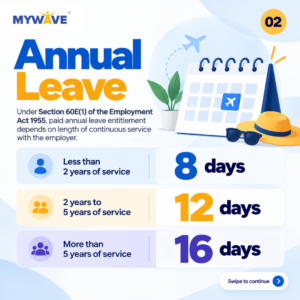
Under Section 60E(1) of the Employment Act 1955, employees are entitled to paid annual leave based on their length of continuous service with the employer.
| Length of Service | Annual Leave Entitlement |
| Less than 2 years of service | 8 days |
| 2 years to 5 years of service | 12 days |
| More than 5 years of service | 16 days |
This means an employee’s annual leave entitlement increases according to their length of service.
For employers, maintaining accurate employment and leave records is therefore important. Annual leave should not simply be treated as a fixed number of days applied uniformly to every employee without considering the employee’s period of service.
Annual Leave for Employees Who Have Not Completed 12 Months of Service
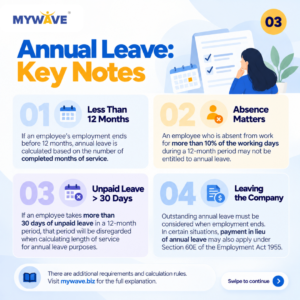
Section 60E(1) of the Employment Act 1955 also addresses annual leave where an employee has not completed 12 months of service during the year in which the employee’s contract terminates. In this situation, the employee’s annual leave entitlement is calculated in direct proportion to the number of completed months of service.
There is also a specific treatment for fractions of a day arising from the calculation.
If the calculated fraction of annual leave is less than half a day, the fraction is disregarded. If the fraction is one-half of a day or more, the leave is deemed to be one full day. This is particularly relevant when HR departments need to determine the annual leave entitlement of an employee whose employment ends before a full 12 months of service have been completed.
Rather than estimating the employee’s remaining annual leave, employers should ensure that the entitlement is calculated based on the applicable rules.
When Employee Absence Can Affect Annual Leave Entitlement
Another important provision under Section 60E(1) of the Employment Act 1955 concerns absence from work. An employee who is absent from work for more than 10% of the working days during the period of 12 months of continuous service shall not be entitled to annual leave.
For employers, accurate attendance and leave records are therefore important when determining annual leave entitlement. HR teams should maintain proper records of employee attendance, approved leave and other absences so that annual leave calculations can be managed consistently.
How Unpaid Leave Can Affect Length of Service for Annual Leave
Unpaid leave can also affect the calculation of an employee’s length of service for annual leave purposes.
Under Section 60E(1) of the Employment Act 1955, if an employee takes unpaid leave during a period of 12 months for more than 30 days, that period shall be disregarded when computing the employee’s length of service with the employer for the purposes of this section.
This is important because unpaid leave involves an employee taking time away from work without wages. Where the period exceeds the threshold stated above, it can also affect the calculation of length of service for annual leave purposes.
Employers should therefore maintain accurate unpaid leave records alongside their normal annual leave records.
Payment in Lieu of Annual Leave Under Section 60E(2) of the Employment Act 1955
There are circumstances where an employee may receive payment instead of taking annual leave.
Under Section 60E(2) of the Employment Act 1955, where the employer requests the employee not to take their annual leave and the employee agrees in writing not to take the leave, the employee is entitled to payment in lieu of that annual leave.
The requirement for the employee’s agreement to be in writing is an important part of this arrangement. Employers should therefore avoid treating payment in lieu of annual leave as an informal verbal arrangement. Proper documentation helps establish that the employee agreed not to take the annual leave at the employer’s request.
Annual Leave Upon Termination Under Section 60E(2A) of the Employment Act 1955
Termination of employment creates another important annual leave consideration.
Under Section 60E(2A) of the Employment Act 1955, upon termination of an employee’s contract of service, the employee shall be entitled to take their annual leave entitlement before the termination takes place.
For HR departments, outstanding annual leave should therefore be considered when an employee’s contract of service is coming to an end.
Maintaining accurate leave records throughout the employee’s service makes this process significantly easier because HR can determine the employee’s remaining annual leave entitlement without having to reconstruct the employee’s leave history at the point of termination.
What Is Emergency Leave in Malaysia?
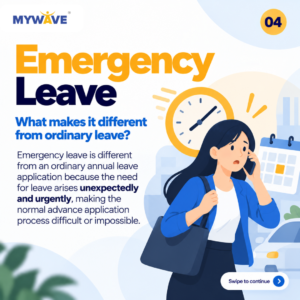
Emergency leave is different from an ordinary annual leave application because the need to take leave arises urgently. Emergency leave may be granted to employees who need to go on leave urgently because of an important matter and cannot comply with the company’s normal requirement to apply for leave two or three days in advance.
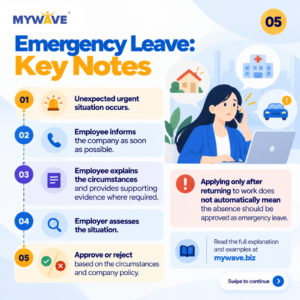
The important consideration is that simply describing an absence as an “emergency” does not mean the leave should automatically be approved. Before approving an emergency leave application, the employee should be asked to explain why emergency leave is required. The employer can then consider whether the circumstances justify the employee’s need to take emergency leave.
When Should Emergency Leave Be Approved?
Employers should approve emergency leave after the employee has justified the need to take leave urgently. For example, the employee may be dealing with an urgent matter that prevented them from following the normal advance leave application procedure.
This allows employers to distinguish genuine emergencies from situations where an employee simply failed to follow the company’s normal leave procedures. Having a clear emergency leave policy can also help employees understand what is expected when an unexpected situation occurs.
Employees should know how they are expected to notify the company, who they need to contact, and what information or supporting evidence may be required.
What If an Employee Applies for Emergency Leave After Being Absent?
A more difficult situation occurs when an employee fails to turn up for work and only applies for emergency leave after returning to work the following day.
In such circumstances, the employee should be able to provide proof that the absence resulted from an urgent and important matter that was unforeseen and could not be avoided.
The employer can assess the explanation and supporting evidence before deciding whether the emergency leave application should be approved.
If the reasons provided are not acceptable, the company may reject the emergency leave application and treat the employee as absent. Disciplinary action may also be taken against the employee.
For employers, the key is to have a clear and consistently applied procedure rather than making decisions without first considering the circumstances behind the employee’s absence.
Is Unpaid Leave an Employee Entitlement in Malaysia?
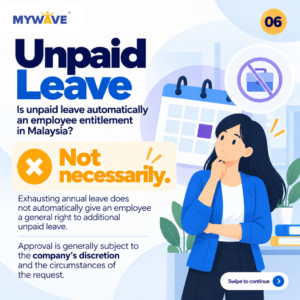
Unpaid leave should not be treated in the same way as statutory annual leave. There is no such general unpaid leave benefit under the law simply because an employee has exhausted their annual leave entitlement.
This distinction is important for both employers and employees.
An employee who has used all available annual leave should not automatically assume that additional leave can simply be taken as unpaid leave. Instead, whether unpaid leave is granted is generally at the company’s discretion and should be considered on a case-by-case basis.
When Should Unpaid Leave Be Granted?
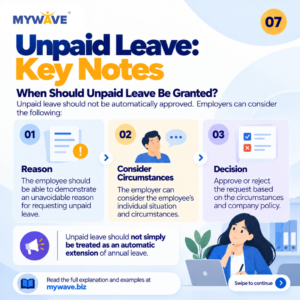
Unpaid leave should not automatically be approved simply because an employee has exhausted their annual leave entitlement. The employee should be able to demonstrate that there is an unavoidable reason for requesting unpaid leave.
The employer can then consider the circumstances before deciding whether the request should be approved. This approach allows employers to manage unpaid leave based on individual circumstances rather than treating it as an automatic extension of an employee’s annual leave entitlement.
A clear company policy on unpaid leave can also help employees understand that approval is discretionary and that exhausting annual leave does not automatically create an entitlement to additional unpaid leave.
Leave Due To Imprisonment S 23, Employment Act, 1955
Employee cannot claim wages from employer:
- For the period he/she is detained by police
- Period spent going to or returning from prison or place of custody
- Period sentenced to imprisonment
- Attending Court case unless attending as witness of employer
Annual Leave, Emergency Leave and Unpaid Leave Should Be Managed Differently
One of the most important lessons for Malaysian employers is that annual leave, emergency leave and unpaid leave should not simply be grouped and managed in the same way.
- Annual leave is governed by the employee’s statutory entitlement under Section 60E(1) of the Employment Act 1955, together with related provisions such as Section 60E(2) of the Employment Act 1955 on payment in lieu and Section 60E(2A) of the Employment Act 1955 concerning annual leave upon termination.
- Emergency leave deals with situations where an employee needs to take leave urgently because of an important and unforeseen matter and cannot follow the company’s normal advance application procedure.
- Unpaid leave, meanwhile, is not something that should automatically be granted because an employee has exhausted annual leave. Approval is at the company’s discretion and should be considered based on the circumstances of each case.
Understanding these differences allows employers to develop clearer policies and helps employees understand what is expected when requesting different types of leave.
MYWave’s Perspective on Effective Employee Leave Management
Many employee leave problems are not caused by the number of days an employee is entitled to. They arise because company policies, approval procedures and employee expectations are unclear. Employers should therefore distinguish between statutory leave entitlements and leave arrangements that depend on company approval.
Annual leave records should accurately reflect an employee’s length of service and leave taken. Emergency leave procedures should make clear what employees need to do when unforeseen circumstances prevent them from following normal application procedures. Unpaid leave should be considered consistently rather than automatically granted after annual leave has been exhausted.
For companies managing larger or more complex workforces, these distinctions become increasingly important. Inconsistent leave practices can create unnecessary administrative difficulties for HR teams and confusion among employees.
As an established HR and payroll agency in Malaysia, MYWave supports Malaysian businesses with HR outsourcing, payroll outsourcing, HR consultancy, and workforce management solutions. By combining local HR and payroll expertise with practical HR technology, MYWave helps businesses establish more structured and manageable HR processes.
Need Support Managing Employee Leave and HR Processes in Malaysia?
Managing employee leave effectively requires more than recording how many days an employee takes off work. Employers need clear HR policies, accurate employee records, and consistent procedures for handling different types of leave.
For businesses without the internal resources or expertise to manage these responsibilities efficiently, MYWave provides HR and payroll outsourcing services in Malaysia backed by experienced local HR and payroll support.
MYWave also provides emplX, a cloud HR and payroll solution designed to help businesses manage their workforce through a more structured digital HR environment.
Whether your organisation needs support with HR administration, payroll outsourcing, or HR technology, contact MYWave to discuss how our HR and payroll solutions can support your business.

👉 Contact Us Now
 For more information, reach out to us at: https://mywave.biz/contact-us/
 Or, through our email at: enquiry@mywave.biz