Table of contents
- Employee Sick Leave Entitlement Under Section 60F(1)(a) of the Employment Act 1955
- Medical Examination Under Section 60F(1)(b) of the Employment Act 1955
- Hospitalisation Leave Under Section 60F(1)(bb) of the Employment Act 1955
- Dental Sick Leave Under Section 60F(1A) of the Employment Act 1955
- When Can an Employee on Sick Leave Be Deemed Absent?
- When Is an Employee Not Entitled to Sick Leave Under Section 60F(4) of the Employment Act 1955?
- How Does SOCSO Leave Work?
- Fake Medical Certificates Are a Serious Misconduct Issue
- What Is Prolonged Illness Leave in Malaysia?
- Sick Leave Management Is More Than Counting MC Days
- Conclusion
Managing employee sick leave is not simply a matter of receiving a medical certificate and recording a day away from work.
Malaysian employers need to understand how sick leave entitlement changes according to an employee’s length of service, when hospitalisation leave applies, how dental sick leave is treated, what happens when an employee fails to inform the company about their absence, and how situations involving SOCSO leave should be handled.
There is also a more difficult side of sick leave management. What should an employer do if there is reason to believe that a medical certificate is fake? And what happens when an employee suffers from a serious illness requiring a much longer recovery period?
These situations require employers to distinguish between statutory sick leave entitlements, misconduct involving fake medical certificates, SOCSO-related absence, and additional benefits that a company may choose to provide on compassionate grounds.
As an experienced HR and payroll agency in Malaysia, MYWave believes effective sick leave management requires both a proper understanding of Malaysian employment requirements and a reliable process for administering employee leave. When those two elements work together, employers can manage absence more consistently while maintaining accurate HR records.
Employee Sick Leave Entitlement Under Section 60F(1)(a) of the Employment Act 1955
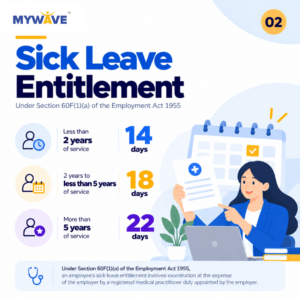
Under Section 60F(1)(a) of the Employment Act 1955, an employee’s sick leave entitlement involves examination at the expense of the employer by a registered medical practitioner duly appointed by the employer.
The number of paid sick leave days an employee is entitled to in each calendar year depends on the employee’s length of service:
|
Length of Service |
Sick Leave Entitlement |
|
Less than 2 years of service |
14 days |
|
2 years to less than 5 years of service |
18 days |
|
More than 5 years of service |
22 days |
For employers, this makes accurate employee records important. Sick leave entitlement should be administered according to the employee’s applicable length of service rather than using the same entitlement for every employee.
It also highlights why leave administration should not rely solely on spreadsheets, emails or individual HR staff remembering how much leave an employee has taken.
A digital leave management system such as emplX e-Leave can support this administrative process by calculating leave balances based on company policies and giving supervisors visibility into employee leave balances. Employees can also use its self-service functionality to submit leave applications, upload attachments, and track their leave status.
Medical Examination Under Section 60F(1)(b) of the Employment Act 1955
There may be situations where the employer has not appointed a registered medical practitioner or where the appointed medical practitioner is not reasonably available.
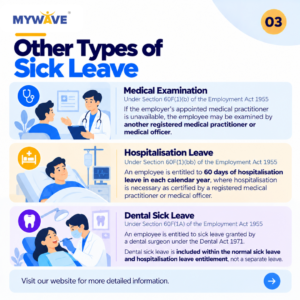
Under Section 60F(1)(b) of the Employment Act 1955, where no registered medical practitioner has been appointed by the employer, or where the nature or circumstances of the illness mean the services of the appointed medical practitioner cannot be obtained within a reasonable time or distance, examination may be carried out by another registered medical practitioner or medical officer.
This is an important consideration when managing employee medical leave because illness does not always occur at a time or place where the employer’s appointed medical practitioner is readily accessible.
Employers should therefore ensure their sick leave procedures are clear enough for employees to understand what they need to do when they become ill and how the relevant medical documentation should be submitted.
Hospitalisation Leave Under Section 60F(1)(bb) of the Employment Act 1955
Sick leave becomes more significant when an employee’s medical condition requires hospitalisation.
Under Section 60F(1)(bb) of the Employment Act 1955, an employee is entitled to 60 days of hospitalisation leave in each calendar year where hospitalisation is necessary as certified by a registered medical practitioner or medical officer.
An important point is that the employee does not necessarily have to be physically admitted to a hospital for the situation to be treated as hospitalisation for the purposes of this provision.
Where a registered medical practitioner or medical officer certifies that the employee is sufficiently ill to require hospitalisation, but the employee is not hospitalised for any reason, the employee is deemed to be hospitalised for the purposes of the section.
For HR teams, this makes proper medical documentation and leave records particularly important. Hospitalisation leave should not simply be determined based on whether an employee physically stayed in a hospital.
Dental Sick Leave Under Section 60F(1A) of the Employment Act 1955
Medical leave is not limited to certification from a medical practitioner.
Under Section 60F(1A) of the Employment Act 1955, an employee is entitled to sick leave granted by a dental surgeon as defined under the Dental Act 1971.
Dental sick leave is included within the normal sick leave and hospitalisation leave entitlement, rather than being treated as a completely separate additional leave entitlement.
For employers, the practical issue is therefore maintaining an accurate overall record of the employee’s sick leave usage regardless of whether the leave originated from medical or dental treatment.
When Can an Employee on Sick Leave Be Deemed Absent?
Having a medical condition does not remove the employee’s responsibility to properly inform the employer about their absence.
Under Section 60F(2) of the Employment Act 1955, an employee who is absent on sick leave can be deemed to have absented themselves from work without the employer’s permission and without reasonable excuse where the sick leave is not certified by a registered medical practitioner, medical officer or dental surgeon.
The same issue can arise even when the sick leave is medically certified if the employee fails to inform or attempt to inform the employer of the sick leave within 48 hours from its commencement.
This distinction is important.
An employee may genuinely be sick and possess medical certification, but proper communication with the employer remains part of managing the absence. Companies should therefore establish clear procedures explaining how employees are expected to notify their supervisor or HR department and how supporting documents such as medical certificates should be submitted.
This is another area where digital leave administration can reduce unnecessary gaps in communication. With emplX e-Leave, employees can submit leave applications and attachments through employee self-service, while the system routes leave applications through the relevant approval workflow and allows employees to track their status.
When Is an Employee Not Entitled to Sick Leave Under Section 60F(4) of the Employment Act 1955?
There are also circumstances where an employee is not entitled to sick leave. Under Section 60F(4) of the Employment Act 1955, an employee is not entitled to paid sick leave for a period during which the employee is:
- on maternity leave;
- receiving temporary disablement benefit under the Workmen’s Compensation Act 1952; or
- receiving temporary disablement benefit from SOCSO.
This becomes particularly relevant when an employee’s absence involves an accident or temporary disablement rather than an ordinary period of sickness.
Employers should therefore understand the reason behind an employee’s absence instead of automatically processing every medically related absence under the company’s normal sick leave category.
How Does SOCSO Leave Work?
SOCSO-related absence needs to be distinguished from ordinary employee sick leave. An employee may be entitled to paid SOCSO leave where an accident occurs at the workplace, while coming to work or going home after work, or while going for lunch or returning to the workplace after lunch.
Where an employee is on SOCSO leave for more than four days, the employee will receive temporary disablement benefits from SOCSO. During that period, the company is not required to pay wages or grant the employee sick leave.
This connects directly with Section 60F(4) of the Employment Act 1955, which addresses periods where an employee is receiving temporary disablement benefits from SOCSO.
Fake Medical Certificates Are a Serious Misconduct Issue
Sick leave administration becomes much more serious when there is reason to believe an employee has submitted a fake medical certificate.
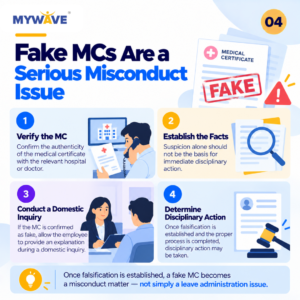
Submitting a fake medical certificate to support an absence is considered serious misconduct. However, suspicion alone should not become the basis for immediately taking disciplinary action against an employee.
The employer should first confirm with the relevant hospital or doctor that the medical certificate is fake before proceeding with disciplinary action. This verification step matters because employers need to establish whether the medical certificate is genuinely falsified rather than relying on assumptions about its authenticity. Once the medical certificate has been confirmed as fake, a domestic inquiry should be carried out to allow the employee to provide an explanation before disciplinary action is taken.
The distinction is important: managing fake sick leave is not simply a leave administration issue. Once falsification is established, it becomes a misconduct matter requiring an appropriate disciplinary process.
What Can Employers Learn From Malaysia Airline Systems Bhd v Ibrahim Abdul Hamid?
The seriousness of submitting a false medical certificate can be seen in Malaysia Airline Systems Bhd v Ibrahim Abdul Hamid, Award No. 1650/2013.
The case involved a Security Officer who relied on a medical certificate that had been obtained without him seeing a doctor.
The employee claimed that he believed the medical certificate to be genuine and properly issued by Putrajaya Hospital. However, he admitted that he had not actually seen a doctor and that he had been told by a worker at the hospital that a medical certificate could be obtained without consulting one.
The Court considered the seriousness of the misconduct together with the nature of the employee’s position, which required a high level of integrity.
Although the employee was a first-time offender and had served the company for 15 years, the Court found that the company had just cause or excuse to dismiss him because of the severity of the misconduct.
For employers, the lesson is not that every questionable medical certificate should automatically result in dismissal. The important point is that falsification of a medical certificate can constitute serious misconduct, and the circumstances surrounding the misconduct matter when disciplinary action is considered.
Employers Should Verify a Suspected Fake MC Before Taking Action
When employers suspect a fake MC in Malaysia, the response should therefore be structured rather than immediate. The first priority is establishing whether the medical certificate is actually fake. The employer should confirm its authenticity with the hospital or doctor concerned.
If the medical certificate is confirmed to be falsified, the employee should be given an opportunity to explain the circumstances through a domestic inquiry before disciplinary action is taken. This protects the integrity of the company’s disciplinary process and ensures that decisions are made based on verified information rather than suspicion.
Good record-keeping also matters. Leave applications, supporting attachments, approval records, and reasons for leave decisions should be kept systematically rather than scattered across different emails or paper forms. The emplX e-Leave module supports attachment uploads, leave-status tracking, approval workflows, and recorded reasons for rejected leave applications, helping employers maintain a more structured leave administration process.
What Is Prolonged Illness Leave in Malaysia?
Not every serious medical condition can be managed within the normal pattern of short-term sick leave. Some employees may experience illnesses that require significantly longer periods of treatment and recovery.
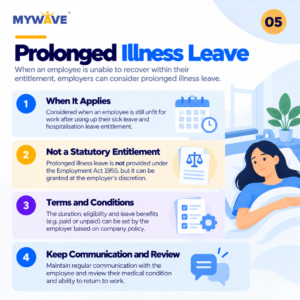
Prolonged illness leave is not a requirement under the law. Instead, it is a benefit that may be granted by an employer on compassionate grounds where an employee is suffering from a serious illness of a prolonged nature. Examples of serious prolonged illnesses include:
- cancer;
- tuberculosis;
- paralysis;
- polio;
- leukemia; and
- leprosy.
The important distinction is that prolonged illness leave should not be confused with statutory sick leave entitlement.
While normal sick leave and hospitalisation leave are addressed under Section 60F of the Employment Act 1955, prolonged illness leave is an additional benefit that a company may choose to provide on compassionate grounds.
Why Companies Need Clear Policies for Prolonged Illness
Because prolonged illness leave is not a statutory requirement, employers that choose to provide such a benefit should make their internal approach clear.
Serious long-term illness can create difficult situations for both the employee and the employer. The employee may require substantial time away from work, while the organisation still needs to manage staffing, workload and leave administration.
Clear internal policies can help HR teams handle these situations more consistently rather than making completely different decisions each time an employee experiences a prolonged illness.
For companies that provide additional leave categories beyond statutory requirements, a configurable leave-management system can also help translate those policies into day-to-day administration. emplX e-Leave supports different leave types, configurable approval processes, leave balances, and company leave calendars, allowing HR teams to manage different categories of employee leave within the same environment.
Sick Leave Management Is More Than Counting MC Days
For Malaysian employers, effective sick leave management involves much more than counting the number of medical certificates an employee submits. HR teams need to understand an employee’s sick leave entitlement based on length of service, recognise when hospitalisation and dental sick leave apply, ensure employees comply with notification requirements, distinguish SOCSO-related absence from ordinary sick leave, and know how to respond when a medical certificate may have been falsified.
Prolonged illness creates another layer because companies may decide to provide additional support beyond statutory sick leave requirements.
When these situations are handled through unclear policies or fragmented records, misunderstandings become much more likely. The stronger approach is to combine clear HR policies, accurate employee records, appropriate approval procedures, and reliable leave-management processes.
Conclusion
Sick leave can quickly become complicated when employers need to manage different entitlements, medical documentation, SOCSO-related absence, potential misconduct and prolonged illness while keeping employee records accurate.
MYWave supports Malaysian businesses through HR and payroll outsourcing, HR consultancy and cloud HR technology, helping companies establish more structured HR processes while reducing the administrative burden on internal teams.
For businesses looking to digitalise leave administration, emplX e-Leave provides a centralized environment for leave applications, supporting attachments, approval workflows, leave balances, calendars, reporting and employee self-service. Its integration with other emplX modules also allows leave to operate as part of a broader HR and payroll ecosystem rather than as an isolated process.
For Malaysian businesses that want stronger control over employee leave administration and broader HR and payroll processes, contact MYWave to explore how our HR expertise and emplX cloud HR solutions can support your organisation.
👉 Contact Us Now
 For more information, reach out to us at: https://mywave.biz/contact-us/
 Or, through our email at: enquiry@mywave.biz