Table of contents
- The Two Essential Processes in Performance Review and Evaluation
- Preparing Employees Before a Performance Review
- What Should Employees Prepare Beforehand?
- What & How to Review
- Conducting a Performance Review: A Practical Case Study
- A Simple Framework for Writing Performance Conclusions
- Process Recap
- Conclusion
- 👉 Contact Us Now!
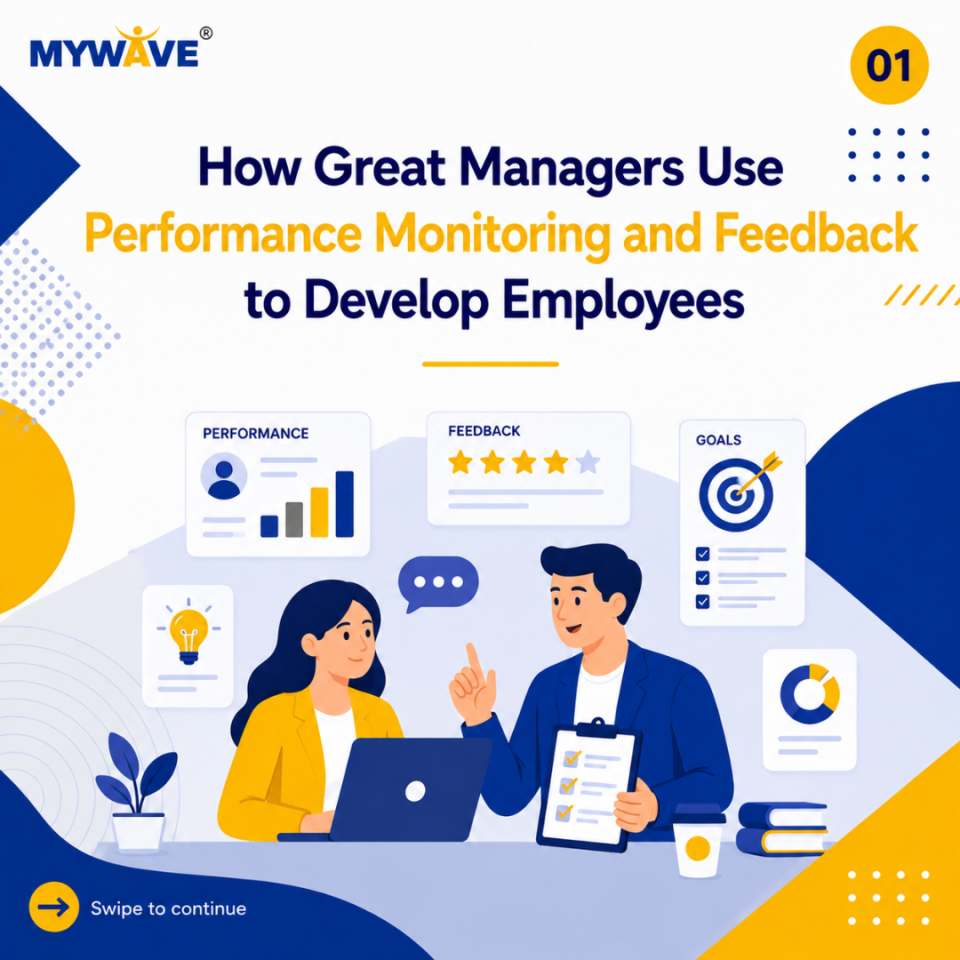
Performance reviews are one of the most important conversations managers have with their employees. When conducted well, they provide an opportunity to recognise achievements, identify areas for development, and establish clear expectations for future performance. When conducted poorly, however, they often become uncomfortable meetings that leave employees feeling uncertain, demotivated, or misunderstood.
Many organisations invest significant effort into setting performance goals and monitoring progress throughout the year, yet the review itself is sometimes treated as little more than completing an evaluation form. An effective performance review should never be reduced to a paperwork exercise. Instead, it should be a structured evaluation process built on evidence, role expectations, and meaningful dialogue.
As one of Penang’s leading HR and payroll specialists, MYWave believes that helping Malaysian businesses build stronger performance management practices is just as important as delivering reliable HR and payroll outsourcing services. Sharing practical HR knowledge is part of our commitment to helping organisations develop capable managers, engaged employees, and high-performing workplaces.
This article explores one of those essential HR topics: how managers can conduct effective performance reviews and evaluations using a structured and objective approach.
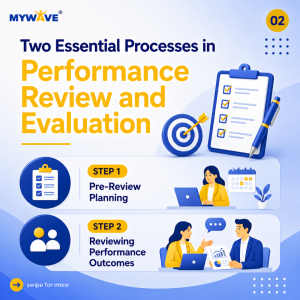
The Two Essential Processes in Performance Review and Evaluation
An effective performance review consists of two distinct processes:
- Step 1: Pre-Review Planning
- Step 2: Reviewing Performance Outcomes
Although closely connected, each process serves a different purpose and contributes to a fairer, more meaningful evaluation.
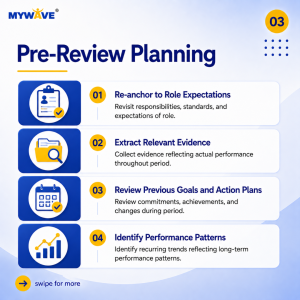
Step 1: Pre-Review Planning
Before any discussion takes place, managers should invest time in understanding the employee’s overall performance over the review period. This preparation helps ensure the review focuses on evidence rather than assumptions. Pre-review planning involves several important activities.
Re-anchor to Role Expectations
Performance should always be evaluated against the employee’s actual role expectations. Rather than comparing employees with one another, managers should revisit the responsibilities, standards, and expectations associated with the employee’s position. This creates a consistent benchmark for assessing whether performance meets the requirements of the role.
Extract Relevant Evidence
Performance discussions become much more objective when they are supported by evidence. Managers should collect information that reflects the employee’s actual performance throughout the review period instead of relying solely on recent experiences or general impressions. Evidence may include completed work, measurable results, behavioural observations, and documented achievements.
Managers can leverage emplX to perform different types of assessment, including 360-degree, peer, and self-evaluations, which provide the qualitative data necessary to identify recurring behavioral patterns. By using system-defined ratings and auto-calculated scores based on agreed KPI weightages, managers can formulate a Balanced Performance Conclusion that is objective, verifiable, and free from common evaluation biases.
Review Previous Goals and Action Plans
An effective performance review should revisit the commitments that were previously agreed upon. Managers should review:
- What was committed
- What was achieved
- What changed during the review period
Looking back at prior goals allows both manager and employee to understand progress over time instead of evaluating performance in isolation.
Identify Performance Patterns
Individual incidents rarely provide a complete picture of an employee’s performance. Instead, managers should look for recurring trends that indicate consistent strengths, recurring challenges, or development opportunities. Identifying patterns allows performance conclusions to reflect long-term behaviour rather than isolated successes or setbacks.
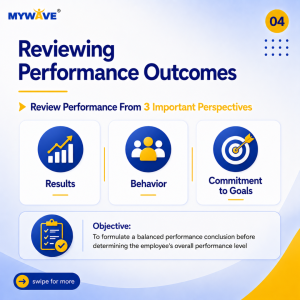
Step 2: Reviewing Performance Outcomes
Once preparation has been completed, managers can begin evaluating the employee’s overall performance. This stage focuses on understanding not only what results were achieved, but also how those results were delivered. Managers should review performance from three important perspectives:
- Results
- Behaviour
- Commitment to goals
The objective is to formulate a balanced performance conclusion before determining the employee’s overall performance level. A structured evaluation ensures that performance ratings are supported by evidence rather than personal opinion.
Preparing Employees Before a Performance Review
Preparation should not be limited to managers alone. Employees also benefit from taking time to reflect on their own performance before the review discussion begins. Simply emailing an evaluation form immediately before the meeting rarely encourages meaningful reflection.
Instead, employees should be encouraged to think critically about their experiences throughout the review period, including both successes and challenges.
Allowing employees to prepare promotes more productive conversations because they arrive ready to discuss accomplishments, obstacles, and future development instead of responding to questions on the spot.
What Should Employees Prepare Beforehand?
Before attending a performance review, employees should spend time evaluating their own performance honestly and objectively.
This self-reflection helps employees organise their thoughts while providing valuable insights that may not be immediately visible through performance data alone.
One useful reflection method is the Rose, Thorn, Bud self-preparation exercise.
The Rose, Thorn, Bud Self-Preparation Exercise
This simple reflection framework encourages employees to evaluate their performance from three different perspectives.
Rose – What’s Going Well?
The “Rose” focuses on positive outcomes achieved during the review period.
Employees should reflect on:
- Successes
- Accomplishments
- Highlights
This helps identify areas where the employee has performed well and contributed positively to the organisation.
Thorn – What’s Not Working?
The “Thorn” encourages honest reflection on current challenges.
Employees should consider:
- Challenges
- Pain points
- Areas where support is needed
Discussing these openly allows managers to better understand obstacles that may be affecting performance.
Bud – What Could I Try?
The “Bud” focuses on future growth and development.
Employees should think about:
- Potential improvements
- New opportunities
- Ideas for learning
- Skills they would like to develop
This shifts the conversation beyond past performance and towards future development.
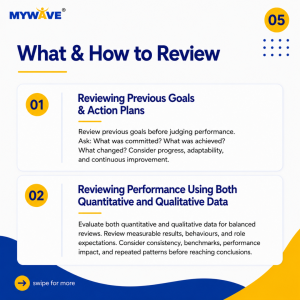
What & How to Review
Reviewing Previous Goals and Action Plans
A meaningful review should always begin by looking back at the employee’s role expectations, prior year goals, and action plans before forming conclusions about current performance. This ensures the discussion remains objective and anchored to commitments that were established earlier, rather than being influenced by recent events or personal impressions.
Managers should revisit three key questions throughout this review process:
- What was committed?
- What was achieved?
- What changed?
These questions create a structured way to assess progress while recognising that circumstances may have evolved throughout the review period. Rather than focusing solely on whether a goal was completed, managers should also understand how the employee approached their responsibilities, adapted to changing situations, and demonstrated commitment to continuous improvement.
Reviewing Performance Using Both Quantitative and Qualitative Data
Effective performance evaluations require more than measurable results alone. Some aspects of performance can be objectively measured through numbers, while others are better understood by observing behaviours, decision-making, and professional conduct over time. For this reason, managers should evaluate both quantitative data and qualitative data before reaching any performance conclusion.
Using both forms of data creates a more balanced assessment and reduces the likelihood of overlooking important aspects of an employee’s contribution.
Quantitative Data
Quantitative data refers to measurable or objective performance outcomes. When reviewing quantitative data, managers should consider several important questions.
- Was the performance sustained throughout the full year?
- Was the performance appropriate for the employee’s role?
- Is the performance being compared against the correct benchmark?
Qualitative Data
Professional behaviour, judgement, communication, adaptability, and teamwork often require observation over time before meaningful conclusions can be drawn. When reviewing qualitative data, managers should ask several key questions.
- Was this a repeated pattern or an isolated incident?
- Did the behaviour affect performance outcomes?
- Was the behaviour aligned with role expectations?
Conducting a Performance Review: A Practical Case Study
To illustrate the review process, consider the following employee.
| Employee Information | |
| Name | Ms. Nur Izzati |
| Role | Administrative Officer (Student Services) |
| Tenure | 1 year |
Reviewing Role Expectations, Previous Goals, and Performance Outcomes
The first step is to revisit what was expected of the employee before evaluating actual performance. Managers should compare the employee’s performance against their role expectations, previously agreed goals, action plans, and documented outcomes. This ensures that performance discussions remain objective and linked to established expectations rather than personal opinions.
| Category | Performance Information |
| Role Expectations | • Maintain record accuracy ≥95%
• Handle routine student enquiries independently • Support events with minimal supervision • Demonstrate professional service behavior |
| Prior Year Goals (2025) | • Maintain 95% accuracy in student records
• Improve confidence in handling difficult enquiries • Support 3 major faculty events without supervision • Complete internal systems certification |
| Prior Action Plan (2025) | • Weekly review of record entries
• Role-play sessions with supervisor • Assigned lead role for 1 small event • Online certification modules |
| Performance Outcomes | Results
• Accuracy at 96% • Escalates complex cases quickly • Supported 2 major events (target 3) • Service-oriented and receptive to feedback Behaviors • Polite and service-oriented • Hesitant under pressure • Highly receptive to feedback |
| Areas Requiring Manager Judgment | • Meets baseline technical expectations
• Confidence and independence still developing • Potential vs current performance distinction |
The employee’s previous SMART goals also provide valuable context when reviewing overall performance.
Previous SMART Goals
- Student Records Accuracy
By the end of each quarterly audit in 2025, I will achieve and sustain at least 95% accuracy in student records, as measured by internal compliance checks.
- Confidence in Difficult Enquiries
By Sept 2025, I will complete two enquiry-handling workshops and demonstrate improved confidence in at least 80% of difficult enquiries, as evidenced by supervisor feedback and self-assessment surveys.
- Independent Event Support
By Jan 2026, I will independently plan and execute three major faculty events, with successful delivery confirmed through post-event evaluations showing no need for supervision.
- Internal Systems Certification
By Dec 2025, I will complete all required modules and obtain internal systems certification, demonstrating proficiency in organizational systems.
Step 1: Pre-Review Planning
Before meeting with the employee, managers should organise the available evidence and identify any patterns that require further discussion. The purpose of this stage is not to determine the final performance rating immediately. Instead, it helps managers extract meaningful evidence, ask the right questions, and identify where additional clarification may be needed.
The following example demonstrates how this planning process can be carried out.
| Focus Area | Evidence Extracted | Clarifying Questions | Key Insight |
| Accuracy ≥95% | Achieved 96% | Is this sustained or recent? | Meets standard |
| Handle enquiries independently | Escalates complex cases quickly | Are these moderately complex or high-risk cases? | Independence still developing |
| Event support | Supported 2 of 3 events | What level of supervision was required? | Partial target achievement |
| Service behaviour | Polite, receptive to feedback | Any complaints? Any pattern of issues? | Behavior aligned |
From this review, two important observations emerge:
- Performance patterns identified through quantitative and qualitative data
- Surface-level evidence is available, but we need better clarity
These insights help managers prepare for a more focused and constructive discussion during the performance review meeting.
Reviewing Quantitative Evidence
The manager then evaluates measurable performance outcomes against the employee’s previous goals.
| Goals | Evidence | Why It Is Quantitative |
| To maintain ≥95% accuracy | 96% record accuracy | Percentage-based metric |
| To support 3 events | Supported 2 major events (target 3) | Countable output |
| To complete certification | Completed internal systems certification | Modular output |
| To handle routine enquiries independently | Escalates X% of complex enquiries (if tracked) | Measurable frequency |
What this tells us:
- She met accuracy standard.
- She partially met event support goal.
- She achieved certification requirement.
- Objective and verifiable evidence is available to support the review.
Reviewing Qualitative Evidence
Performance reviews should not rely solely on measurable outcomes. Managers should also assess behavioural patterns that influence how work is performed. The following table illustrates how qualitative evidence can be evaluated.
| Role Expectation | Evidence | Why It Is Qualitative |
| To demonstrate professional service behavior | Polite and service-oriented | Observed behaviour |
| To be independent in handling enquiries | Hesitant under pressure | Behavioural pattern |
| There is growth potential | Receptive to feedback | Development attitude |
| To display confidence & judgment | Escalates cases quickly | Pattern of decision behaviour |
What this tells us:
- Her conduct aligns with service standards.
- Confidence is still developing.
- A positive growth mindset is present.
Combining quantitative and qualitative evidence provides managers with a much more complete understanding of performance than relying on numbers alone.
Step 2: Review Performance Outcome
Once all evidence has been analysed, managers can begin forming an overall assessment.
Rather than assigning a performance level based on a single metric, the manager integrates the available evidence into a balanced review.
| Focus Area | Assessment | Supporting Evidence |
| Results | Mostly achieved | Accuracy met; events partially met |
| Behaviour | Strong alignment | Service-oriented, receptive |
| Commitment to Prior Goals | Partial improvement | Certification completed; confidence improving |
This assessment summarises the employee’s overall performance while ensuring that each conclusion is supported by documented evidence.
Drafting the Performance Conclusion
After reviewing all available information, the manager can prepare a structured performance conclusion.
Draft Performance Conclusion
“Nur Izzati delivers reliable and accurate administrative support and maintains a consistently professional service standard. She meets role expectations in core responsibilities. The key development priority is strengthening her confidence and decision-making in moderately complex cases, which will be essential for her progression to full independence next year.”
Final Rating: Meets Expectations
A Simple Framework for Writing Performance Conclusions
An effective performance conclusion should follow a consistent structure.
Strength + Standard + Gap + Forward Expectation
[Employee] demonstrates [clear strength] and consistently meets [core role standard]. The primary development area is [specific gap]. In the next cycle, the expectation is [forward shift].
This framework helps managers produce balanced performance summaries that recognise achievements while providing clear direction for future development.
Process Recap
An effective performance review follows a logical and structured sequence from preparation through to future planning.
The overall process can be summarised as follows:
- Start with role expectations and past year’s goals/action plans
- Extract evidence
- Integrate all outcomes
- Formulate a structured conclusion
- Set future goals (new or linking back from Review portion)
- Translate goals into actionable steps
Following this structured approach allows managers to conduct performance reviews that are evidence-based, objective, and focused on continuous employee development rather than simply assigning a performance rating.
Conclusion
An effective performance review is not defined by the final performance rating, but by the quality of the process that leads to that decision. When managers begin by revisiting role expectations, reviewing previous goals and action plans, gathering both quantitative and qualitative evidence, and formulating a structured performance conclusion, performance evaluations become more objective, consistent, and meaningful for everyone involved.
The structured approach covered in this guide demonstrates that performance reviews are more than annual appraisal meetings. They are opportunities to recognise employee strengths, identify development areas, provide constructive feedback, and establish clear expectations for the next performance cycle. By following a systematic review process, managers can ensure that performance discussions are based on evidence rather than assumptions, creating greater trust and supporting continuous employee growth.
If your organisation is looking to improve its performance management process or requires professional HR and payroll support, MYWave is ready to help. From HR outsourcing and payroll outsourcing services to cloud HRMS solutions that simplify performance management and workforce administration, our team works closely with Malaysian businesses to build efficient, compliant, and people-focused HR operations.

👉 Contact Us Now!
Contact MYWave today to discover how we can support your organisation’s long-term growth through better HR management.
👉 For more information, reach out to us at: https://mywave.biz/contact-us/
📧 Or, through our email at: enquiry@mywave.biz