Many organisations invest significant time in setting goals, conducting performance reviews, and providing employee feedback. Yet despite these efforts, employee performance often remains stagnant. The reason is simple: performance management does not end with feedback. The real value comes from what managers do after feedback has been given.
Rewarding employees who consistently perform well, addressing underperformance promptly, and turning feedback into meaningful development opportunities are what truly reinforce positive behaviours and encourage continuous improvement. Without these actions, even the best performance management process loses its effectiveness.
As one of Penang’s leading HR and payroll specialists, MYWave is committed to helping Malaysian businesses stay informed on important HR practices that strengthen both organisational performance and employee development. This article is part of our ongoing HR knowledge-sharing series designed to help businesses build stronger, higher-performing workforces.
Learn how Malaysian managers can reward high performers, manage poor performance, and turn feedback into employee development plans for lasting business success.
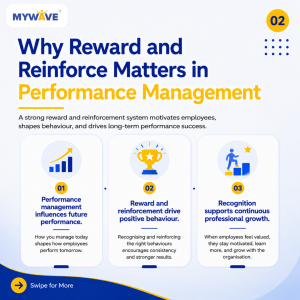
Why Reward and Reinforce Matters in Performance Management
Performance management is not simply about measuring results. It is about influencing future performance. Employees naturally observe how organisations respond to good and poor performance. When outstanding contributions receive little recognition, high performers may begin to question whether their efforts are truly valued. Likewise, when underperformance goes unaddressed, employees may conclude that performance expectations are optional rather than essential.
Reward and reinforcement ensure that performance conversations lead to action. They encourage employees to continue positive behaviours, correct performance issues early, and create opportunities for continuous professional growth.
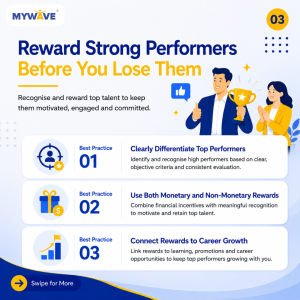
1. Reward Strong Performers Before You Lose Them
One of the biggest mistakes organisations make is assuming that top performers will remain motivated simply because they have always delivered excellent results. In reality, consistently high-performing employees often have the highest expectations for personal growth and career progression. When they feel overlooked or treated the same as everyone else, they may become disengaged or seek opportunities elsewhere.
Three common mistakes contribute to this problem:
- Organisations focus almost entirely on financial rewards.
- Recognition is delayed until annual performance reviews.
- All high performers receive identical treatment regardless of their contributions.
The result is predictable: talented employees lose motivation or eventually leave the organisation.
Best Practice 1: Clearly Differentiate Top Performers
Not every employee delivers the same level of contribution. Managers should ensure that the organisation’s highest-performing employees (Top 10-20%) feel genuinely recognised for their achievements. Rather than creating a culture where everyone is considered “above average,” organisations should clearly distinguish those who consistently deliver exceptional performance.
The goal is not to discourage other employees, but to ensure that outstanding performance is visibly appreciated.
To differentiate Top Performers effectively, HR administrators can use emplX’s Data Export and Graph features to visually identify top talent and analyze performance scores across the entire company. Our HR Calibration tool further ensures fairness and consistency, helping managers align ratings during calibration sessions to manage bias risks.
Best Practice 2: Use Both Monetary and Non-Monetary Rewards
While salary increments and bonuses remain important, they should not be the only forms of recognition. A balanced reward approach may include:
|
Monetary Rewards |
|
|
Non-Monetary Rewards |
|
Different employees value different forms of recognition. Providing a combination of financial and non-financial rewards helps organisations recognise contributions more meaningfully.
Best Practice 3: Connect Rewards to Career Growth
Recognition should extend beyond thanking employees for their current performance.
High performers often look for opportunities to expand their skills, take on greater responsibilities, and advance their careers. Providing growth opportunities demonstrates that the organisation values their long-term development, not just their immediate output.
One important reality every manager should remember is this: If you don’t actively grow your top performers, someone else will.
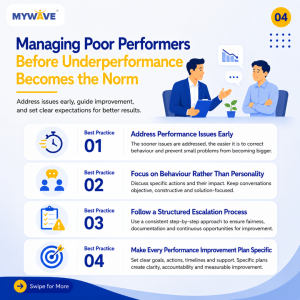
2. Managing Poor Performers Before Underperformance Becomes the Norm
Poor performance rarely improves on its own.
Many organisations struggle with underperformance because managers delay difficult conversations, postpone feedback until formal appraisals, or fail to establish a structured improvement process. Over time, underperformance becomes normalised, making it increasingly difficult to restore accountability.
Effective managers address performance concerns early while there is still an opportunity for improvement.
Best Practice 1: Address Performance Issues Early
Performance discussions should take place within days or weeks after an issue occurs, not several months later during annual reviews. Timely feedback helps employees understand expectations while the situation remains fresh, making improvement more achievable. Waiting too long often allows small problems to develop into larger performance issues.
Best Practice 2: Focus on Behaviour Rather Than Personality
Constructive feedback should always address observable actions instead of personal characteristics.
Instead of saying:
“You are careless.”
A manager should focus on the specific behaviour:
“The report had three data errors.”
This approach keeps the conversation objective, reduces defensiveness, and provides employees with clear guidance on what needs improvement.
Best Practice 3: Follow a Structured Escalation Process
When performance does not improve after initial feedback, organisations should adopt a structured intervention process. A typical progression includes:
Step 1: Coaching conversation
Step 2: Resetting clear performance expectations
Step 3: Implementing a Performance Improvement Plan (PIP)
Using a consistent process promotes fairness while giving employees a clear pathway towards improvement.
Best Practice 4: Make Every Performance Improvement Plan Specific
A Performance Improvement Plan (PIP) should never be treated as a punishment.
Instead, it provides employees with clear expectations, measurable objectives, and defined support to help them succeed.
An effective PIP should include:
- Clear performance goals
- A defined timeline (for example, 30 to 60 days)
- Support that will be provided
- The consequences if expectations are not achieved
The purpose of a PIP is clarity, not punishment.
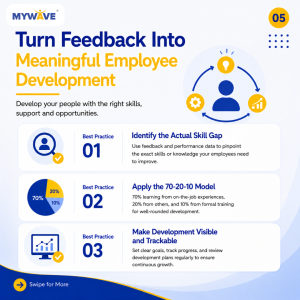
3. Turn Feedback Into Meaningful Employee Development
Best Practice 1: Identify the Actual Skill Gap
Instead of using broad feedback statements, managers should define the exact capabilities employees need to strengthen. For example, “Needs better communication” could become:
- Presentation skills
- Stakeholder management
- Data storytelling
Specific skill gaps make development plans significantly more practical and measurable.
Best Practice 2: Apply the 70-20-10 Model
A simple and practical approach to employee development is the 70-20-10 Model, which balances workplace experience, guidance from others, and formal learning.
Key Components of the 70-20-10 Model:
|
70% – Experiential Learning (Experience) |
Employees learn through daily work, stretch assignments, solving problems, taking on new responsibilities, and learning from mistakes. |
|
20% – Social Learning (Exposure) |
Development takes place through mentoring, coaching, feedback, collaboration with colleagues, networking, and observing experienced role models. |
|
10% – Formal Learning (Education) |
Employees build foundational knowledge through structured training, workshops, e-learning programmes, and professional certifications before applying those skills in the workplace. |
Rather than relying solely on classroom training, this model encourages learning through real workplace experience while reinforcing development with coaching and formal education.
Best Practice 3: Make Development Visible and Trackable
Development plans should not be forgotten after the performance review. Managers should:
- Set clear milestones.
- Review progress during regular check-ins.
Finally, emplX allows managers to capture development plans directly within the system. This ensures that milestones are visible and trackable during regular check-ins, guaranteeing that feedback is successfully transferred into measurable professional growth.
Conclusion
Rewarding and reinforcing employee performance is one of the most important stages of any performance management process. Recognising top performers, addressing underperformance early, and translating feedback into structured development plans create an environment where employees understand what success looks like and how they can continue improving.
When these practices are consistently applied, organisations are better positioned to retain high-performing employees, improve overall workforce capability, and foster a culture of continuous learning and accountability.
At MYWave, we are committed to helping Malaysian businesses navigate every aspect of HR management through practical insights, professional HR expertise, and comprehensive HR and payroll outsourcing solutions. By sharing HR knowledge such as this, we aim to empower business leaders and managers with the tools they need to build stronger, more engaged, and higher-performing teams.
If your organisation is looking to strengthen its HR practices or streamline HR and payroll operations, MYWave is ready to support your business with solutions tailored to your workforce needs.
👉 Contact Us Now!
Contact our team to discover how our HR expertise, payroll solutions, and workforce management services can support your organisation’s long-term success.
👉 For more information, reach out to us at: https://mywave.biz/contact-us/
📧 Or, through our email at: enquiry@mywave.biz