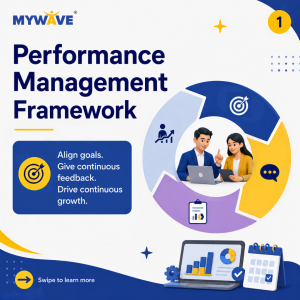
Employee performance does not improve simply by conducting an annual appraisal. Sustainable business growth comes from having a structured performance management framework that helps employees understand expectations, receive ongoing feedback, and continuously develop their capabilities. Performance management is not a one-time event. It is an ongoing process that connects business objectives with individual employee performance, allowing organisations to remain proactive, adaptable, and focused on continuous improvement.
At MYWave, we believe one of the responsibilities of a trusted HR and payroll partner is to help Malaysian business owners stay informed about the latest HR practices, workforce strategies, and compliance developments. As one of Penang’s leading HR and payroll outsourcing companies, MYWave regularly shares practical HR knowledge that helps businesses strengthen their people management practices while focusing on business growth.
In this blog, we’ll explore what performance management is, how an effective performance management framework works, the continuous performance management cycle, and the respective roles of HR and line managers throughout the process.
What Is Performance Management?
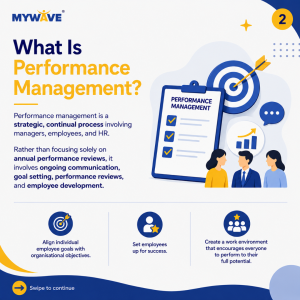
Performance management is a strategic, continual process involving managers, employees, and HR. Rather than focusing solely on annual performance reviews, performance management involves ongoing communication about expectations, responsibilities, goal setting, performance reviews, and employee development strategies.
The objective is to:
- Align individual employee goals with organisational objectives.
- Set employees up for success.
- Create a work environment that encourages everyone to perform to their full potential.
When implemented consistently, performance management becomes part of everyday business operations instead of a yearly administrative exercise.
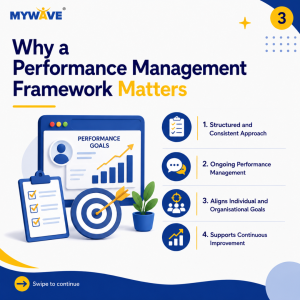
Why a Performance Management Framework Matters
A performance management framework provides organisations with a structured and consistent approach to managing employee performance throughout the entire employment journey. Rather than relying solely on annual performance appraisals to measure results, it establishes an ongoing process that keeps employees, managers, and HR aligned on expectations, progress, and development.
By embedding regular goal-setting, continuous conversations, timely feedback, and objective performance evaluations into everyday operations, organisations are better equipped to respond to changing business priorities while supporting employee growth. Performance becomes something that is actively managed throughout the year instead of being reviewed only after outcomes have already been achieved.
This structured approach also strengthens the connection between individual contributions and organisational objectives. Employees gain greater clarity about what is expected of them, managers have more opportunities to provide guidance and coaching, and HR can ensure that performance decisions are made consistently and based on measurable outcomes. At the same time, organisations are able to recognise high performers, identify performance gaps earlier, and translate feedback into meaningful development plans that support continuous improvement.
Ultimately, a well-designed performance management framework creates a culture where performance is continuously monitored, reviewed, and developed, helping both employees and the organisation move towards shared goals.
Understanding the Performance Management Framework: A Continuous Cycle
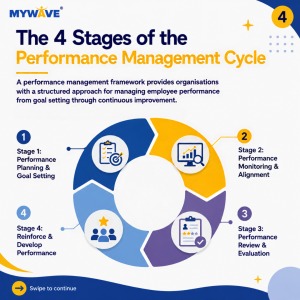
A performance management framework provides organisations with a structured approach for managing employee performance from goal setting through continuous improvement. Rather than viewing performance management as separate activities, the framework connects each stage into a complete process where every phase builds upon the previous one. The framework consists of four interconnected stages:
- Stage 1: Performance Planning & Goal Setting
- Stage 2: Performance Monitoring & Alignment
- Stage 3: Performance Review & Evaluation
- Stage 4: Reinforce & Develop Performance
These stages work together as a continuous cycle that supports both organisational objectives and employee growth.
Stage 1: Performance Planning & Goal Setting
Every successful performance management process begins with careful planning. Before employees can perform effectively, they need a clear understanding of what is expected of them and how success will be measured.
During this stage, managers and employees work together to establish performance goals and identify the success indicators that will be used to evaluate progress. Rather than relying on broad or subjective expectations, goals should be quantifiable, measurable, and time-bound so employees have clear direction from the outset.
Planning also provides an opportunity to introduce stretch assignments and action plans that encourage employees to expand their capabilities while contributing to organisational objectives. These additional responsibilities not only support employee development but also prepare individuals for greater responsibilities in the future.
When planning is completed thoroughly, employees begin the performance cycle with clarity, confidence, and a shared understanding of expectations.
Stage 2: Performance Monitoring & Alignment
Setting goals is only the beginning of effective performance management. Once objectives have been established, managers play an ongoing role in helping employees remain focused and aligned throughout the performance period.
Performance monitoring involves regularly tracking progress rather than waiting until the end of the review cycle. As priorities evolve, managers should continuously monitor performance, identify changes that require realignment, and provide the support employees need to remain successful.
Feedback and coaching are essential components of this stage. Instead of limiting conversations to formal reviews, managers should provide timely guidance that enables employees to overcome challenges, improve performance, and stay aligned with changing business needs.
This continuous interaction allows organisations to respond proactively rather than reactively, ensuring employee performance remains connected to organisational priorities even as business conditions evolve.
Stage 3: Performance Review & Evaluation
Performance reviews provide an opportunity to evaluate outcomes against the goals established earlier in the process. Because expectations have already been communicated and progress has been monitored throughout the cycle, evaluations become evidence-based discussions rather than subjective opinions.
During this stage, managers review performance outcomes and differentiate performance based on measurable evidence. Clear differentiation helps ensure employees understand how their performance has been assessed while maintaining consistency across the organisation.
Where applicable, performance ratings provide a structured way of recognising varying levels of achievement. More importantly, the evaluation process provides employees with meaningful insights into both their accomplishments and the areas where further development may be beneficial.
A fair and transparent evaluation process strengthens employee confidence while supporting better decision-making throughout the organisation.
Stage 4: Reinforce & Develop Performance
Performance management should never conclude once evaluations have been completed. The final stage of the framework focuses on reinforcing positive performance while creating opportunities for continuous employee development.
Employees who consistently demonstrate strong performance should be recognised and rewarded appropriately. Recognition reinforces desired behaviours and encourages continued excellence across the organisation.
At the same time, organisations must also address situations where performance falls below expectations. Rather than treating poor performance as the end of the conversation, managers should use feedback to guide improvement and support future development.
The insights gathered throughout the performance review should ultimately be transferred into meaningful development plans. This ensures that feedback becomes actionable, helping employees continue growing while preparing for the next performance cycle.
Why the Performance Management Cycle Should Be Continuous, Proactive, and Adaptive
An effective performance management framework is not a one-time event but a continuous, proactive, and adaptive process. Rather than relying solely on annual performance reviews, organisations should continuously plan, monitor, evaluate, and develop employee performance throughout the year. This ongoing approach allows managers to provide timely feedback, address challenges early, and ensure employees remain aligned with changing business priorities. As a result, employees receive consistent guidance and support instead of waiting until the end of the review period to understand how they are performing.
The performance management cycle consists of four interconnected stages: Plan & Set Goals, Monitor & Feedback, Review & Evaluate, and Develop & Reward. Each stage builds upon the previous one, creating a continuous cycle of improvement rather than a linear process. Employees begin with clearly defined goals, receive regular coaching and feedback as they work towards those objectives, have their performance evaluated based on measurable outcomes, and use the feedback to support their ongoing development. By continuously moving through these stages, organisations create a culture of continuous improvement where employee growth and business objectives remain closely aligned.
Assessing Your Organisation’s Goals and Needs Before Developing a Performance Management Framework
Before implementing a performance management framework, organisations should first develop a clear understanding of their business goals and the outcomes they hope to achieve. Every organisation has its own priorities, challenges, and ways of operating, which means there is no one-size-fits-all approach to performance management. A framework should be designed to support the organisation’s unique needs rather than simply introducing another administrative process.
Understand Your Organisation’s Goals and Assess Existing Practices
The starting point is to understand what the organisation wants to achieve, as well as the challenges and priorities that influence its direction. At the same time, organisations should evaluate their existing performance management practices to determine how effective they are and identify areas where improvements may be needed. By understanding both the organisation’s strategic objectives and the effectiveness of its current processes, businesses can establish a stronger foundation for a performance management framework that supports long-term organisational success.
Co-Create a Performance Management Framework That Fits the Business
Rather than adopting a generic approach, organisations should co-create a performance management framework that aligns with their business objectives and operating requirements. This begins with clearly defining the organisation’s goals and determining how those objectives should cascade across departments and individual employees. The framework should also establish SMART goals, identify the relevant Key Results Area (KRA), and define the Key Performance Indicators (KPI) that will be used to measure each objective. By creating clear links between business goals and individual performance expectations, employees gain a better understanding of how their contributions support the organisation’s overall success.
Define Roles, Responsibilities, and Areas of Influence
An effective performance management framework also requires clearly defined roles and responsibilities. Line managers should be empowered to take accountability for managing employee performance, providing guidance, and supporting continuous improvement throughout the performance cycle. At the same time, employees should take ownership of their own development by actively participating in goal setting, performance discussions, and personal growth. When accountability is clearly defined across the organisation, performance management becomes a collaborative process where HR, managers, and employees work together towards shared organisational goals.
HR and Line Managers’ Roles in Performance Management
A successful performance management framework is built on collaboration between HR and line managers. While both parties share the common objective of improving employee performance and helping the organisation achieve its business goals, their responsibilities are different throughout each stage of the performance management process.
HR is primarily responsible for designing the framework, providing governance, ensuring consistency, and equipping managers with the necessary tools and guidance. Line managers, on the other hand, are responsible for putting the framework into practice through regular communication, coaching, monitoring, evaluation, and employee development.
When both HR and line managers understand and fulfil their respective responsibilities, performance management becomes a shared organisational effort rather than an HR-driven exercise.
|
Performance Management Stage |
HR’s Role |
Line Manager’s Role |
|
Planning |
• Design KRA & KPI framework • Provide goal-setting templates • Align goals with business strategy • Train managers on goal setting • Review goal quality and consistency |
• Set individual KRAs and KPIs • Align team goals with business objectives • Clarify performance expectations • Agree on goals with employees |
|
Enablement |
• Design competency framework • Provide learning and development programmes • Train managers on coaching and feedback • Provide supporting tools and resources |
• Coach employees regularly • Identify skill gaps • Support employee development • Remove performance barriers |
|
Monitoring |
• Provide performance tracking systems • Define check-in cadence • Monitor completion of check-ins • Analyse performance trends |
• Conduct regular check-ins • Provide real-time feedback • Track KPI progress • Adjust priorities where necessary |
|
Evaluation |
• Design rating framework • Facilitate calibration sessions • Ensure fairness and consistency • Minimise evaluation bias • Ensure proper documentation |
• Evaluate performance against KPIs • Provide evidence-based ratings • Justify performance ratings • Communicate review outcomes |
|
Action |
• Design reward and Performance Improvement Plan (PIP) framework • Provide development plan guidelines • Advise on complex performance cases • Ensure compliance and fairness • Track promotion and exit outcomes |
• Recommend bonuses and promotions • Develop employee development plans • Initiate and manage PIPs • Provide continuous coaching • Make retention or exit recommendations |
Conclusion
Performance management is often misunderstood as a yearly administrative exercise, when in reality it is an ongoing business process that influences employee engagement, productivity, and organisational success. A well-designed framework provides employees with clear direction, supports managers in developing their teams, and helps organisations maintain alignment between individual performance and business objectives.
At MYWave, we believe that empowering Malaysian businesses goes beyond providing HR and payroll outsourcing services. As one of Penang’s leading HR and payroll outsourcing companies, we are committed to sharing practical HR knowledge, industry best practices, and workforce management insights that help employers strengthen their people management strategies. By keeping businesses informed about evolving HR frameworks and approaches, we aim to support organisations in building high-performing teams that contribute to sustainable business growth.
Whether an organisation is reviewing its existing performance management practices or developing a new framework, establishing clear expectations, encouraging continuous feedback, and supporting employee development remain fundamental to creating a successful performance management culture.
👉 Looking to enhance your HR processes or explore professional HR and payroll outsourcing solutions?
MYWave is ready to support! Contact MYWave here: https://mywave.biz/contact-us/