Singapore’s workforce policies continue to evolve toward stronger family support. One key initiative employers must understand is the Singapore Government Paid Paternity Leave (GPPL), a government-funded scheme designed to support working fathers while maintaining business continuity.
This guide breaks down what GPPL means for employers, including eligibility, entitlements, compliance requirements, and operational impact.
What is Singapore Government Paid Paternity Leave (GPPL)?
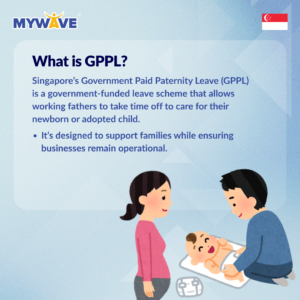
Singapore Government Paid Paternity Leave (GPPL) is a government initiative that provides paid leave to eligible working fathers—ensuring they can care for their newborn or adopted child.
Purpose of GPPL
- Supports fathers in early-stage childcare responsibilities
- Encourages shared parental responsibility
- Promotes stronger family structures while maintaining workforce participation
Key point for employers:
GPPL is fully funded by the government, meaning employers are reimbursed for the leave granted (subject to caps).
GPPL Eligibility Criteria
Employers must first determine whether an employee qualifies under the Singapore Government Paid Paternity Leave scheme.
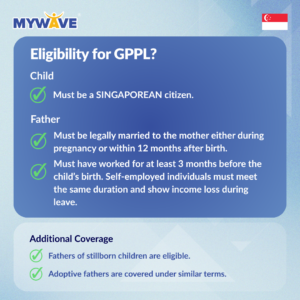
Child Eligibility
- Must be a Singapore citizen
Marital Requirement
- Father must be lawfully married to the child’s mother:
- Between conception and birth, OR
- Within 12 months from the child’s date of birth (inclusive)
Employment Criteria
For employed fathers:
- Must have worked with the employer for at least 3 months before the child’s birth
For self-employed fathers:
- Must have been working for at least 3 months
- Must demonstrate loss of income during leave
Additional Coverage
- Fathers of stillborn children are eligible
- Adoptive fathers are covered under similar terms
GPPL Entitlement (Effective 1 April 2025)
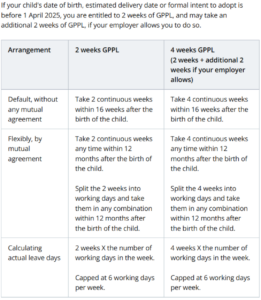
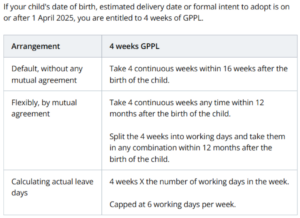
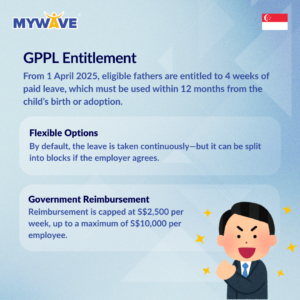
Under the updated policy, Singapore Government Paid Paternity Leave offers:
- 4 weeks of paid leave
- Leave must be taken within 12 months of:
- Child’s birth, or
- Adoption placement
Leave Flexibility
- Default: Continuous leave
- Alternative: Can be taken in blocks, subject to employer agreement
Government Reimbursement
- S$2,500 per week cap
- Maximum claim: S$10,000 per employee
Practical Example for Employers
Understanding how GPPL works in real operations is critical.
Scenario:
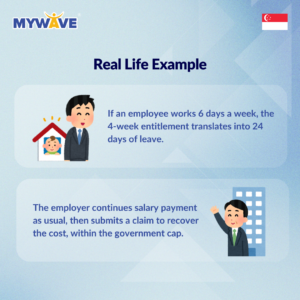
- Employee works 6 days per week
- Child is born on or after 1 April 2025
Outcome:
- Employee is entitled to 24 days of GPPL (4 weeks × 6 days)
Employer Responsibility:
- Continue paying the employee during the leave period
Reimbursement:
- Employer can claim:
- Up to S$2,500 per week
- Total capped at S$10,000
Legal Obligations and Employer Compliance
Employers must adhere strictly to GPPL regulations to avoid legal risk.
Employee Protection
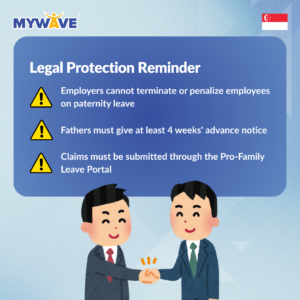
- Employers cannot terminate or penalize employees for taking GPPL
Notice Requirement
- Employees must provide at least 4 weeks’ advance notice
Claims Process
- Reimbursement claims must be submitted via the Pro-Family Leave Portal
Paternity Leave Plan Before vs After 1 April 2025
Conclusion
Singapore Government Paid Paternity Leave (GPPL) is a structured, government-funded initiative that balances employee welfare with employer sustainability. If handled correctly, GPPL becomes less of a compliance burden and more of a strategic HR advantage.
Reference: https://www.mom.gov.sg/employment-practices/leave/paternity-leave
Contact Us
Would like to inquire more? Reach out to us for professional HR consultations. We’re here to help — get in touch with us.