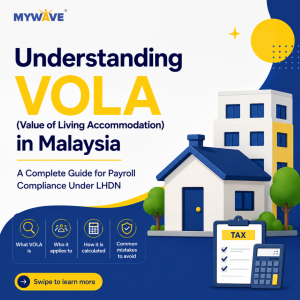
Employee remuneration extends beyond salaries, bonuses, and allowances. When an employer provides residential accommodation as part of an employee’s employment package, the value of that accommodation may also be subject to income tax. Under Malaysia’s Income Tax Act 1967, this benefit is known as the Value of Living Accommodation (VOLA). For payroll professionals, understanding how VOLA is treated is essential to ensure accurate payroll processing, correct tax reporting, and compliance with LHDN requirements. Incorrect valuation or classification can result in payroll errors, under-reporting of taxable benefits, and increased compliance risks. This guide explains what VOLA is, why it is taxable, how it is valued under different employee categories, and the payroll responsibilities involved in managing these benefits in accordance with LHDN Public Ruling No. 3/2005.
As one of Malaysia’s most trusted HR and payroll agencies, MYWave is committed to sharing the latest HR and payroll regulatory updates to help businesses stay compliant with Malaysian employment and tax regulations.
Understanding the Legal Framework of VOLA
The taxation of living accommodation is governed by several provisions under the Income Tax Act 1967, supported by guidance issued through LHDN Public Ruling No. 3/2005.
The legal framework establishes:
Paragraph 13(1)(c): Taxability of Living Accommodation
Paragraph 13(1)(c) provides that the value of living accommodation provided by an employer forms part of an employee’s gross employment income and is therefore subject to income tax.
Section 32: Valuation Rules
Section 32 provides the rules used to determine the value of living accommodation for different categories of employees and directors.
Section 38: Employee Contributions
Where employees contribute towards rent or other housing-related expenses, Section 38 allows these contributions to reduce the taxable value of the accommodation benefit.
LHDN Public Ruling No. 3/2005
Public Ruling No. 3/2005 provides employers and payroll professionals with practical guidance on applying these provisions correctly, including valuation methods and reporting requirements.
What is VOLA?
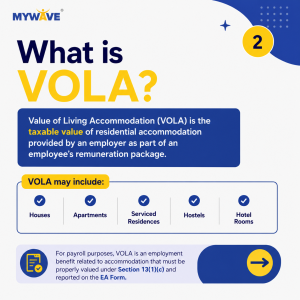
Value of Living Accommodation (VOLA) represents the taxable value of residential accommodation provided by an employer to an employee as part of the employee’s remuneration package. Accommodation may include:
- Houses
- Apartments
- Serviced residences
- Hostels
- Hotel rooms
When these accommodations are provided as employment benefits, their value is treated as a taxable employment benefit.
For payroll purposes, VOLA is an employment benefit related to accommodation that must be properly valued under Section 13(1)(c) and reported on the EA Form.
Why is VOLA Taxable?
The taxation of VOLA follows a straightforward principle under Malaysian tax law.
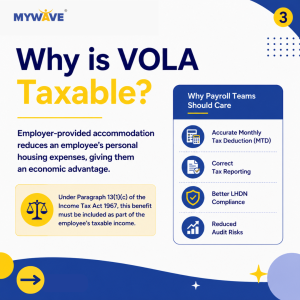
Employment benefits are generally taxable unless specifically exempted by legislation. Employer-provided accommodation gives employees an economic advantage because it reduces or eliminates housing expenses that they would otherwise bear themselves.
As a result, Paragraph 13(1)(c) of the Income Tax Act 1967 requires the value of living accommodation to be included as part of the employee’s taxable employment income.
For payroll professionals, understanding this principle makes it easier to explain tax deductions to employees while ensuring payroll records remain compliant during LHDN reviews or audits.
Who is Covered Under VOLA?
VOLA extends beyond accommodation occupied solely by the employee.
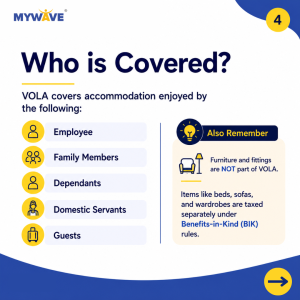
The taxable benefit also covers accommodation used by:
- The employee
- Family members
- Dependants
- Domestic servants
- Guests
This reflects the principle of use and enjoyment, where the taxable benefit includes personal use associated with the employee.
Payroll teams should therefore consider the full accommodation benefit when determining taxable income to avoid under-reporting and potential compliance issues.
VOLA and Benefit-in-Kind (BIK): Understanding the Difference
Although both are employment benefits, VOLA and Benefits-in-Kind (BIK) are treated differently for tax purposes.
VOLA refers only to the value of unfurnished living accommodation.
Furniture and fittings provided together with the accommodation, such as beds, sofas, and similar items, are not included in VOLA. Instead, these items are taxed separately under the Benefits-in-Kind (BIK) rules.
Employers should therefore separate:
- The value of the accommodation (VOLA)
- The value of furniture and fittings (BIK)
This distinction is important for accurate payroll calculations and tax reporting.
Compliance should follow both:
- LHDN Public Ruling No. 3/2005 (Living Accommodation)
- LHDN Public Ruling No. 11/2019 (Benefits-in-Kind)
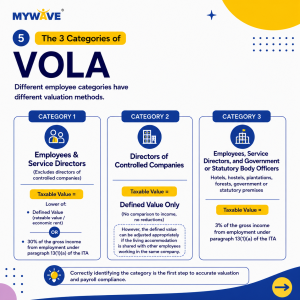
The Three Categories of VOLA
Correctly identifying the applicable employee category is essential because different valuation methods apply.
Category 1: Employees and Service Directors
This category covers:
- Employees
- Service directors
It excludes directors of controlled companies.
For this category, the value of living accommodation is determined using the lower of:
- The defined accommodation value; or
- 30% of the employee’s gross employment income
This comparison helps ensure that the taxable accommodation benefit remains proportionate to the employee’s remuneration.
Payroll teams should consistently calculate both values to determine the correct taxable amount.
Understanding Defined Value
The defined value refers to the value used to determine living accommodation for VOLA purposes.
Where applicable:
- The rateable value is used if the accommodation is owned by the employer.
- If rateable value is not applicable, economic rent reflects the assumed market rental value.
Accurate documentation, including tenancy agreements and other supporting records, is important to substantiate the defined value used in payroll reporting.
Category 1 Calculation Guidance
LHDN Public Ruling No. 3/2005 includes practical examples demonstrating how Category 1 accommodation should be valued.
The valuation continues to follow the lower-of comparison between:
- Defined value
- 30% of the gross income from employment under paragraph 13(1)(a) of the ITA
Adjustments may also apply where:
- Accommodation is shared.
- Accommodation is partially used.
- The employee is required to stay on the employer’s premises.
These examples provide useful guidance for payroll teams managing real-life accommodation arrangements.
Example 1:
Encik Ali, an accountant in a housing development company, has gross income from employment under paragraph 13(1)(a) of the ITA amounting to RM120,000 for the year ended 31.12.2005. His employer also provides for him rent free living accommodation throughout the year 2005. The defined value of the living accommodation is RM24,000.
Gross income from employment of Encik Ali under paragraph 13(1)(c) of the ITA for Y/A 2005 is calculated as follows:
30% X RM120,000 = RM36,000
OR
Defined value of living accommodation = RM24,000
Whichever is the less.
Therefore, the value of living accommodation benefit received by Encik Ali for Y/A 2005 is RM24,000.
Example 4:
Cik Dee, an anaesthetist in a private hospital, has gross income under paragraph 13(1)(a) of the ITA amounting to RM120,000 for the year ended 31.12.2005. This benefit is shared with another doctor who works at the same hospital. The defined value of that living accommodation is RM30,000.
Gross income from employment of Cik Dee under paragraph 13(1)(c) of the ITA for Y/A 2005 is calculated as follows:
30% X RM120,000 = RM36,000
Or
Defined value of the living accommodation = ½ x RM30,000 = RM15,000
Whichever is the less
Therefore, the value of living accommodation benefit received by Cik Dee for Y/A is RM15,000.
Category 2: Directors of Controlled Companies
Category 2 applies specifically to directors of controlled companies.
Unlike Category 1, the valuation method is more stringent.
The value of living accommodation is based solely on the defined value, without comparing it to gross employment income. However, the defined value can be adjusted appropriately if the living accommodation is shared with other employees working in the same company.
Payroll teams should pay particular attention to Category 2 cases, as director benefits are frequently reviewed during tax audits.
Example 6:
Encik Alf, a director (not a service director) of a controlled company has gross income from employment under paragraph 13(1)(a) of the ITA amounting to RM200,000 for the year ended 31.12.2005. He also enjoyed living accommodation benefit provided for by the employer. Rent paid by his employer towards the living accommodation is RM4,800 a month including rent on the furniture amounting to RM1,200 a month. Throughout the year 2005, the premises is shared with another director who is employed in the same company.
The computation of the value of living accommodation under paragraph 13(1)(c) of the ITA in respect of Encik Alf for Y/A 2005 is as follows:
0.5 X (RM4,800 – RM1,200*) X 12 = RM21,600
(Note*: The rent paid on the furniture is excluded from the computation of the value of living accommodation under paragraph 13(1)(c) of the ITA. The rent of RM1,200 each month is considered to be a benefit-in-kind and assessed under paragraph 13(1)(b) of the ITA. However, in determining the gross income from employment under paragraph 13(1)(b) of the ITA, the employer can opt to use the value as determined in the Public Ruling No. 2/2004 on Benefits-in-Kind).
Category 3: Employees, Service Directors, and Government or Statutory Body Officers
Category 3 applies to special accommodation provided in locations such as:
- Hotels
- Hostels
- Plantations
- Forests
- Government premises
- Statutory body premises
Instead of calculating rental or market value, 3% of the gross income from employment under paragraph 13(1)(a) of the ITA is used.
This simplified approach reduces administrative complexity while maintaining consistency in tax valuation.
Accurate gross employment income remains essential because it directly determines the taxable accommodation value.
Part-Year Accommodation and Proration
Accommodation is not always provided for the entire year.
Where accommodation is available only for part of the year, the taxable value should be prorated based on the period during which the accommodation was available, rather than the actual period the employee occupied it.
Payroll teams should accurately record:
- Accommodation commencement dates
- Accommodation end dates
- Availability periods
Maintaining proper documentation is essential to support payroll calculations during compliance reviews and tax audits.
Example 7:
Where living accommodation that is provided to Encik Ali in Example 1 is for the period from 1.7.2005 to 31.12.2005, his gross income from employment under paragraph 13(1)(c) of the ITA for Y/A 2005 is calculated as follows:
30% X RM120,000 = RM36,000
Or
Defined value of living accommodation = RM24,000
Whichever is the less
The lesser amount is RM24,000.
Therefore, value of living accommodation for the period from 1.7.2005 to 31.12.2005 is:
6/12 X RM24,000 = RM12,000
Payroll Implications of VOLA
The value of living accommodation affects both monthly payroll processing and annual tax reporting.
Payroll professionals should ensure that accommodation benefits are properly incorporated into:
- Monthly Tax Deduction (MTD) calculations
- Annual employee tax reporting
Effective coordination between payroll, HR, and finance departments is important to obtain accurate accommodation information and valuations.
Supporting records should also be maintained, including:
- Tenancy agreements
- Valuation notices
- Internal approvals
Accurate payroll processing not only supports regulatory compliance but also promotes transparency and trust among employees.
As one of the best HR and payroll agencies in Malaysia, MYWave regularly helps businesses understand evolving payroll requirements and shares practical HR and payroll insights to support accurate and compliant payroll management.
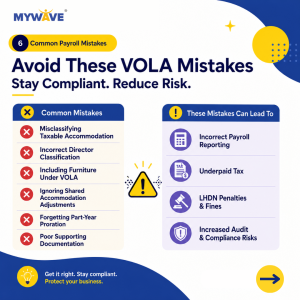
Common Payroll Errors Related to VOLA
Several common mistakes can lead to payroll inaccuracies and increased compliance risks.
Misclassifying Taxable Accommodation
Failing to recognise employer-provided accommodation as a taxable benefit results in incorrect payroll calculations and reporting.
Incorrect Director Classification
Placing directors under the wrong VOLA category may lead to incorrect valuation methods being applied.
Accommodation Valuation Errors
Common valuation mistakes include:
- Using market rent instead of defined value where applicable.
- Ignoring adjustments for shared accommodation.
- Failing to apply prorated calculations for part-year accommodation.
Increased Audit Risks
Payroll errors involving VOLA may increase the likelihood of tax adjustments, penalties, and reputational risks during LHDN audits.
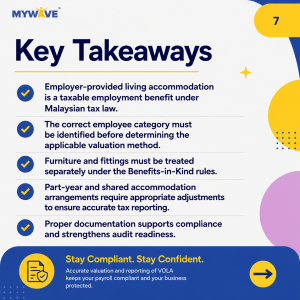
Key Takeaways
Understanding VOLA is essential for employers and payroll professionals responsible for managing employee remuneration and tax compliance.
The key principles include:
- Employer-provided living accommodation is a taxable employment benefit under Malaysian tax law.
- The correct employee category must be identified before determining the applicable valuation method.
- Furniture and fittings must be treated separately under the Benefits-in-Kind rules.
- Part-year and shared accommodation arrangements require appropriate adjustments to ensure accurate tax reporting.
- Proper documentation supports compliance and strengthens audit readiness.
Conclusion
Managing the Value of Living Accommodation (VOLA) correctly is an important part of payroll compliance in Malaysia. From identifying the correct employee category to applying the appropriate valuation method and maintaining proper supporting documentation, every step plays a role in ensuring accurate payroll reporting and compliance with the Income Tax Act 1967 and LHDN Public Ruling No. 3/2005.
At MYWave, we believe that payroll compliance is built on knowledge, accuracy, and consistent application of regulatory requirements. As one of Malaysia’s most trusted HR and payroll agencies, we are committed to sharing the latest HR and payroll trends, regulatory updates, and practical guidance to help businesses strengthen their payroll processes and remain compliant with confidence.
Whether you’re managing payroll internally or looking for expert support, MYWave is ready to help your organisation stay informed and navigate Malaysia’s HR and payroll requirements with confidence.

👉 Contact MYWave today to learn how our HR and payroll expertise can support your business with reliable, compliant, and efficient payroll solutions.
Contact us here: https://mywave.biz/contact-us/