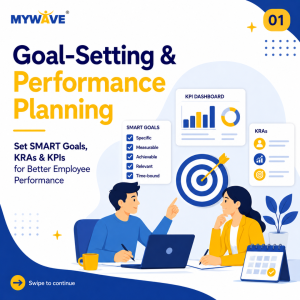
Performance management rarely fails because employees are unwilling to perform. More often, it fails because employees are expected to achieve objectives that were never clearly defined in the first place. When people are unsure of what success looks like, priorities become blurred, expectations differ between managers and employees, and performance reviews become subjective rather than meaningful. Instead of driving improvement, performance management turns into an administrative exercise.
This is why goal-setting and performance planning form the foundation of every successful performance management framework. Clear goals create direction, measurable expectations, and accountability from the very beginning. Without that clarity, even the most capable employees may struggle to deliver consistent results.
As one of Penang’s leading HR and payroll outsourcing companies, we work closely with Malaysian organisations to strengthen their HR practices while keeping business owners informed of the latest developments, best practices, and practical knowledge in human resource management.
As part of our commitment to helping organisations build effective performance management systems, this blog will guide Malaysian companies through the fundamentals of SMART goals, the differences between KRAs and KPIs, common planning pitfalls, and best practices for creating a stronger performance management framework.
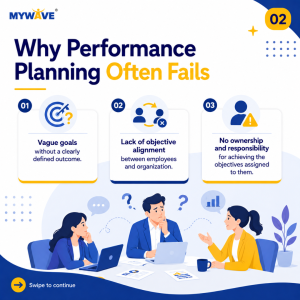
Why Performance Planning Often Fails
Vague Goals
One of the biggest obstacles to effective performance management is setting goals that are too broad or unclear. Objectives such as “improve communication,” “work harder,” or “increase productivity” may sound positive, but they leave significant room for interpretation. Different employees and managers may have completely different ideas about what these statements actually mean.
Without a clearly defined outcome, employees cannot confidently determine whether they are making meaningful progress or have successfully achieved the objective.
No Alignment
Individual goals should contribute towards broader team or organisational priorities. When employees work towards objectives that are disconnected from departmental or organisational direction, valuable time and resources may be spent on activities that do not create meaningful business outcomes.
Performance planning becomes far more effective when every employee understands how their individual responsibilities contribute to the larger organisational goals.
No Ownership
Even well-written goals can fail when accountability is unclear. Employees need to understand that they are responsible for achieving the objectives assigned to them. Likewise, managers play an important role in providing guidance, monitoring progress, and supporting employees throughout the performance period. Without clear ownership, goals often become forgotten until the performance review arrives.
Performance Planning: Why Clarity at the Start Determines Everything
Performance planning is more than simply listing objectives for employees. It establishes a shared understanding between managers and employees regarding expected outcomes, performance standards, timelines, and responsibilities before work begins.
When expectations are clearly communicated from the outset, employees have greater confidence in prioritising their work, managers can provide more focused coaching, and performance discussions become objective because both parties are working towards agreed outcomes. Conversely, when planning is unclear, organisations often experience inconsistent expectations, misunderstandings, shifting priorities, and performance evaluations that feel subjective rather than fair.
For this reason, successful performance management starts with one simple principle: Clarity at the start determines everything that follows.
Understanding KRA and KPI in Performance Management
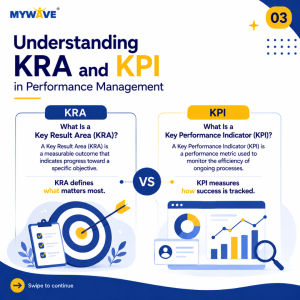
Two terms frequently used in performance planning are Key Result Area (KRA) and Key Performance Indicator (KPI). Although they are often mentioned together, they serve different purposes. Understanding the distinction helps organisations measure performance more effectively.
What Is a Key Result Area (KRA)?
A Key Result Area (KRA) is a measurable outcome that indicates progress toward a specific objective. Rather than focusing on the activities employees perform, a KRA defines success through the results that need to be achieved. It enables organisations to evaluate whether the work being done is moving the organisation closer to its intended objectives.
In simple terms:
KRA defines what matters most.
What Is a Key Performance Indicator (KPI)?
A Key Performance Indicator (KPI) is a performance metric used to monitor the efficiency of ongoing processes. KPIs measure how well a process is functioning over time. They provide diagnostic insight by tracking performance through leading or lagging indicators, allowing organisations to understand whether operations are performing as expected.
In simple terms:
KPI measures how success is tracked.
Core Components of a Strong Goal: The SMART Framework
A well-written goal gives employees a clear understanding of what needs to be achieved, how success will be measured, and when the expected outcome should be delivered. Without these elements, even motivated employees may struggle because they are working without a clear destination.
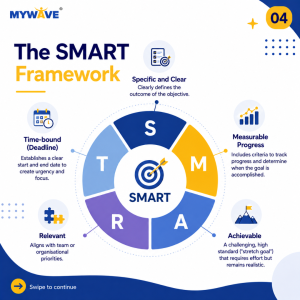
One of the most widely used approaches for writing effective goals is the SMART framework. Rather than creating broad aspirations, SMART goals provide a practical structure that makes objectives easier to understand, execute, and evaluate.
(S) Specific and Clear
A strong goal begins with clarity. Employees should immediately understand what outcome is expected without having to interpret vague language. Goals such as “improve performance” or “do better” provide little direction because they fail to define exactly what should improve. Instead, the objective should clearly describe the intended outcome so everyone shares the same understanding of success. The more specific a goal is, the easier it becomes to focus effort in the right direction.
(M) Measurable Progress
Progress should never rely on opinion. A SMART goal includes clear criteria that allow both employees and managers to monitor progress throughout the performance period and determine whether the objective has been achieved. Measurable goals create transparency because performance can be evaluated using agreed indicators rather than personal judgement.
(A) Achievable
Effective goals should challenge employees while remaining realistic. Goals that are too easy may not encourage improvement, while goals that are impossible to achieve often reduce motivation and engagement. An achievable goal sets a high standard—a “stretch goal”—that requires genuine effort but remains attainable with the available resources, skills, and support.
(R) Relevant
Every individual goal should contribute towards broader team or organisational priorities. When employees understand how their objectives support the organisation’s overall direction, they are more likely to focus on work that creates meaningful impact rather than simply completing tasks. Relevant goals ensure that individual performance contributes to collective success.
(T) Time-bound (Deadline)
Every goal should include a clearly defined timeframe. Deadlines create urgency, improve planning, and provide a clear point at which performance can be evaluated. Without a start and end date, goals can easily become ongoing intentions instead of measurable achievements. A defined timeline helps employees manage priorities while giving managers an appropriate opportunity to review progress.
The SMART Framework at a Glance
| SMART Component | Description |
| Specific and Clear | Clearly defines the outcome of the objective. |
| Measurable Progress | Includes criteria to track progress and determine when the goal is accomplished. |
| Achievable | A challenging, high standard (“stretch goal”) that requires effort but remains realistic. |
| Relevant | Aligns with team or organisational priorities. |
| Time-bound (Deadline) | Establishes a clear start and end date to create urgency and focus. |
Types of Goals: Building a Balanced Performance Plan
Performance management should evaluate more than just operational results. Employees contribute to an organisation in different ways. Some objectives focus on delivering measurable business outcomes, while others encourage innovation, professional growth, or collaboration across teams. A balanced performance plan recognises these different dimensions instead of concentrating on only one area.
1. Performance or Operational Goals
Performance or operational goals focus on the results that employees are expected to achieve as part of their core responsibilities. These goals are closely connected to day-to-day work and help ensure that employees consistently deliver the outcomes required by the organisation.
The primary question these goals answer is: What results must be achieved?
2. Improvement or Innovation Goals
Organisations cannot remain competitive without continuous improvement. Improvement or innovation goals encourage employees to examine existing work processes and identify opportunities to enhance efficiency, quality, or effectiveness. Rather than maintaining current practices, these goals promote ongoing development and better ways of working.
The primary question these goals answer is: What work processes or practices can be improved?
3. Development Goals
Performance management is also an opportunity to build future capability. Development goals focus on strengthening the knowledge, competencies, and skills employees need to perform effectively both now and in the future. These goals support continuous learning while preparing employees for greater responsibilities over time.
The primary question these goals answer is: What capability must be built?
4. Contribution or Collaboration Goals
Individual performance is important, but organisational success also depends on teamwork. Contribution or collaboration goals recognise how employees support colleagues, departments, and the wider organisation through knowledge sharing, teamwork, mentoring, and cross-functional collaboration. These goals encourage employees to contribute beyond their individual responsibilities.
The primary question these goals answer is: How does the staff support the team or organisation?
Weak Goal vs Stronger SMART Goal Examples
The following examples demonstrate how a broad or unclear objective can be transformed into a stronger SMART goal by making it specific, measurable, achievable, relevant, and time-bound.
| No. | Weak Goal | Stronger SMART Goal |
| 1 | Improve teaching quality | Achieve an average teaching evaluation score of 4.3 or above by the end of the academic year |
| 2 | Improve student engagement | Increase average tutorial participation to 70% by Week 8 through structured discussion activities |
| 3 | Publish more research | Submit two research papers to peer-reviewed journals by December |
| 4 | Be more collaborative | Participate in two cross-faculty research or teaching discussions during the academic year |
| 5 | Support students better | Hold three structured consultation sessions per semester for students needing academic support |
| 6 | Improve response time to students | Respond to 90% of student enquiries within 48 hours during semester periods |
| 7 | Improve admissions processing | Process 95% of completed student applications within five working days during the admission cycle |
| 8 | Increase student enrolment | Achieve a 10% increase in confirmed enrolments for the next intake compared with the previous intake |
| 9 | Improve marketing outreach | Generate 15% more qualified programme enquiries through digital campaigns by year-end |
| 10 | Improve social media presence | Pilot two new short-form video campaigns to increase social media engagement by 25% during the recruitment cycle |
| 11 | Improve financial reporting | Submit monthly financial reports within five working days after month-end closing |
| 12 | Reduce budget issues | Maintain departmental spending within approved budget with variance not exceeding 3% during the fiscal year |
| 13 | Improve IT support | Resolve 80% of helpdesk tickets within the established service-level timeframe each month |
| 14 | Improve system reliability | Maintain 99.5% uptime for critical university systems during the academic year |
| 15 | Improve quality assurance processes | Pilot a digital documentation tracking system to streamline programme review submissions by the next review cycle |
| 16 | Improve documentation | Ensure 100% of programme documentation meets university quality standards during the annual review |
| 17 | Improve communication within department | Facilitate two departmental knowledge-sharing sessions during the academic year |
| 18 | Develop professional skills | Complete two professional development courses relevant to role responsibilities by year-end |
| 19 | Help new staff members | Mentor one new staff member and conduct quarterly check-in sessions during the year |
| 20 | Improve data analysis skills | Complete one data analytics training programme and develop one departmental reporting dashboard by year-end |
When organisations consistently write goals using the SMART framework while balancing operational, improvement, development, and collaboration objectives, performance planning becomes significantly more meaningful. Employees understand what is expected of them, managers have clearer criteria for coaching and evaluation, and performance discussions become more objective because everyone is working towards clearly defined outcomes.
Conclusion
Many organisations invest considerable time designing performance appraisal forms, competency matrices, and evaluation systems. While these tools have their place, they cannot compensate for poorly planned goals.
From our experience working with Malaysian businesses, the most effective performance management frameworks begin with clear expectations. Employees perform better when they know exactly what outcomes are expected, managers provide more consistent guidance when objectives are measurable, and performance reviews become more transparent because success has already been defined at the beginning of the cycle.
At MYWave, we believe performance management should help organisations improve—not simply evaluate—employee performance. As one of Penang’s leading HR and payroll outsourcing companies, we are committed to helping Malaysian businesses strengthen their HR practices by sharing practical knowledge, industry insights, and the latest HR developments.

👉 Looking to improve your organisation’s HR practices or build a stronger performance management framework?
Contact MYWave today to discover how our HR expertise and outsourcing solutions can help your business achieve sustainable growth: https://mywave.biz/contact-us/