Choosing the right type of employment arrangement is essential for businesses in Malaysia. Misclassifying workers can lead to compliance risks, disputes, and unexpected statutory liabilities. Understanding the difference between a Contract of Service and a Contract for Service helps employers protect their business while ensuring compliance with Malaysian employment laws.
As a trusted HR and payroll outsourcing company in Malaysia, MYWave frequently assists businesses in identifying the correct worker classification to avoid costly mistakes.
What is a Contract of Service?
A Contract of Service is an agreement, whether written, oral, expressed, or implied, where one person agrees to employ another as an employee, and the other agrees to serve as an employee.
Under this arrangement, an employer-employee relationship exists. The employee is protected by employment laws and is entitled to statutory benefits and protections provided under Malaysian labour regulations.
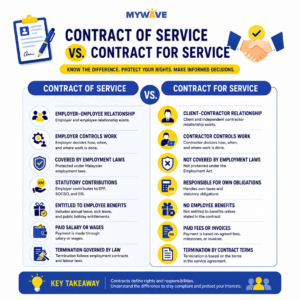
Key Characteristics of a Contract of Service
- Employer-employee relationship exists
- Employer controls how, when, and where work is performed
- Employee is covered by employment laws
- Employer is responsible for statutory contributions such as EPF, SOCSO, and EIS
- Employee is entitled to benefits such as annual leave, sick leave, and public holiday entitlements
- Payment is made through salary or wages
- Termination is governed by employment contracts and labour laws
What is a Contract for Service?
A Contract for Service is an agreement where a person or business is engaged as an independent contractor, freelancer, consultant, or vendor to perform specific work or complete a project for an agreed fee. Unlike employees, independent contractors operate their own business and are not considered employees under the Employment Act. Therefore, no employer-employee relationship exists.
Key Characteristics of a Contract for Service
- Client-contractor relationship
- Contractor determines how work is performed
- Not covered by employment laws
- Responsible for their own taxes and statutory obligations
- Not entitled to employee benefits unless specifically stated in the agreement
- Payment is based on agreed fees, milestones, or invoices
- Termination is governed by commercial contract terms
Contract of Service vs Contract for Service: Comparison
| Item | Contract of Service | Contract for Service |
| Relationship | Employer-Employee | Client-Independent Contractor |
| Employment Status | Employee | Self-employed individual or company |
| Control | Employer controls work arrangements | Contractor controls work methods |
| Employment Law Protection | Protected under employment laws | Generally not covered |
| Statutory Contributions | Employer responsible for EPF, SOCSO, EIS | Contractor manages own obligations |
| Benefits | Entitled to statutory employee benefits | Benefits only if agreed contractually |
| Payment | Salary or wages | Fees, project payments, or invoices |
| Termination | Subject to labour laws | Governed by commercial agreements |
Why Proper Worker Classification Matters
Many businesses engage freelancers, consultants, and project-based workers without fully understanding the legal distinction between employees and independent contractors.
If a worker is treated like an employee but engaged under a Contract for Service, authorities may determine that an employment relationship exists. This can expose employers to liabilities involving unpaid statutory contributions, employee benefits, and potential legal claims.
For growing SMEs, managing these classifications correctly is an important part of effective HR governance and payroll administration.
How MYWave Helps Businesses Stay Compliant
As a leading HR and payroll outsourcing company in Malaysia, MYWave helps businesses navigate complex employment regulations, payroll requirements, and workforce management challenges.
Our HR and payroll specialists assist companies with:
- Employment contract management
- Payroll processing and compliance
- EPF, SOCSO, and EIS administration
- HR advisory and workforce planning
- Employee onboarding and documentation
- Labour law compliance support
By partnering with an experienced HR and payroll outsourcing company in Malaysia, businesses can reduce compliance risks while focusing on growth and operational efficiency.
Conclusion
Understanding the difference between a Contract of Service and a Contract for Service is critical for every employer in Malaysia. The classification affects statutory obligations, employee benefits, payroll processing, and legal compliance.
If you are unsure whether your workers should be engaged as employees or independent contractors, seeking professional HR guidance can help prevent costly compliance issues.
At MYWave, we help Malaysian businesses simplify workforce management with reliable HR, payroll, and compliance solutions.
👉 Contact Us Now
Contact our team today to learn how our HR and payroll outsourcing services can support your business growth. Contact us now. https://mywave.biz/contact-us/