Effective October 1, 2026, Malaysia’s Employment Insurance System (EIS) under Act 800 has officially rolled out major benefit upgrades. Here is what HR professionals and business owners need to understand about the latest enhancements.
The social safety net for Malaysian workforce members has officially evolved. Administered by PERKESO (Social Security Organization), recent amendments to the Employment Insurance System and Employment Services Act 2017 (Act 800) went into effect on October 1, 2026.
Designed to impact over 7 million insured contributors, these legislative updates shift the focus beyond basic income replacement. They heavily incentivize early re-employment, enhance upskilling capabilities, and introduce practical financial support for job relocation.
If you are an HR leader, business owner, or employee navigating workforce changes, here is a detailed breakdown of the four key enhancements.
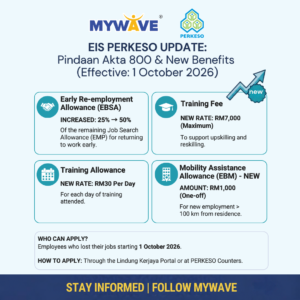
1. Early Re-employment Allowance (Elaun Bekerja Semula Awal/ EBSA) Upgraded to 50%
-
What changed: Previously, workers who secured a new job before exhausting their Job Search Allowance (EMP) were entitled to an Early Re-employment Allowance equivalent to 25% of their remaining unpaid allowance.
-
The update: This has now doubled to 50%.
-
HR Impact: This acts as a stronger financial catalyst, encouraging retrenched employees to transition back into the workforce swiftly rather than waiting out the full duration of their claim period.
2. Introduction of the RM1,000 Mobility Assistance Allowance (Elaun Bantuan Mobiliti / EBM)
-
What changed: A brand-new addition to the framework.
-
The update: Eligible contributors who experience job loss and secure a new employment opportunity located more than 100 km from their current place of residence can now claim a one-off cash payment of RM1,000.
-
HR Impact: Relocation costs often serve as a major barrier for job seekers accepting out-of-town roles. This allowance aids employers looking to source talent beyond their immediate local regions, improving cross-state job matching.
3. Increased Training Allowance (RM30 Per Day)
-
What changed: Previously, unemployed individuals attending approved upskilling programs received a modest training allowance ranging between RM10 and RM20 per day.
-
The update: The daily rate has been standardized to a flat RM30 per day for every day of training attended.
-
HR Impact: This ensures that individuals actively participating in reskilling programs have better daily financial sustenance while bridging the gap toward their next career step.
4. Higher Training Fee Limit (Up to RM7,000)
-
What changed: The maximum training fee support limit capped at RM4,000 has been raised.
-
The update: The cap is now elevated to a maximum of RM7,000.
- HR Impact: Allows retrenched or transitioning workers to enroll in higher-value, specialized technical certification courses, ensuring they remain competitive in a rapidly changing labor market.
Who is Eligible to Claim?
These upgrades apply to qualified pencarum (contributors)—primarily Malaysian citizens and permanent residents aged 18 to 60 working in the private sector—who suffer an involuntary loss of employment starting October 1, 2026.
Eligible individuals can submit their claims via the official Lindung Kerjaya Portal or walk into any local PERKESO counter.
The Next Wave: Mandatory Job Vacancy Reporting (Effective 2 January 2027)
While the October 2026 amendments focused on upgrading benefits for retrenched employees, the second major phase of the Act 800 amendments introduces strict legal recruitment obligations for all Malaysian employers starting 2 January 2027 (under the new Section 45F via platforms like MYFutureJobs).
Recruitment is no longer just an internal hiring process—it now involves a formal statutory workflow:
1. The Two-Step Notification Rule
-
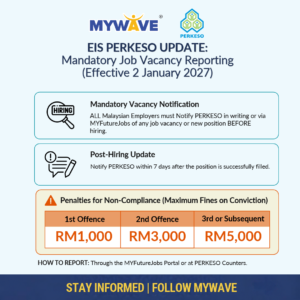
Before Hiring (Section 45F(1)): Employers must notify PERKESO in writing (or via the official portal) about any job vacancy or newly created position before officially hiring or extending a confirmed offer to a candidate.
-
After Filling the Position (Section 45F(3)): Employers must notify PERKESO within 7 days once the position has officially been filled.
2. Penalties for Non-Compliance
Failing to submit the mandatory pre-hiring notification carries tiered maximum fines upon conviction:
-
1st Offence: Up to RM1,000
-
2nd Offence: Up to RM3,000
-
3rd or Subsequent Offence: Up to RM5,000
How HR Leaders Should Prepare Now:
-
Map Your Hiring Triggers: Identify the exact moment a requisition opens (e.g., resignation approval or budget sign-off) so PERKESO notification happens right at the start.
-
Update Recruitment Checklists: Add PERKESO submission steps before interviewing/advertising and within 7 days post-hire.
-
Centralize Accountability: Assign a specific team member or HR administrator to manage and log your MYFutureJobs and PERKESO portal filings to maintain a clear audit trail.
Final Thoughts for Employers
While EIS contributions themselves remain a shared statutory obligation between employers and employees (at standard rates under Act 800 schedules), these expanded safety nets highlight the government’s push toward an agile, highly-skilled workforce.
Need guidance on managing workforce restructuring, compliance, or payroll updates?
Visit us at https://mywave.biz or get in touch with our team today to ensure your organization stays aligned with the latest Malaysian labor policies.